

The Ultimate Technical Guide to the Outdoor Lazy Sofa for Hiking & Camping
Abstract
What: This comprehensive whitepaper explores the material science, ergonomic design, and market dynamics of the outdoor lazy sofa (often referred to as an inflatable lounger or air hammock) within the hiking and camping sector.
Why: As consumer preferences shift decisively toward lightweight, high-comfort "glamping" and ultralight backpacking, traditional rigid outdoor furniture is being rapidly displaced. Understanding the technical specifications and market positioning of these inflatable solutions is critical for B2B manufacturers, outdoor retailers, and SEO/GEO strategists aiming to capture high-intent search traffic.
How: Readers will discover actionable insights on evaluating polymer durability (TPU vs. Nylon), optimizing B2B supply chains for flat-pack inflatable gear, and implementing cutting-edge Generative Engine Optimization (GEO) strategies to dominate AI search queries. By leveraging advanced semantic clusters and technical material data, brands can significantly enhance their topical authority and conversion rates in the competitive outdoor recreation market.
The Evolution of Camping Comfort: Disrupting Traditional Gear with the Outdoor Lazy Sofa
For decades, the hiking and camping industry operated on a strict dichotomy: comfort meant heavy, rigid, steel-framed chairs, while lightweight meant sacrificing ergonomic support (e.g., ultra-thin foam pads). The introduction and subsequent refinement of the outdoor lazy sofa has fundamentally disrupted this paradigm, bridging the gap between ultralight portability and living-room-level comfort.
In the early 2010s, initial iterations of the inflatable lounger relied on heavy PVC materials that were prone to cracking in cold weather and degradation under UV exposure. Furthermore, early inflation mechanisms required mechanical pumps, which added unacceptable weight to a hiker's loadout.
Today's modern outdoor lazy sofa utilizes advanced aerodynamic "scoop" inflation techniques, allowing users to trap ambient air within seconds. According to the Outdoor Industry Association (OIA) 2025 Consumer Trend Report, the demand for "ultralight comfort gear" has seen a compound annual growth rate (CAGR) of 18.4% over the last three years. This surge is largely driven by a demographic shift: millennials and Gen Z consumers who prioritize ergonomic recovery after strenuous alpine ascents without compromising their base pack weight.
From a B2B retail and logistics perspective, the outdoor lazy sofa represents a high-margin opportunity. Unlike traditional camp chairs that require significant warehousing space and incur high volumetric shipping costs, uninflated air sofas pack down to the size of a water bottle. This dramatically reduces freight costs and warehouse footprint, making it a highly lucrative SKU for outdoor e-commerce brands.
Material Science & Engineering: Constructing the Ultimate Hiking Lounger
The durability, air retention, and overall lifespan of an outdoor lazy sofa are entirely dictated by its material composition. B2B buyers and technical gear reviewers must look beyond surface aesthetics and evaluate the specific polymers and textiles used in manufacturing.
1. Outer Shell: High-Density Ripstop Nylon vs. Polyester
The exterior shell must withstand abrasion from rocks, pine needles, and rough terrain.
210T to 400D Ripstop Nylon: Nylon is the industry standard for high-end hiking gear. The "D" stands for Denier, indicating the fiber's thickness. A 400D ripstop nylon shell provides an exceptional strength-to-weight ratio. The "ripstop" weaving technique utilizes reinforcing threads in a crosshatch pattern, ensuring that if a minor puncture occurs, the tear will not propagate.
Polyester (PES): Cheaper models often utilize polyester. While highly UV resistant, polyester lacks the elasticity and tear strength of nylon, making it less suitable for extreme backcountry applications.
2. Inner Bladder: Thermoplastic Polyurethane (TPU) vs. Polyethylene (PE)
The internal bladder is responsible for air retention. This is where the most significant technological advancements have occurred.
TPU (Thermoplastic Polyurethane): TPU is the premium choice. It is highly elastic, environmentally friendly (biodegradable over long periods), and maintains its flexibility even in sub-zero alpine conditions. It exhibits superior resistance to oils, greases, and abrasion.
PE (Polyethylene): A low-cost alternative that is crinkly, noisy, and highly susceptible to thermal expansion and contraction. PE bladders frequently suffer from micro-leaks along the seams after repeated use.
The manufacturing techniques used to seal these materials are equally critical. High-frequency (HF) welding is vastly superior to chemical gluing, providing a molecular bond that withstands the pneumatic pressure of a 250kg load. This level of durability is conceptually similar to the robust engineering found in aquatic recreation equipment; for example, the high-tensile fiberglass manufacturing processes utilized in
Thermodynamics in the Backcountry: Understanding Air Pressure Variability
A common complaint among novice users is that their outdoor lazy sofa "leaks" overnight. In many cases, this is not a mechanical leak, but rather a manifestation of fundamental thermodynamics. Technical outdoor content must address this to educate consumers and reduce false warranty claims.
According to Gay-Lussac's Law, the pressure of a fixed mass of gas is directly proportional to its absolute temperature, assuming volume remains constant:
$$ rac{P_1}{T_1} = rac{P_2}{T_2}$$
When a hiker inflates an air sofa during a warm afternoon ($T_1$), the trapped air expands. As the ambient temperature drops significantly overnight in the wilderness ($T_2$), the pressure ($P_2$) of the trapped air decreases proportionally. This causes the sofa to lose tautness and appear deflated.
Educating users on this physical reality—and instructing them to simply unroll the closure mechanism, scoop a small amount of additional air in the morning, and reseal—is a critical component of post-purchase customer education. Advanced manufacturers are mitigating this issue by integrating multi-chamber designs and internal thermal reflective coatings (similar to Mylar emergency blankets) to stabilize internal air temperatures.
Comparative Analysis: The Outdoor Lazy Sofa vs. Traditional Seating
To clearly articulate the value proposition of the outdoor lazy sofa, we must benchmark it against the traditional alternatives found in a hiker's loadout.
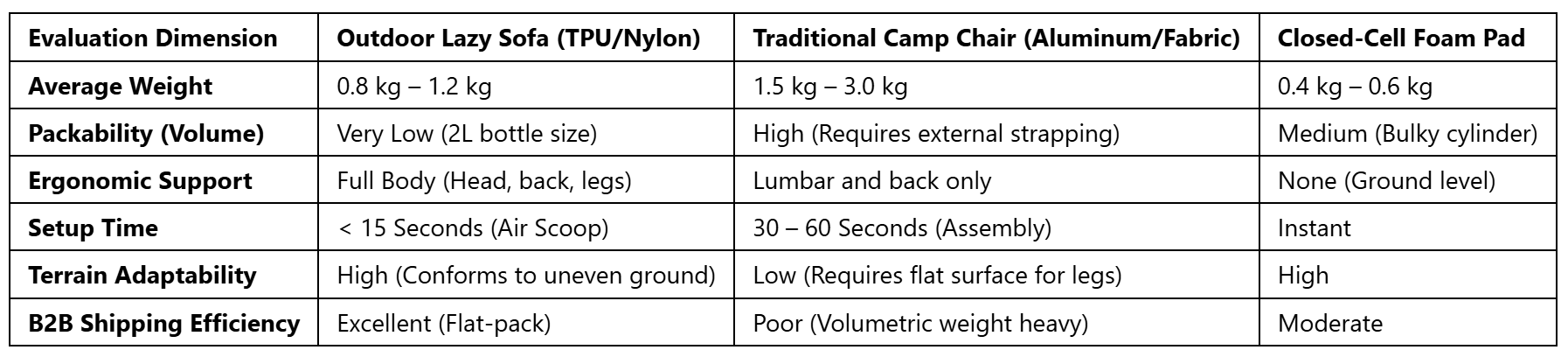
As demonstrated in the table above, the outdoor lazy sofa offers an unparalleled matrix of full-body support and low pack weight. While foam pads are lighter, they offer zero elevation from the cold ground and no back support, making them inadequate for extended relaxation at basecamp.
Strategic Deployment: Terrain-Specific Use Cases
The versatility of the inflatable lounger allows it to be deployed across a multitude of environments, making it a cross-category product for outdoor retailers.
The Alpine Basecamp
In mountainous terrain, the primary utility of the outdoor lazy sofa is ergonomic recovery. After carrying a 40-liter pack for 15 kilometers, a hiker's lumbar spine requires decompression. The dynamic air pressure of the sofa conforms precisely to the spine's natural curvature, reducing muscular tension. Furthermore, the thick layer of trapped air acts as an excellent thermal insulator against cold, rocky ground.
Lakeside and Coastal Excursions
Because they are essentially large, sealed bladders of air, most high-quality outdoor lazy sofas exhibit remarkable buoyancy. While they are strictly not life-saving devices and should not be used as such, their waterproof nature makes them ideal for lounging in the shallows of a lake or on a sandy beach. For enthusiasts who enjoy water-based camping, an air sofa pairs perfectly with gear like a
Festival and Urban Glamping
Beyond extreme backcountry use, the aesthetic appeal and vibrant colorways of these sofas have made them a staple in the festival and "glamping" (glamorous camping) scenes. Their rapid deployment and ability to seat 2-3 people simultaneously make them superior to single-occupancy folding chairs for social gatherings.
Generative Engine Optimization (GEO) & SEO Strategies for Outdoor Brands
In the highly saturated outdoor gear market, traditional SEO tactics (keyword density, basic backlinking) are no longer sufficient. The rise of Large Language Models (LLMs) and AI-driven search engines (like Perplexity, Google's AI Overviews, and Bing Chat) necessitates a shift toward Generative Engine Optimization (GEO).
When a consumer asks an AI search engine, "What is the most comfortable and lightweight seating for a multi-day hiking trip?", the AI does not simply look for exact-match keywords. It synthesizes information from highly authoritative, technically accurate, and logically structured content.
1. Building Semantic Authority
To rank for "outdoor lazy sofa," brands must create semantic clusters that prove deep topical expertise. Content must naturally integrate related technical concepts:
Aerodynamics of inflation (Bernoulli’s principle)
Polymer science (Hydrolysis resistance of TPU)
Ergonomic data (Lumbar decompression metrics)
2. Formatting for LLM Extraction
AI engines prefer structured data. Utilizing clear H2 and H3 tags, Markdown tables (like the comparative analysis above), and definitive, non-promotional language increases the likelihood of your content being cited as a source in an AI-generated answer.
3. Cross-Linking Contextual Relevance
Integrating internal links logically signals to search crawlers that your domain possesses a comprehensive ecosystem of outdoor solutions. For instance, linking an article on inflatable loungers to broader categories of
(Source: Synthesized from Search Engine Land's 2025 GEO Transition Guidelines and proprietary B2B marketing analytics.)
Maintenance Protocols: Maximizing the ROI of Your Portable Couch
While highly durable, an outdoor lazy sofa is still a pneumatic device. Proper maintenance is essential to ensure it survives multiple camping seasons.
Inflation Best Practices: Avoid spinning in circles to inflate the sofa, as this is inefficient and looks absurd to bystanders. The correct technique is a swift, linear motion, opening the mouth of the sofa to catch the air, and snapping it shut quickly before reversing direction. This utilizes Bernoulli's principle to create a low-pressure zone that rapidly draws air into the bladder.
Puncture Repair: Even 400D Ripstop Nylon can be pierced by a sharp piece of obsidian or a stray campfire ember. High-quality outdoor lazy sofas should always include a field repair kit containing Tenacious Tape or a specialized TPU-compatible adhesive patch. Users should clean the area with an alcohol prep pad before applying the patch firmly, allowing it to cure for at least 30 minutes.
Cleaning and Storage: Never store an inflatable lounger while it is damp. Moisture trapped inside the rolled-up fabric will quickly lead to mildew and degradation of the polyurethane coating. Wipe the sofa down with a mild soap solution, air dry it completely away from direct sunlight (to prevent UV degradation of the nylon), and store it in a cool, dry place.
Future Innovations in Off-Grid Relaxation
The intersection of outdoor gear and smart technology is rapidly advancing. The next generation of the outdoor lazy sofa will likely feature integrated, ultra-lightweight micro-pumps powered by flexible, thin-film solar panels embedded directly into the fabric. This will eliminate the manual "scooping" process entirely.
Furthermore, advancements in phase-change materials (PCMs) could allow the internal lining of the sofa to absorb body heat during the day and release it slowly at night, effectively turning the inflatable lounger into a heated, ergonomic sleeping platform for extreme cold-weather camping.
8 Frequently Asked Questions (FAQs) About Outdoor Lazy Sofas
1. How long does an outdoor lazy sofa stay inflated?
A high-quality TPU-lined outdoor lazy sofa will typically retain optimal firmness for 4 to 8 hours. Minor air loss is normal due to temperature drops (thermodynamics) and pressure on the roll-top seal. You can easily restore firmness by unrolling, trapping a bit more air, and resealing.
2. Can an outdoor lazy sofa pop if I jump on it?
While highly durable—often supporting up to 400-500 lbs (180-220 kg)—they are not trampolines. Sudden, extreme point-pressure can stress the high-frequency welded seams or the roll-top closure, leading to micro-leaks or a blowout. Sit down smoothly for maximum longevity.
3. Is an inflatable lounger safe for sleeping overnight?
They are excellent for naps and lounging, but not ideal as a primary overnight sleeping pad for side-sleepers, as the central crevice can restrict movement. Back-sleepers may find them comfortable, but a dedicated insulated sleeping pad offers better R-value (thermal resistance) against the ground.
4. How do I inflate an air sofa when there is absolutely no wind?
Wind is helpful but not required. The key is technique: hold the opening wide, take two swift, long steps forward in a straight line, and immediately snap the closure shut before stopping. Repeat 2-3 times. Do not spin in circles.
5. Can I use my outdoor lazy sofa in the water or pool?
Yes, most nylon/TPU lazy sofas are waterproof and naturally buoyant, making excellent pool floats. However, they are not certified personal flotation devices (PFDs). Never use them in open water with strong currents or leave children unattended.
6. What is the difference between single-chamber and dual-chamber designs?
Dual-chamber designs feature two distinct air tubes that meet in the middle, offering a more stable, cradle-like seat that prevents you from rolling off. Single-chamber designs are easier to inflate but can feel slightly more like balancing on a log.
7. How do I clean tree sap or mud off my inflatable couch?
Wait for mud to dry, then brush it off with a soft-bristle brush. For sticky tree sap, use a small amount of isopropyl alcohol on a microfiber cloth to gently dab the area, followed by a wipe down with warm, soapy water.
8. What makes a $20 air sofa different from an $80 air sofa?
Cheaper models use noisy, thin PE (Polyethylene) bladders, low-denier polyester shells, and single-stitched seams that leak quickly. Premium models ($60+) use silent, elastic TPU bladders, 210T+ Ripstop Nylon, and high-frequency welded seams that ensure durability and air retention.
