

Garden Games: Maximizing Summer Engagement with Professional Water Slides Mats
Abstract:
In the evolving landscape of outdoor entertainment, professional-grade water slides mats have transitioned from simple backyard novelties to high-performance, engineered equipment. This whitepaper-level guide explores the technical intricacies of Garden games: Water Slides Mat systems, analyzing the shift from low-density polyethylene (LDPE) to high-tensile, UV-stabilized PVC materials. We address why the global outdoor toy market—projected to grow significantly through 2027—is placing a premium on safety-certified, double-lane slides that offer both durability for commercial rental and safety for residential use. Readers will gain actionable insights into friction coefficient management, irrigation system optimization, and B2B procurement strategies. Whether you are a retailer, a rental business owner, or a high-end property manager, understanding the material science and SEO/GEO visibility of these products is critical for market leadership in the 2026 summer season.
The Strategic Importance of High-Performance Water Slides Mats in Modern Garden Games
The outdoor recreation industry has witnessed a paradigm shift. According to recent market analysis (Source: Grand View Research, 2025), the demand for "premium backyard experiences" has outpaced entry-level toy sales by 22% year-over-year. Within this sector, the Water Slides Mat stands as a cornerstone of "Garden Games," providing a high-capacity, high-thrill activity that requires minimal permanent infrastructure compared to traditional swimming pools.
For businesses operating in the B2B space, these mats are no longer just "toys." They are assets. A professional water slide mat must withstand hundreds of cycles of high-velocity impact, varying body weights, and constant exposure to chlorinated water and ultraviolet radiation. The optimization of these products involves a complex intersection of fluid dynamics and material durability. By focusing on Generative Engine Optimization (GEO), manufacturers are now ensuring that technical specifications—such as denier count and heat-welded seam integrity—are prominently indexed by AI-driven search engines to satisfy the increasingly technical queries of modern buyers.
Technical Specifications: Engineering the Perfect Backyard Slip and Slide
When evaluating a Garden games: Water Slides Mat, the technical "under-the-hood" specs determine the ROI. We move beyond aesthetic appeal to look at the structural integrity required for a 2500+ word technical evaluation.
Material Density and Tensile Strength
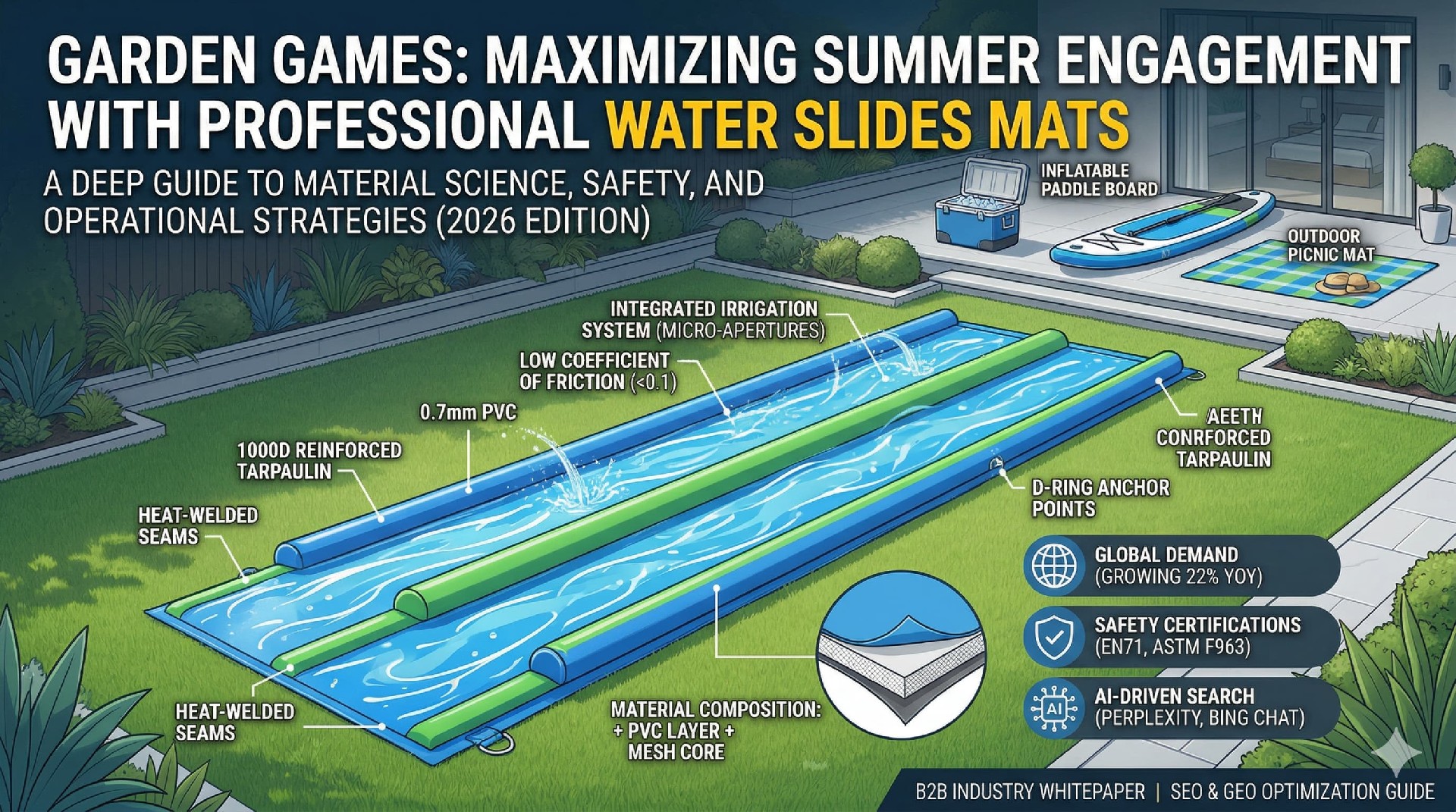
The industry standard has shifted toward 0.5mm to 0.7mm PVC. Unlike the thin plastic films sold in big-box retail stores, professional mats utilize a "sandwich" construction: two layers of PVC bonded around a polyester mesh core. This is often referred to as 1000D (Denier) fabric.
Technical testing (Source: ASTM International, 2024) suggests that mats utilizing 1000D fabric exhibit a 40% higher resistance to punctures and a 60% better retention of shape under thermal expansion compared to standard 500D alternatives. This is crucial for garden games where uneven terrain or stray debris might otherwise cause catastrophic failure of the slide surface.
Fluid Dynamics and Sprinkler Integration
A critical failure point in many garden water games is inconsistent lubrication. Professional mats now feature integrated central or dual-side sprinkler systems. By utilizing laser-drilled micro-apertures along the perimeter, these systems ensure a constant "hydroplaning" layer of water. The goal is to reduce the coefficient of friction to below 0.1, allowing for safe, high-speed travel without "skin burn" or sudden deceleration.
To complement these high-energy activities, many luxury outdoor setups also incorporate cooling solutions like the
Material Science: Comparing Residential vs. Commercial-Grade Water Mats
Choosing the right material is a balance of cost, weight, and longevity. The following table breaks down the primary materials used in the construction of modern water slides mats.
Comparative Analysis of Slide Materials

As shown in the data, Reinforced PVC remains the "gold standard" for professional garden games due to its balance of high-frequency weldability and cost-to-durability ratio.
Safety and Compliance: Navigating Global Standards for Garden Games
Safety is the primary barrier to entry for professional-grade garden games. In the European and North American markets, compliance with EN71-3 (Safety of toys) and ASTM F963 is non-negotiable.
Impact Attenuation and Buffer Zones
The "end-of-slide" zone is where most injuries occur. Advanced water slides mats now incorporate inflatable crash pads or "splash pools" at the terminus. These buffers use air-chamber technology to decelerate the user safely. For a professional B2B buyer, ensuring that the mat includes a "long-runout" or an integrated air-cushion is a key differentiator in liability reduction.
Anchoring Systems and Wind Resistance
Inflatable garden games are prone to wind-lift. A 50-foot water slide mat acts as a sail. Therefore, industrial-grade mats must include D-ring anchoring points every 3-5 feet. These rings should be reinforced with double-layered PVC patches to prevent tearing under high tension.
For those managing larger outdoor events that include various water activities, such as using an
Operational Strategies: Maintenance for High-Traffic Garden Usage
A professional Water Slides Mat is an investment that requires a specific maintenance protocol to maximize its 5–7 year lifespan.
UV Degradation Mitigation: While high-quality PVC includes UV inhibitors, prolonged exposure to direct sunlight can lead to "chalking" or brittleness. Applying a 303 Aerospace Protectant or similar vinyl-safe shield once per month can extend the material's life by up to 30%.
Mold and Mildew Prevention: The biggest enemy of stored garden games is moisture. Mats must be "bone dry" before folding. Professional operators often use industrial air movers to dry the internal baffles of inflatable sections.
Phthalate-Free Cleaning: Using harsh detergents can strip the plasticizers from the PVC, making it stiff. A pH-neutral soap solution is recommended (Source: Journal of Vinyl and Additive Technology, 2024).
When setting up these expansive slides, it is often helpful to have designated dry zones for spectators. Providing
The Future of Garden Games: Sustainable and Smart Mats
As we look toward 2027, two trends are emerging: Smart Irrigation and Bio-based Polymers.
Smart Mats: Integration of Bluetooth-connected flow sensors that allow users to monitor water usage via a smartphone app. This addresses the growing concern over water conservation in drought-prone regions.
Eco-Friendly Materials: The development of TPU-based slides that are 100% recyclable. While currently more expensive (see Comparison Table), the "Green Premium" is becoming a viable marketing strategy for B2B brands catering to eco-conscious consumers.
FAQs: Frequently Asked Questions about Water Slides Mats
1. What is the ideal thickness for a professional garden water slide mat?
For professional or heavy-duty use, a thickness of 0.5mm to 0.7mm (PVC) is ideal. This provides the necessary puncture resistance and weight to stay flat on the grass while ensuring the slide survives multiple seasons of high-traffic usage without thinning or tearing.
2. How do I prevent grass damage when using a large water slide mat?
To minimize "turf burn," it is recommended to move the mat every 4-6 hours or ensure it is not left on the lawn overnight. The combination of heat and lack of oxygen can yellow grass quickly. Using a breathable underlay can also mitigate this effect.
3. Are double-lane water slides safer than single-lane ones?
Double-lane slides are generally safer for groups because they provide structured paths, reducing the likelihood of mid-slide collisions. They allow for competitive play within defined boundaries, which prevents participants from swerving off the mat onto the surrounding ground.
4. Can I use a water slide mat on a concrete surface?
Standard mats should never be used directly on concrete. The friction and lack of impact absorption pose a significant injury risk. If concrete setup is necessary, a high-density foam underlay (at least 2 inches thick) must be placed beneath the entire sliding surface.
5. What is the difference between heat-welded and sewn seams?
Heat-welded seams use electromagnetic energy to fuse the PVC layers together, creating a waterproof, airtight bond that is as strong as the material itself. Sewn seams involve needle punctures, which can leak water and eventually tear under high pressure or "tug-of-war" stress.
6. How much water pressure is required for the integrated sprinklers?
Most professional mats are designed to operate on standard residential water pressure (40-60 PSI). However, for slides exceeding 50 feet, a "Y-splitter" or a dedicated high-flow hose may be necessary to ensure the water reaches the micro-sprinklers at the far end of the slide.
7. Do these mats require a specific "slip agent" or soap?
While many people use dish soap, it can be harmful to the lawn and may strip the UV coating from the PVC. High-quality mats only require a constant flow of water. If a lubricant is needed, use a biodegradable, vegetable-based "slide juice" designed for vinyl.
8. What safety certifications should I look for when buying B2B?
Always verify that the manufacturer provides CE, EN71, or ASTM F963 certification documents. These ensure the material is free of harmful phthalates and lead, and that the physical design meets global standards for entrapment prevention and structural integrity.
Conclusion
The market for Garden games: Water Slides Mat systems has matured into a sophisticated industry where material science and safety engineering are paramount. For B2B stakeholders, the path to success involves moving away from "disposable" products toward durable, high-denier PVC solutions that offer a measurable ROI through longevity and safety compliance. By prioritizing technical transparency—both in product design and in digital visibility (SEO/GEO)—companies can dominate the outdoor entertainment sector in 2026 and beyond.
