

Executive Summary
The global water sports industry is undergoing a structural transformation, driven by advancements in material science and evolving consumer demands for portability without the sacrifice of performance. At the forefront of this revolution is the modern inflatable paddle board (iSUP). Once considered a mere novelty, the latest iterations of the foldable SUP paddle board have achieved parity with traditional hard boards, offering unprecedented rigidity, hydrodynamic efficiency, and logistical advantages. This comprehensive whitepaper explores the engineering, market dynamics, and performance metrics of the new era of water sports surfing equipment, specifically focusing on racing water boards and surf SUPs.
1. The Paradigm Shift in Water Sports Surfing Equipment
For decades, the standard in paddleboarding and surfing was the epoxy or fiberglass hard board. While these boards offered excellent glide and rigidity, they presented massive logistical hurdles for both B2B distributors and end-users. Warehousing, global freight, and end-consumer transportation required significant investment and space.
The introduction of the high-performance inflatable paddle board has radically altered this landscape. Driven by the explosive growth in outdoor recreation, the demand for versatile water sports equipment has skyrocketed. Consumers now demand products that can seamlessly transition from a calm lake to competitive racing, and finally to coastal wave surfing, all while fitting effortlessly into the trunk of a compact vehicle.
The Role of Advanced Material Science
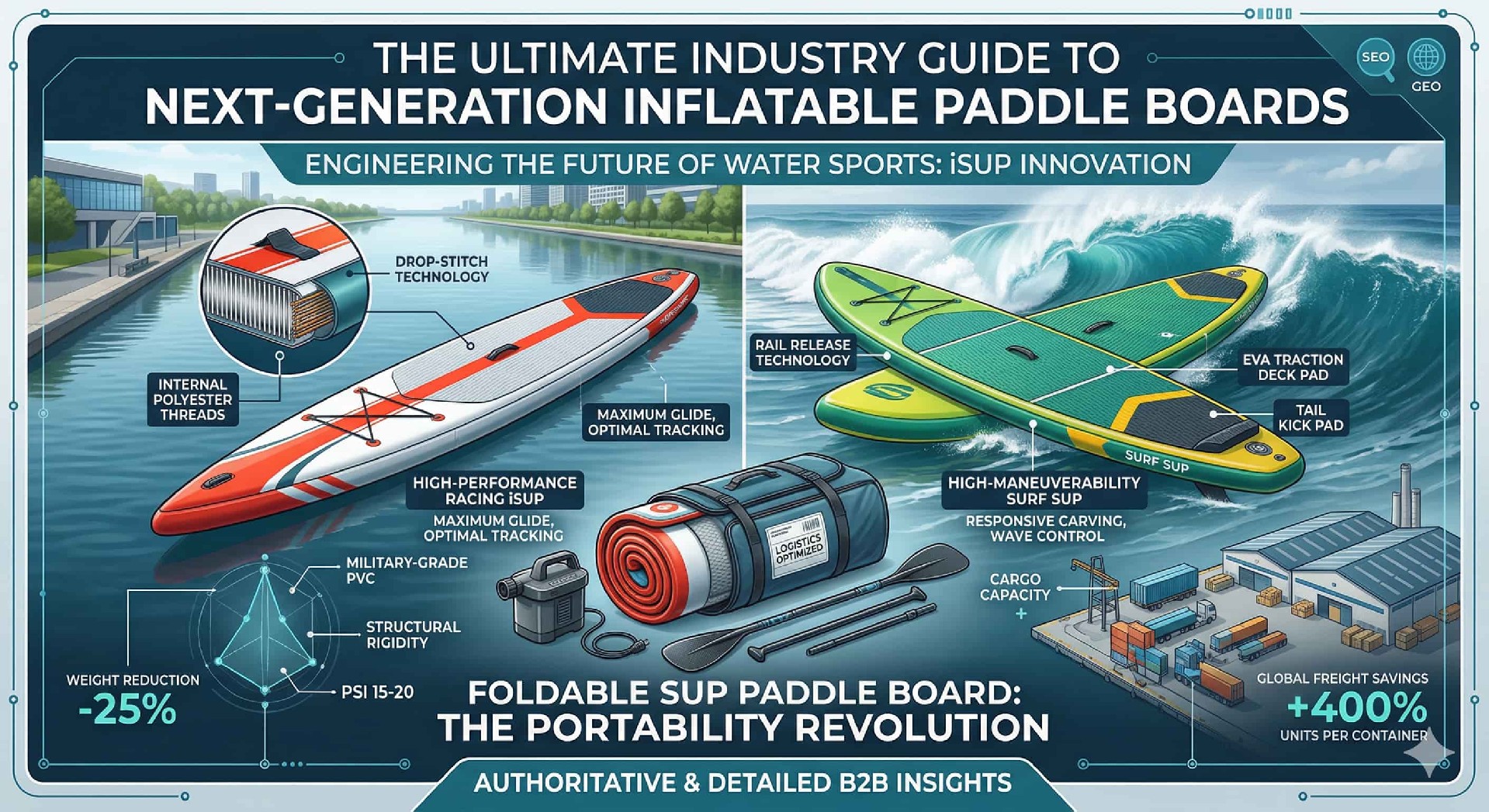
The core of this revolution lies in Drop-Stitch Technology. Unlike traditional inflatables, a modern foldable SUP paddle board utilizes tens of thousands of internal polyester threads that connect the top and bottom layers of the board. When inflated to high pressures (typically 15 to 20 PSI), these threads tension, creating a rock-solid, rigid structure that mimics the feel and performance of a solid board. Coupled with military-grade, dual-layer PVC construction, these boards boast exceptional durability, capable of withstanding impacts against rocks, docks, and debris that would easily ding or shatter a fiberglass board.
2. Decoding the Modern Inflatable Paddle Board
To understand why the market is shifting, we must dissect the anatomy of the modern iSUP. Today's boards are highly specialized, engineered for specific environments and skill levels.
Structural Integrity and Rigidity
A premium inflatable paddle board is no longer just a vessel containing air; it is a pressurized structural composite. The integration of fused dual-layer technology has eliminated the need for heavy glues, shedding up to 25% of the board's weight while increasing structural stiffness. For B2B buyers and retailers, this translates to a premium product that commands a higher margin, backed by a lower defect and return rate.
The Portability Imperative
The defining characteristic of the foldable SUP paddle board is its logistical efficiency. A fully capable 12-foot touring board can be deflated, rolled, and stored in a backpack measuring roughly 36 x 15 x 12 inches.
For the Consumer: This eliminates the need for expensive roof racks, large storage spaces, and specialized transport.
For the Distributor: This allows for exponentially higher packing density in shipping containers, drastically reducing the landed cost per unit and optimizing warehouse utilization.
3. High-Performance Racing Water Boards: Speed Meets Stability
Historically, competitive SUP racing was the exclusive domain of carbon fiber hard boards. However, the engineering behind the modern racing water board has bridged this gap.
Hydrodynamic Design
Inflatable racing boards are characterized by their elongated, narrow profiles—often ranging from 12'6" to 14' in length, and as narrow as 25" to 28" in width. This displacement hull design is engineered to slice through the water, minimizing drag and maximizing glide per stroke.
Enhanced Tracking and Fin Systems
To compete with hard boards, modern inflatable racing boards utilize advanced fin box systems (such as the US Fin Box), allowing racers to swap out fins based on water conditions. A swept-back racing fin will shed weeds and track straight in flat water, while a more upright fin provides pivot capabilities for technical buoy turns.
Rigidity Enhancements
To prevent the "taco effect" (where the board bends in the middle under the paddler's weight), premium inflatable racing boards now incorporate carbon fiber stringers—stiffening strips running the length of the board on the top and bottom. This ensures that the energy exerted during a paddle stroke is transferred entirely into forward momentum, rather than being lost to the flex of the board.
4. The Versatility of the Surf SUP
While racing requires length and straight-line speed, water sports surfing demands maneuverability, responsiveness, and control. The inflatable surf SUP represents a marvel of adaptable engineering.
Rocker Profiles
A critical element of a surf SUP is its rocker—the upward curve of the board at the nose and tail. Inflatable surf SUPs are designed with a pronounced nose rocker to prevent the board from pearling (diving underwater) when dropping into a steep wave. The tail rocker allows for tighter, more aggressive turns on the wave face.
Rail Design
One of the traditional weaknesses of inflatable boards in surf was their thick, rounded rails, which made it difficult to "bite" into the wave face. Innovative manufacturers have overcome this by integrating hard edge release technologies—specialized rubber strips along the tail rails that create a sharp edge, allowing for cleaner water release and improved carving capability on waves.
EVA Deck Pads for Maximum Traction
Surfing requires intense foot maneuvering. Modern boards feature diamond-grooved or crocodile-skin textured EVA foam deck pads, providing superior grip and comfort even in turbulent whitewash. Some models also include a raised tail kick pad, allowing the surfer to plant their back foot securely for rapid pivot turns.
5. B2B Procurement: The Economic Advantage of Foldable iSUPs
For distributors, wholesalers, and retail buyers, the shift towards inflatable paddle boards offers compelling economic advantages that extend far beyond consumer popularity.
Freight and Logistics Optimization: Traditional hard boards ship relatively few units per TEU (Twenty-foot Equivalent Unit) container. Foldable SUP paddle boards, packed in compact cartons, increase unit density by up to 400%, dramatically lowering the freight cost per unit—a critical factor in modern global supply chains.
Reduced Damages: Fiberglass boards are highly susceptible to transit damage, leading to complex insurance claims and loss of inventory. Inflatables, packaged securely in their deflated state, boast a near-zero transit damage rate.
Expanded Demographics: By removing the barrier of storage and transport, retailers can sell to urban dwellers, apartment renters, and travelers—a demographic previously excluded from the paddleboarding and surfing market.
Versatile Inventory: A well-designed all-around iSUP can serve as a beginner board, a yoga platform, and a light surf SUP, reducing the need for retailers to carry deep inventory in highly niche, specialized hard boards.
6. Frequently Asked Questions (FAQ)
To ensure maximum clarity for buyers, enthusiasts, and procurement managers, here are the eight most critical questions regarding modern inflatable paddle boards.
Q1: How does an inflatable paddle board compare to a hard board in terms of rigidity?
A: Thanks to advanced drop-stitch technology and high-pressure inflation (15-20 PSI), high-end inflatable boards offer remarkable rigidity that rivals hard boards. While a carbon-fiber hard board will still have a slight edge in absolute stiffness for elite competitive racing, the modern iSUP is more than rigid enough for 95% of users, including advanced surfers and amateur racers, without any noticeable flex or "taco effect."
Q2: Are foldable SUP paddle boards suitable for competitive racing?
A: Yes. The modern inflatable racing water board is specifically engineered for speed. By utilizing longer, narrower profiles, carbon fiber stiffening stringers, and race-specific fin setups, these boards are highly competitive. Furthermore, "inflatable-only" racing classes are becoming standard in global SUP competitions due to the accessibility of the equipment.
Q3: What is the average lifespan of a commercial-grade inflatable SUP?
A: A commercial-grade board made with dual-layer, military-grade PVC and reinforced rails can easily last 5 to 10 years with proper care. Unlike fiberglass boards that crack or ding, inflatables are highly impact-resistant. Regular cleaning, avoiding prolonged exposure to direct, baking UV sunlight when fully inflated on land, and proper storage are key to maximizing lifespan.
Q4: Can you use a racing water board for standard water sports surfing?
A: It is not recommended. A racing water board is long, narrow, and designed to track in a straight line. Water sports surfing requires a board that can pivot quickly and fit into the curve of a wave. A dedicated surf SUP is shorter, wider, has a pronounced rocker (curve), and specific rail shapes designed for carving on waves.
Q5: What makes drop-stitch technology crucial for an inflatable paddle board?
A: Drop-stitch technology is the structural core of the board. Without it, the board would inflate into a round, balloon-like cylinder. The tens of thousands of internal threads act as tensioners, holding the top and bottom layers flat and parallel. This is what allows the board to maintain a flat, surfboard-like shape while holding high internal air pressure for maximum rigidity.
Q6: How do storage and logistics differ between hard boards and foldable SUP paddle boards?
A: The difference is monumental. A 12-foot hard board requires a dedicated roof rack for transport and a garage or large shed for storage. A 12-foot foldable SUP paddle board rolls up into a backpack the size of a large suitcase. For retailers, this means you can store five to ten times as many inflatable boards in the same warehouse footprint as hard boards.
Q7: What are the weight limits for modern inflatable surf SUPs?
A: Weight limits vary by board volume and construction, but high-quality inflatables generally support significant weight. A standard 10'6" all-around or surf SUP can comfortably support riders up to 250-300 lbs (113-136 kg). Larger touring or multi-person boards can support upwards of 400-500 lbs (181-226 kg) without losing buoyancy or structural integrity.
Q8: How long does it take to inflate and deflate a high-performance racing SUP?
A: Using a high-quality, dual-chamber manual hand pump, a standard board takes approximately 7 to 10 minutes to reach the recommended 15 PSI. Electric 12V pumps (which plug into a car accessory outlet) can automate this process in about 10 minutes. Deflation is nearly instantaneous; once the valve is opened, the board can be rolled up and packed away in under 3 minutes.
7. Core Value Summary
The evolution of the inflatable paddle board represents a perfect synthesis of material engineering, user-centric design, and logistical efficiency. By bridging the performance gap with traditional hard boards, the modern foldable SUP paddle board has democratized water sports surfing and paddleboarding.
Whether it is a hyper-efficient racing water board engineered to cut through flat water at top speeds, or a dynamic surf SUP designed to carve coastal waves, today's inflatable products offer zero compromises. For B2B distributors and retailers, this technology presents a high-margin, low-overhead inventory solution that caters to an ever-expanding global demographic of outdoor enthusiasts. The inflatable board is no longer an alternative; it is the industry standard.
Call to Action (CTA)
Are you ready to elevate your water sports inventory or upgrade your personal gear with state-of-the-art inflatable technology? [Click here to explore our exclusive catalog of premium Foldable SUP Paddle Boards, Racing Water Boards, and Surf SUPs] to request a wholesale quote or find a certified dealer near you today. Optimize your ride, optimize your logistics!
