

Abstract
This comprehensive whitepaper explores the complex technical, operational, and commercial dynamics of the global Pool Floats manufacturing and wholesale industry. What this article covers: We dissect the material science behind inflatable water recreation equipment, the rigorous global safety compliance standards, and the sophisticated manufacturing processes required for commercial-grade products. Why it matters now: As the experiential travel and resort sectors rebound globally, the demand for durable, photogenic, and eco-compliant water leisure products is surging. Relying on outdated procurement models or subpar PVC formulations can lead to severe regulatory fines and brand degradation. How you will benefit: Procurement managers, B2B distributors, and resort operators will learn actionable, data-backed strategies for vendor auditing, optimizing cross-border supply chains, navigating ASTM/EN71 regulations, and selecting the optimal polymer blends to maximize product lifecycle and ROI.
1. Analyzing the Global Pool Floats Market Dynamics and Growth Trajectories
The global landscape for water recreation equipment has evolved significantly from a seasonal novelty sector into a robust, year-round industry driven by the hospitality sector, social media marketing, and the burgeoning "staycation" economy. Understanding these macroeconomic trends is critical for B2B buyers looking to optimize their inventory and procurement strategies.
The market for inflatable leisure products, specifically
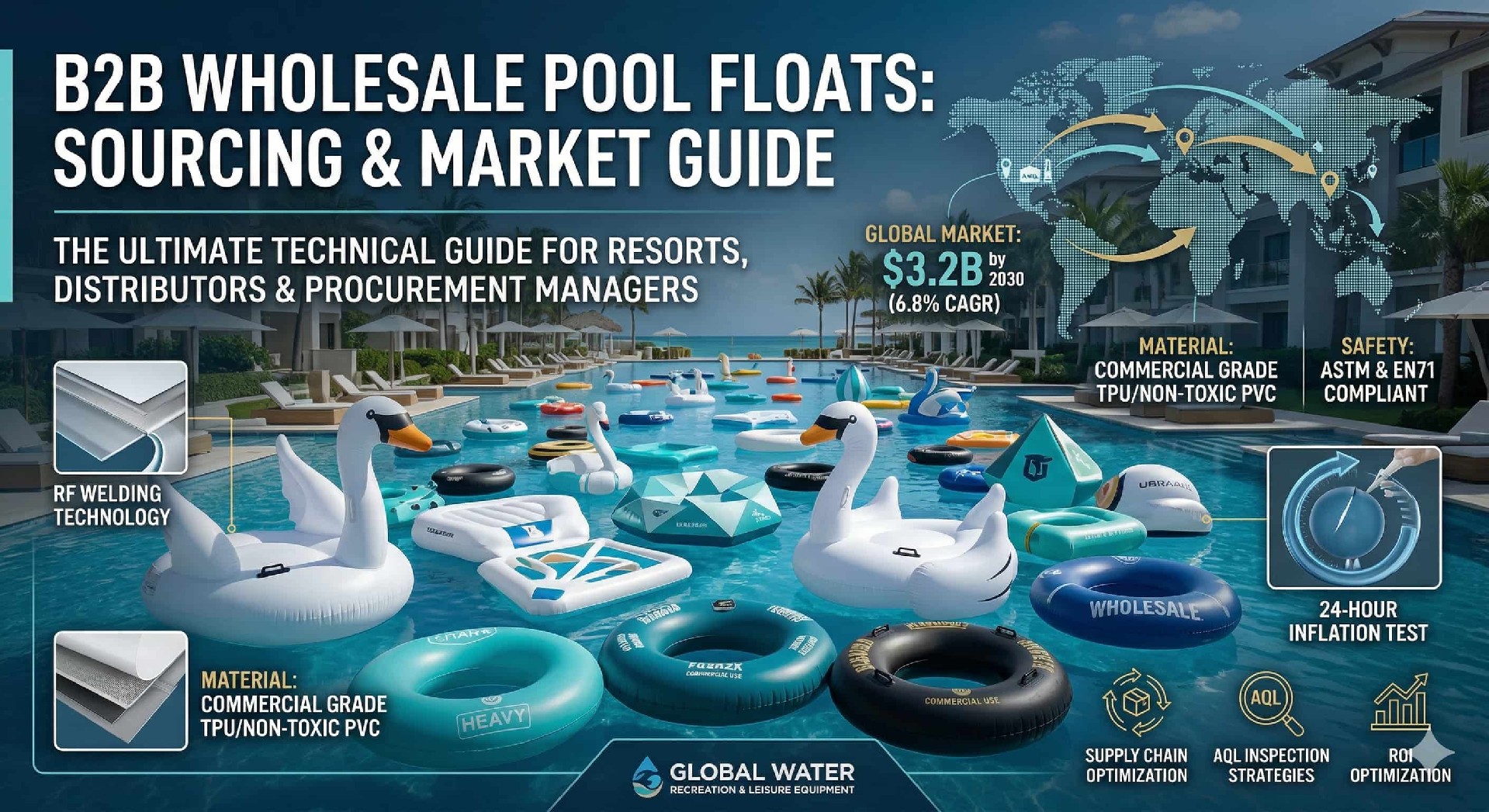
Data indicates that the global inflatable leisure products market is projected to grow at a Compound Annual Growth Rate (CAGR) of 6.8% from 2024 to 2030, potentially reaching a valuation of over $3.2 billion. (Source: Grand View Research, 2024). This growth is not evenly distributed; the commercial B2B sector is outpacing direct-to-consumer retail due to bulk replacement cycles and the increasing stringency of municipal safety codes requiring certified commercial-grade inflatables.
For distributors and wholesale buyers, this means standard procurement parameters—previously focused solely on unit cost—must now incorporate Total Cost of Ownership (TCO). A cheaper pool float that fails after one season due to UV degradation or seam splitting ultimately costs a commercial operator more in replacement logistics and potential liability than a premium unit engineered for longevity.
2. Material Science: Polymer Selection in Pool Floats Manufacturing
The foundation of any high-quality inflatable product lies in its polymer chemistry. The B2B buyer must understand the nuanced differences between material substrates to specify the correct product for its intended commercial application.
Polyvinyl Chloride (PVC): The Industry Standard
Traditional PVC remains the dominant material due to its cost-effectiveness, ease of welding, and flexibility. However, in the B2B space, not all PVC is created equal.
Gauge and Thickness: Commercial grade
Commercial Inflatable Water Parks Plasticizers and Phthalates: PVC is inherently rigid; it requires plasticizers to become flexible. Historically, phthalates were used, but due to severe health concerns and stringent regulations (like California’s Prop 65 and the EU's REACH directive), modern commercial pool floats must utilize phthalate-free or non-toxic PVC formulations.
Additives: High-end manufacturing incorporates UV inhibitors to prevent photodegradation (yellowing and brittleness) and anti-microbial agents to prevent mold growth in damp, folded storage environments. (Source: Polymer Science Advanced Materials Report, 2024).
Thermoplastic Polyurethane (TPU): The Premium Alternative
TPU represents the frontier of high-end water recreation equipment. Unlike PVC, TPU is free of plasticizers, meaning it does not become brittle over time as chemicals leach out.
Durability: TPU offers superior abrasion resistance, high tensile strength, and excellent elasticity. It is significantly more resistant to punctures and tears.
Environmental Impact: TPU is highly recyclable and biodegradable compared to PVC, aligning with the ESG (Environmental, Social, and Governance) goals of modern corporate buyers.
Weight: TPU is lighter than PVC for the same structural strength, reducing international shipping costs (calculated by CBM and gross weight).
Application: Ideal for
Heavy-Duty Floating River Tubes
Nylon/Polyester Coated Fabrics
For the ultimate in commercial durability, a composite material is used. This involves a tightly woven polyester or nylon base fabric (e.g., 420D to 1000D Denier) that is heavily coated or laminated with PVC or TPU. This construction prevents the fabric from stretching under high pneumatic pressure and renders it virtually indestructible under normal recreational use.
3. Advanced Manufacturing Processes: Welding Technologies
The structural integrity of any inflatable relies entirely on the quality of its seams. B2B buyers must audit their suppliers' welding technologies to ensure high burst strength and leak-proof performance.
High-Frequency (HF) / Radio Frequency (RF) Welding
This is the gold standard for manufacturing PVC and TPU pool floats. RF welding uses electromagnetic energy (typically at 27.12 MHz) to agitate the molecules within the polymer. This rapid molecular movement generates internal heat, causing the materials to melt and fuse at the cellular level under pressure.
The Result: The seam becomes stronger than the surrounding material.
Advantages for B2B: RF welding creates airtight, watertight, and highly uniform seams without degrading the structural integrity of the adjacent material, unlike mechanical sewing or simple heat sealing.
Hot Air Welding
Hot air welding is often utilized for extremely thick, heavy-duty commercial inflatables (like massive floating obstacle courses) where RF welding machinery might struggle with the sheer volume of material. A specialized machine blows intensely hot air between the overlapping layers of material while pressure rollers instantly fuse them together.
Valve Engineering
A high-quality material and seam are useless if the air valve is defective. Commercial buyers must specify valves that match the application:
Boston Valves: Essential for large volume inflatables, featuring a two-way design that allows for rapid inflation and deflation without air escaping when the pump is removed.
Recessed Safety Valves: Required for consumer-facing products to ensure the valve can be pushed flush with the surface, preventing abrasion or catching hazards.
4. Navigating Global Safety Standards and Regulatory Compliance
For B2B importers and cross-border traders, regulatory compliance is not optional; it is a critical risk-management mandate. Importing non-compliant pool floats can result in customs seizures, massive fines, and catastrophic liability in the event of an accident.
United States Market Compliance
CPSIA (Consumer Product Safety Improvement Act): If a pool float is marketed towards children under 12, it must comply with CPSIA regulations, which mandate strict limits on lead and phthalate content. Products must undergo third-party testing by a CPSC-accepted laboratory and possess a Children's Product Certificate (CPC).
ASTM F963: The standard consumer safety specification for toy safety in the US. It dictates physical and mechanical testing, flammability standards, and chemical toxicity limits.
US Coast Guard (USCG) Designations: It is crucial to legally distinguish between a "pool toy" and a "personal flotation device" (PFD). Pool floats must carry mandatory warning labels explicitly stating they are not life-saving devices to mitigate legal liability. (Source: Consumer Product Safety Commission, 2025).
European Union Market Compliance
EN 71 Standard: This is the equivalent to ASTM in the EU.
EN 71-1: Covers mechanical and physical properties (e.g., ensuring small parts cannot detach and cause choking).
EN 71-2: Specifies flammability requirements.
EN 71-3: Regulates the migration of certain heavy metals and toxic elements.
REACH Directive: B2B buyers must secure REACH compliance certificates from their manufacturers, proving the products are free from Substances of Very High Concern (SVHC).
5. Strategic B2B Sourcing: Auditing Suppliers and Quality Assurance
Sourcing water recreation equipment from overseas manufacturers (predominantly in Asia) requires a systematic and rigorous approach. B2B buyers must move beyond Alibaba storefronts and implement comprehensive supplier audits.
Evaluating Factory Capabilities
When selecting a manufacturing partner for pool floats, wholesalers must evaluate:
Production Capacity vs. Lead Time: Ensure the factory has sufficient high-frequency welding machines to meet your required volume during peak pre-summer production seasons (typically January through April).
In-House Tooling: Factories that design and produce their own molds (tooling) can prototype custom designs significantly faster and cheaper than those that outsource.
ISO 9001 Certification: This ensures the factory has a standardized quality management system in place, reducing the variance between production batches.
Implementing Acceptable Quality Limit (AQL) Inspections
Never authorize a final container shipment without a third-party AQL inspection. For inflatable products, the industry standard is typically AQL Level II (Major 2.5, Minor 4.0).
Critical Defects (AQL 0): E.g., Open seams, missing warning labels, toxic materials. Shipment must be rejected.
Major Defects (AQL 2.5): E.g., Slow air leaks discovered during a 24-hour inflation test, malfunctioning valves, severe printing errors.
Minor Defects (AQL 4.0): E.g., Slight color deviations, minor scuffs on non-visible areas, packaging imperfections.
The 24-Hour Inflation Test
A mandatory step in QA for any inflatable product. A statistically significant sample size must be inflated to operational pressure and left for 24 to 48 hours to monitor for pressure drops. High-end factories will perform a 100% inflation test on all commercial-grade items before packaging.
6. Supply Chain Optimization, Packaging, and Cross-Border Logistics
The physical nature of inflatable products presents unique challenges and opportunities in international logistics. Because they are filled with air during use but flat-packed for shipping, their volume-to-weight ratio is highly favorable when deflated.
Packaging Engineering
Proper packaging minimizes shipping costs and protects the product.
Vacuum Sealing: Advanced B2B suppliers use vacuum sealing to compress the PVC/TPU materials tightly. This can reduce the cubic meter (CBM) footprint of a master carton by up to 15%, allowing buyers to fit significantly more units into a 40HQ (High Cube) shipping container.
Talcum Powder Application: Before folding, high-quality manufacturers lightly dust the inflatables with an industrial talc or cornstarch powder. This prevents the synthetic polymers from fusing together during high-temperature transit through the ocean freight corridors.
Master Carton Integrity: Cartons must be double-corrugated (5-ply minimum) and drop-tested to withstand the rigors of LCL (Less than Container Load) shipping, where cartons are handled multiple times.
Landed Cost Calculation and Incoterms
B2B procurement managers must calculate the true landed cost. While FOB (Free On Board) prices might look attractive, buyers must factor in ocean freight, customs duties (which vary wildly depending on the HS Code classification—often categorized under toys or sports equipment), marine insurance, and inland drayage. Leveraging favorable Incoterms and optimizing container packing density (CBM utilization) are key differentiators for profitable wholesale operations.
7. Future Trends in the Water Recreation Equipment Industry
To maintain a competitive edge, B2B distributors and retail buyers must anticipate the future trajectory of the pool float and water recreation market.
Eco-Conscious and Circular Manufacturing
The most significant trend is the rapid shift toward sustainability. Buyers are increasingly demanding products made from post-consumer recycled (PCR) plastics or bio-based polymers. Furthermore, manufacturers are exploring "circular" business models, designing inflatables that can be easily dismantled and recycled at the end of their lifecycle, rather than ending up in landfills.
Modular and Smart Inflatables
The commercial sector is seeing a rise in modular inflatable systems. Instead of massive, single-piece structures, resorts are purchasing interlocking modules that can be reconfigured weekly to create new experiences. Additionally, the integration of "smart" technology—such as embedded RFID tags for inventory tracking and QR codes printed directly on the material linking to safety videos and digital user manuals—is becoming a standard requirement for high-end commercial procurements.
Advanced Digital Printing
Traditional silk-screen printing is being replaced by large-format digital UV printing. This allows B2B buyers to order completely customized, photorealistic designs with significantly lower Minimum Order Quantities (MOQs), enabling hyper-targeted marketing campaigns and bespoke branding for individual resort chains or corporate events.
8. FAQs on Sourcing and Manufacturing Pool Floats
Q1: What is the standard MOQ (Minimum Order Quantity) for custom B2B pool floats?
A: For customized shapes requiring new tooling, MOQs typically range from 1,000 to 3,000 units depending on the size. For standard shapes with custom digital printing, manufacturers may accept MOQs as low as 500 units to accommodate boutique commercial buyers.
Q2: How can I verify that a manufacturer's PVC is truly phthalate-free?
A: Never rely solely on factory claims. You must request a recent, valid test report from a globally recognized third-party laboratory (like SGS, Intertek, or TUV) explicitly stating compliance with REACH or CPSIA phthalate limits for that specific material batch.
Q3: What is the typical lead time for a 40HQ container of pool floats?
A: During the off-season (August-October), lead times average 30-45 days. During peak production (January-April), lead times can stretch to 60-90 days. B2B buyers must forecast and place orders at least 4-5 months ahead of their local summer season.
Q4: What HS code should be used for importing pool floats, and how does it affect duty?
A: Inflatables are often classified under HS Code 9506.29 (Water skis, surf-boards, sailboards and other water-sport equipment) or 9503.00 (Toys). The specific classification drastically affects import duty rates; consult a licensed customs broker to ensure accurate, legally compliant categorization.
Q5: Why do some inflatable seams split shortly after purchase?
A: Seam splitting is generally caused by improper high-frequency welding (insufficient heat or pressure time), using too thin a gauge of PVC for the intended weight capacity, or over-inflation by the end-user combined with extreme thermal expansion under direct sunlight.
Q6: What is the difference between an air mattress and a commercial pool float?
A: Commercial pool floats utilize a significantly thicker polymer gauge (0.40mm+), reinforced stress points, multi-chamber air systems for safety redundancy, and heavy-duty valves. Air mattresses prioritize sleep comfort over puncture resistance and UV degradation resilience.
Q7: Can we manufacture pool floats using purely biodegradable materials?
A: Currently, 100% biodegradable materials that can hold high pneumatic pressure and withstand harsh UV/chlorine exposure do not exist at commercial scale. The industry is currently focused on recyclable TPU and post-consumer recycled PVC as the most viable eco-friendly alternatives.
Q8: How do we handle warranty claims on defective wholesale shipments?
A: Robust B2B contracts must include a Defect Liability Period. If the defect rate exceeds the agreed AQL limit upon delivery or within a specified timeframe, the manufacturer is contractually obligated to provide replacement units in the next shipment or issue a proportional credit note.
9. Conclusion
The commercial procurement and B2B wholesale distribution of pool floats is a highly technical endeavor that requires a deep understanding of polymer chemistry, global safety compliance, and rigorous quality assurance protocols. Moving away from a pure cost-per-unit mentality toward a Total Cost of Ownership model will protect your brand reputation, mitigate legal liabilities, and ensure a superior experience for the end-user. Whether you are outfitting a global resort chain or distributing to regional retail networks, prioritizing heavy-duty materials like TPU, demanding stringent RF welding standards, and enforcing third-party AQL inspections are the keys to long-term profitability.
Ready to elevate your inventory with premium, compliant water recreation equipment? Audit your current supply chain today, demand technical specifications from your vendors, and start sourcing data-driven, commercially viable products that drive real ROI.
