

Why Onboard Safety Accessories Are a Non-Negotiable Investment
For commercial fishing operations, charter captains, and serious offshore anglers, the question isn't whether to carry safety gear, but whether the gear you have will perform when conditions turn against you. Unlike recreational boaters, commercial operators face the dual pressures of operational uptime and crew safety. A failed bilge pump or an expired flare can mean the difference between a profitable trip and a Coast Guard citation—or worse.
This guide focuses on the essential safety accessories that should be permanently mounted or securely stowed on your fishing boat. We will move beyond the basic legal requirements to examine the commercial-grade equipment that offers genuine reliability, ease of maintenance, and the best return on investment when it comes to risk mitigation. The goal is to help you build a safety system that is robust, accessible, and tailored to the unique demands of fishing environments, from inshore flats to the continental shelf.
Critical Safety Systems: Beyond the Bare Minimum
When evaluating safety accessories, think in terms of systems: "How do I stay afloat?", "How do I communicate?", "How do I stop flooding?", and "How do I get back on board?". The following categories represent the core of a professional-grade safety inventory.
Visual Distress Signals (VDS) & Sound Devices
Day and night signals are required by law, but commercial operators should prioritize durability and shelf-life. Handheld red flares (day/night) must be stored in a watertight container and checked for expiration dates during every quarterly inspection. For sound signals, a marine-grade air horn or an electric horn that meets COLREGS (Collision Regulations) requirements is essential for maneuvering in fog or heavy rain. Consider adding a parachute flare to your offshore kit for long-range visibility in a search-and-rescue scenario. A common oversight is not having an easily accessible signal mirror—a highly effective, never-expire tool for daylight signaling.
Fire Suppression: A Class for Every Fire
Fishing boats are packed with fuel, oil, electrical wiring, and cooking equipment. A single ABC dry chemical extinguisher is rarely sufficient. A commercial-grade vessel should carry at least two extinguishers, with one mounted near the helm and another at the engine room or galley entrance. For engine compartments, consider a fixed automatic system that releases a clean agent (like FM-200 or Novec 1230) to suppress a fire before you even know it exists. Verify the extinguishers are marine-rated and properly bracketed to prevent movement in heavy seas.
Vessel Stability & Safety Accessories
Stability is the silent factor in fishing safety. Swamping, capsizing, and flooding are leading causes of fishing vessel accidents. Accessories that maintain stability are as crucial as those that help after an incident occurs.
High-Capacity Bilge Pumps & Alarms
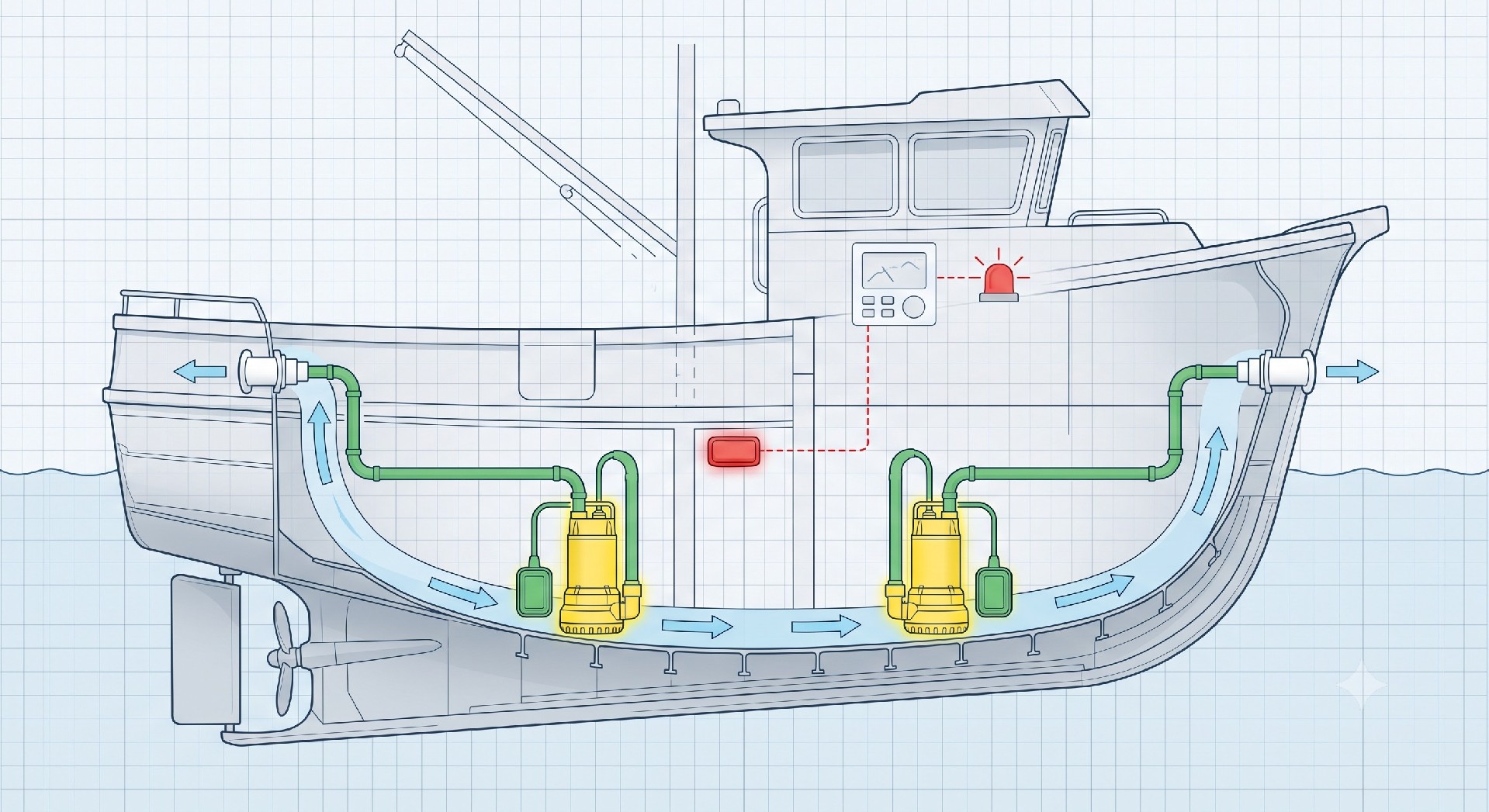
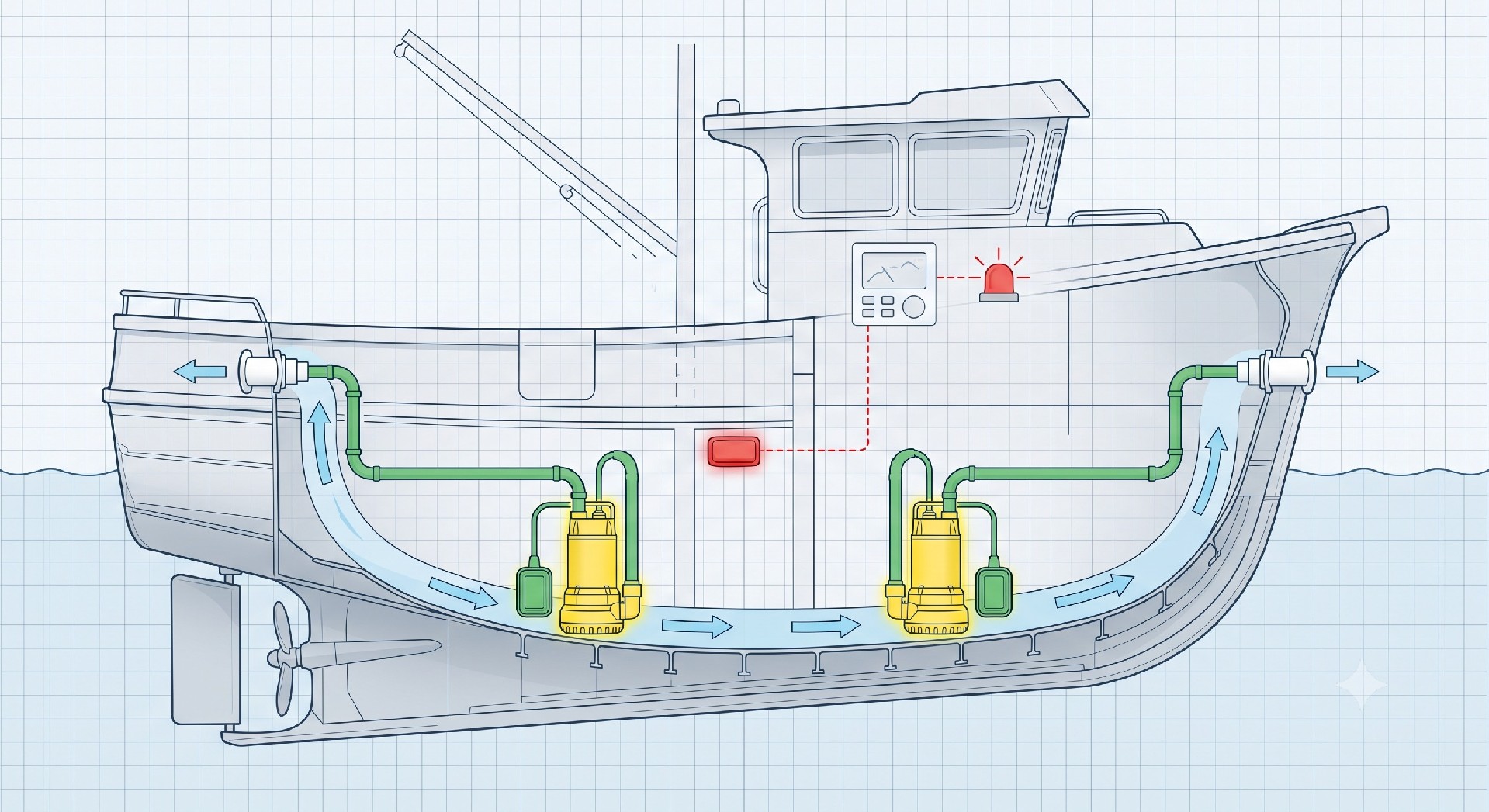
The standard bilge pump may handle incidental water from rain or a packing gland leak, but it won't keep up with a broken hose or a hull breach. A primary pump combined with a high-water alarm (which alerts you audibly before the water reaches the floorboards) is the minimum recommended setup. For added redundancy, install a secondary bilge pump with a separate through-hull fitting and a separate battery source. This ensures that if your primary pump fails or your main battery is compromised, you still have the capacity to buy critical time.
Emergency Towing & Rigging Hardware
In a man-overboard scenario or if you need to be towed by a Good Samaritan, a dedicated towing bridle with a strong, corrosion-resistant D-ring is invaluable. Pre-rig your boat with a bridle that can be deployed quickly from the bow. Similarly, carry at least one Type IV throwable device (like a buoyant cushion or horseshoe buoy) that is ready to deploy. While not a "throwable," a rescue sling or a Lifesling system is a premium accessory that allows you to recover a person from the water using the boat's winch or manual effort, saving your crew from debilitating back injuries during recovery.
Jack Lines & Safety Harnesses
For boats operating in rough weather or at night, crew members should wear a safety harness with a short tether attached to a heavy-duty jackline run down the center of the deck. This is not just for sailboats; a wave over the bow on a sportfisher can wash a crewman off the deck in seconds. Installing webbing jacklines from the cockpit to the bow, and storing harnesses in a dry locker next to the helm, ensures they are accessible when sea conditions deteriorate.
| Safety Accessory | Recommended Type / Spec | Key Use Case | Maintenance Interval |
|---|---|---|---|
| Visual Distress Signals | USCG-Approved Handheld Red Flares & Parachute Flare | Day/Night signaling for Search & Rescue | Replace by Expiration Date (typically 42 months) |
| Sound Signaling Device | Marine Air Horn (Refillable) or Electric Horn (COLREGS) | Maneuvering in Fog/Heavy Rain, Collision Warning | Test Monthly; Ensure Adequate Air Supply |
| Fire Extinguisher | Marine-rated ABC or Class B+C; dual units | Engine fire, galley fire, electrical short | Weigh/Check gauge monthly; Annual professional service |
| Bilge Pump System | Primary (2000 GPH) + Secondary (2000 GPH) with High Water Alarm | Manage major water ingress from broken hoses or hull damage | Test float switch weekly; Clean debris quarterly |
| Man Overboard System | Lifesling or Horseshoe Buoy with Light/Smoke | Recovery of crewman overboard without lifting injury | Inspect straps and lights monthly |
| EPIRB (Emergency Beacon) | 406 MHz GPS-Enabled EPIRB (Cat I or Cat II) | Global distress alerting when vessel is unrecoverable | Test using self-test function monthly; Replace battery every 5 years |
| Jacklines & Harnesses | 2-inch webbing jackline; Auto-inflating PFD with tether | Preventing crew from being washed overboard in rough seas | Inspect webbing for UV rot; Service PFD annually |
Practical Considerations: Stowage, Accessibility, and Maintenance
Having the right gear is useless if you cannot find it in a crisis. Here are the operational rules for managing safety accessories on a fishing boat.
Stowage: Proximity vs. Protection
Fire extinguishers must be visible and unobstructed, not buried under tackle boxes. Life jackets should be stored in a way that they fall free from a locker when the latch is opened. Flares must be stored in a dedicated, waterproof ditch bag that is grabbed last when abandoning ship. Consider color-coding your storage: a yellow bag for the ditch kit, red brackets for fire extinguishers, and a white floating pouch for EPIRBs (Emergency Position Indicating Radio Beacons).
The Preventative Maintenance Cycle
A safety checklist should be completed before every offshore trip. This is not merely a regulatory formality; it is a procedural defense against equipment failure.
Monthly: Check battery charge of EPIRB and handheld VHF; test bilge pump float switches; inspect fire extinguisher gauges and ensure they are seated securely in brackets.
Quarterly: Remove and visually inspect fire extinguishers for corrosion; crack-test flare containers for seal integrity; test the engine kill switch lanyard.
Annually: Weigh or pressure-test fire extinguishers; replace expired flares; service inflatable life jackets (for CO2 cartridges and auto-inflation mechanisms); test the EPIRB using the test function (checking the 406 MHz signal is transmitted to the satellite).
Creating a Safety Orientation Protocol
A safety culture is established through routine. Before departing the dock, the captain should conduct a 5-minute "Safety Stand Down" with the crew.
Location: Physically point to the location of each safety accessory.
Operation: Show how to deploy the throwable device; demonstrate the bilge pump override switch; instruct how to manually trigger the EPIRB.
Contingency: Walk through the "abandon ship" procedure—who grabs the ditch bag, who activates the EPIRB, and who takes the helm during a fire.
Navigating Regulations and Insurance Requirements
Safety compliance is not optional. The US Coast Guard (USCG) has specific requirements for carriage requirements based on vessel length, which are strictly enforced. Beyond the USCG, your commercial insurance policy will likely mandate specific safety equipment (such as auto-inflating PFDs or specific extinguisher types). Ensure your accessory list satisfies both legal standards and your liability coverage requirements. Failure to carry the correct gear can void your policy in the event of a claim.
The Commercial Logic: Safety as an Operational Efficiency
For a commercial fishing enterprise, time is money. A breakdown in safety gear leads to trip cancellations, lost fishing time, and expensive repair bills. By investing in high-quality, dual-component safety systems (e.g., dual bilge pumps, dual VHF radios), you build in redundancy that minimizes downtime. The small upfront cost of an extra bilge pump is far less than the revenue lost from a flooded engine room.
Buyer's Decision Checklist: What to Carry and Why
When specifying safety accessories for your fishing boat, use this checklist to ensure you are not forgetting a critical system:
Remote EPIRB: Automatic activation upon immersion. Essential for offshore operations beyond VHF range.
Handheld VHF: A waterproof, floating unit with GPS. Provides backup communication if the main radio fails.
First Aid Kit: Marine-specific kit that includes trauma supplies like tourniquets and hemostatic gauze, not just bandages.
Flooding Control: A soft wood plug (tapered wooden plug) set and a spare hose repair kit to combat emergency hose failures.
Electronics: A backup GPS or chartplotter, or at least a robust compass and paper charts for navigating without electrical power.
Investing in safety accessories is a statement of professionalism. It protects your crew, your asset, and your livelihood. By moving from a reactive "check the box" approach to a proactive "build the system" approach, you ensure that your fishing boat is not just equipped for fishing, but capable of surviving whatever the ocean sends your way.
