

Why Your 4-Person Tent is Actually a 2+2 Tent
If you are specifying tents for a rental fleet, outfitter, or resort, the first mistake buyers make is taking the person rating at face value. A 4-person tent is not designed to sleep four adults comfortably with gear. This is not a marketing trick; it is a function of floor area, sleeping pad dimensions, and the structural geometry of the shelter. For commercial operators, this mismatch directly impacts guest satisfaction, gear storage, and daily turnover efficiency. The industry standard floor area for a comfortable sleeping space is approximately 20 ft² per adult. A typical 4-person tent offers about 56 to 64 ft² of floor area. That equates to about 14 to 16 ft² per person, which is camping density, not comfort. In this guide, we break down the geometry, commercial implications, and specification criteria you need to avoid capacity mismatches when selecting a 4-person tent for commercial use.
Commercial Capacity: The 20 ft² Rule
The core of the tent size issue lies in usable floor area. For a commercial outfitter, capacity is not just about bodies; it is about gear, movement, and storage. The 20 ft² per person benchmark is a practical minimum for a comfortable sleep system. A 4-person tent with a 60 ft² floor provides 15 ft² per person. Once you add sleeping pads, bags, and a gear pile near the vestibule, the space becomes cramped. For a rental customer paying a premium, this can lead to negative reviews and higher wear and tear on the tent as occupants struggle to move around.
Measuring Usable Space
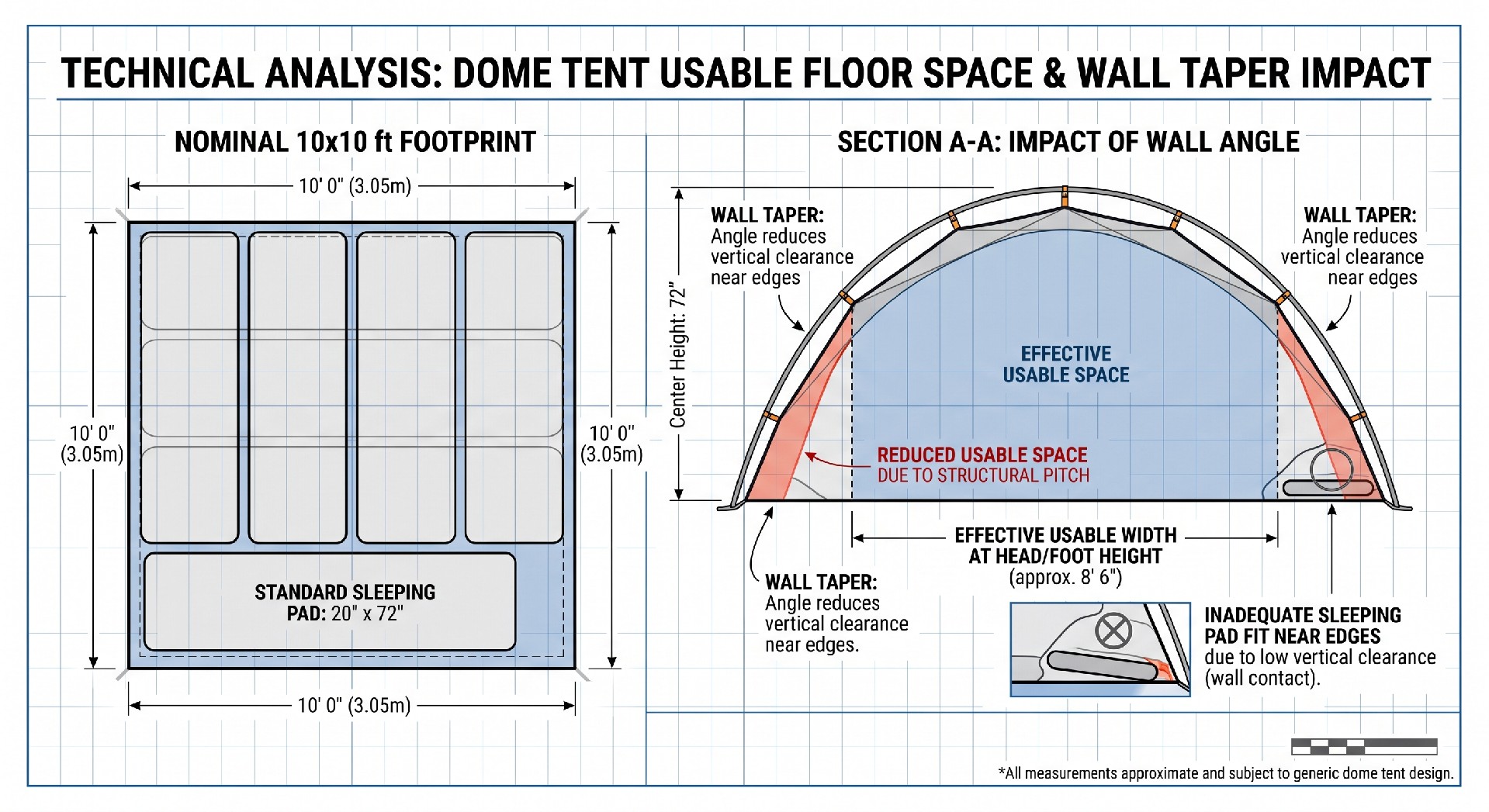
The stated floor dimensions often include the area under the fly or the awning. You need to measure the inner tent floor only. Check the tent's peak height and wall angles. A steep wall pitch reduces usable floor space near the edges, meaning a 10x10 ft footprint might only offer 80 sq. ft. of truly usable space at the sleeping mat level. This is a key specification to verify with your supplier before ordering a batch of 4-person tents for your fleet.
Gear Storage and Vestibule Dynamics
In a commercial setting, gear storage is as important as sleeping capacity. For a 4-person rental, you need to account for at least four 70L backpacks, boots, and cooking equipment. If the tent lacks a large vestibule (at least 15-20 ft²), that gear comes inside. This reduces the actual sleeping space further and increases the risk of damage to the tent floor. For commercial tents, look for designs with a separate gear loft or a large canopy vestibule to keep the interior clear.
| Tent Rating | Typical Floor Area | Actual Comfortable Capacity | Commercial Recommendation |
|---|---|---|---|
| 2-Person | 30-35 ft² | 1 Adult + Gear | Buyer's choice |
| 4-Person | 56-64 ft² | 2 Adults + Gear | Not ideal for 4 adults |
| 4-Person (Large) | 68-75 ft² | 3 Adults | Good for 2 adults + 2 children |
| 6-Person | 80-90 ft² | 4 Adults + Gear | Recommended for 4 adults |
Structural Geometry and Sleeping Pad Layout
The physical shape of the tent dictates how many sleeping pads fit on the floor. A standard 20-inch wide sleeping pad requires a specific layout. In a rectangular 4-person tent, four pads fit side-by-side. However, if the tent has a tapered or dome shape, you may only fit three pads comfortably, with the fourth forced into a smaller wedge. This is a common complaint in rental tents, as guests expect to fit their standard pads. When specifying a commercial 4-person tent, request a floor plan showing a 20-inch x 72-inch pad layout. This ensures the tent truly fits four sleeping systems without overlap or cramping.
The Impact on ROI and Turnover
For a rental operator, the inefficiency of a cramped tent adds up. Setup time increases as guests try to organize cramped interiors. Takedown is slower, and the risk of accidental damage from packed gear is higher. More importantly, a cramped tent leads to shorter booking lengths as guests prefer larger cabins. By specifying a 5-person tent for a group of four, you increase the floor area to around 75 ft², which gives a comfortable 18.75 ft² per person. This slight increase in tent size costs marginally more but significantly improves guest experience and reduces tent wear and tear.
[IMAGE_2]
Weather Performance and Occupant Comfort
Overcrowding a tent has a direct impact on condensation management. A 4-person tent is designed for a specific airflow and moisture evaporation rate based on four adult occupants. When four people are crammed into a space designed for two, the heat and moisture output increases dramatically. This leads to heavy condensation on the inner fly, which drips onto sleeping bags and gear. To mitigate this, commercial buyers should prioritize tents with adequate cross-ventilation, such as high-low vents, rather than just relying on the person capacity printed on the box.
Buyer Specification Checklist
When evaluating a 4-person tent for commercial use, use this checklist to ensure you are buying the right capacity.
Floor Area: Confirm the inner tent floor area is at least 60 ft² for a 4-person rating.
Pad Fit: Verify a 20-inch x 72-inch sleeping pad fits in each designated sleeping zone.
Vestibule Space: Ensure there is at least 15 ft² of covered vestibule space for gear.
Peak Height: A peak height of at least 48 inches allows for comfortable movement and reduces the cramped feeling.
Ventilation: Check for high and low ventilation panels to manage condensation.
Seam Construction: Ensure taped seams are present on all load-bearing points to prevent leaks in rain.
Final Decision: What to Order
For a rental fleet, we recommend labeling your 4-person tents as "2-3 Person" to set accurate expectations. If you need to comfortably sleep four adults, order a 5-person or 6-person tent. The cost difference is minimal compared to the operational headaches of complaints, returns, and damage. For resorts or glamping operations, always size up one level. A 4-person tent is a good shelter for a couple, but it is a poor investment for a family of four. Use this guideline to make a data-driven purchasing decision and improve your commercial ROI.
