

The Side Sleeper Sleep System Challenge
For side sleepers, a standard rectangular or restrictive mummy sleeping bag often leads to a familiar problem: the insulation compresses under the shoulder and hip, the bag rotates overnight, and the zipper or hood creates pressure points. This is not simply a comfort preference. When insulation is compressed, its thermal resistance (R-value) drops dramatically. The occupied volume required to maintain loft is directly at odds with the reduced internal volume and narrower cut of many standard bags. For commercial buyers—whether outfitting a lodge, stocking a rental fleet, or sourcing for a private-label brand—specifying a sleeping bag that genuinely accommodates side sleepers means moving beyond weight and temperature rating to evaluate internal girth, draft prevention, and the recovery behavior of the fill.
This guide focuses on the structural and material choices that determine suitability for side sleepers. We will address the specific commercial considerations for hotels, adventure tour operators, and equipment suppliers who need reliable performance across diverse body types and sleeping positions.
What Defines a Sleeping Bag as Side-Sleeper Friendly?
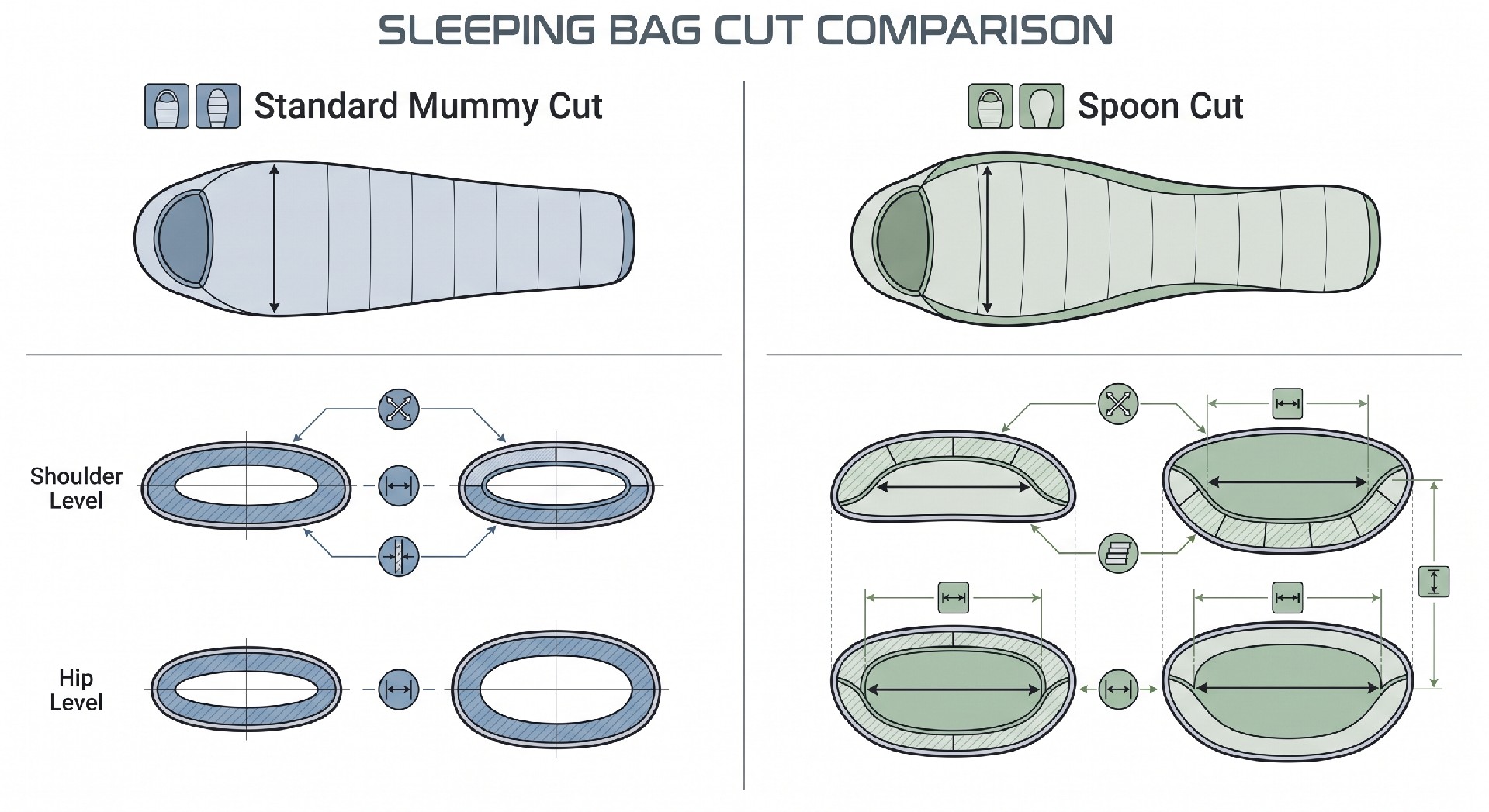
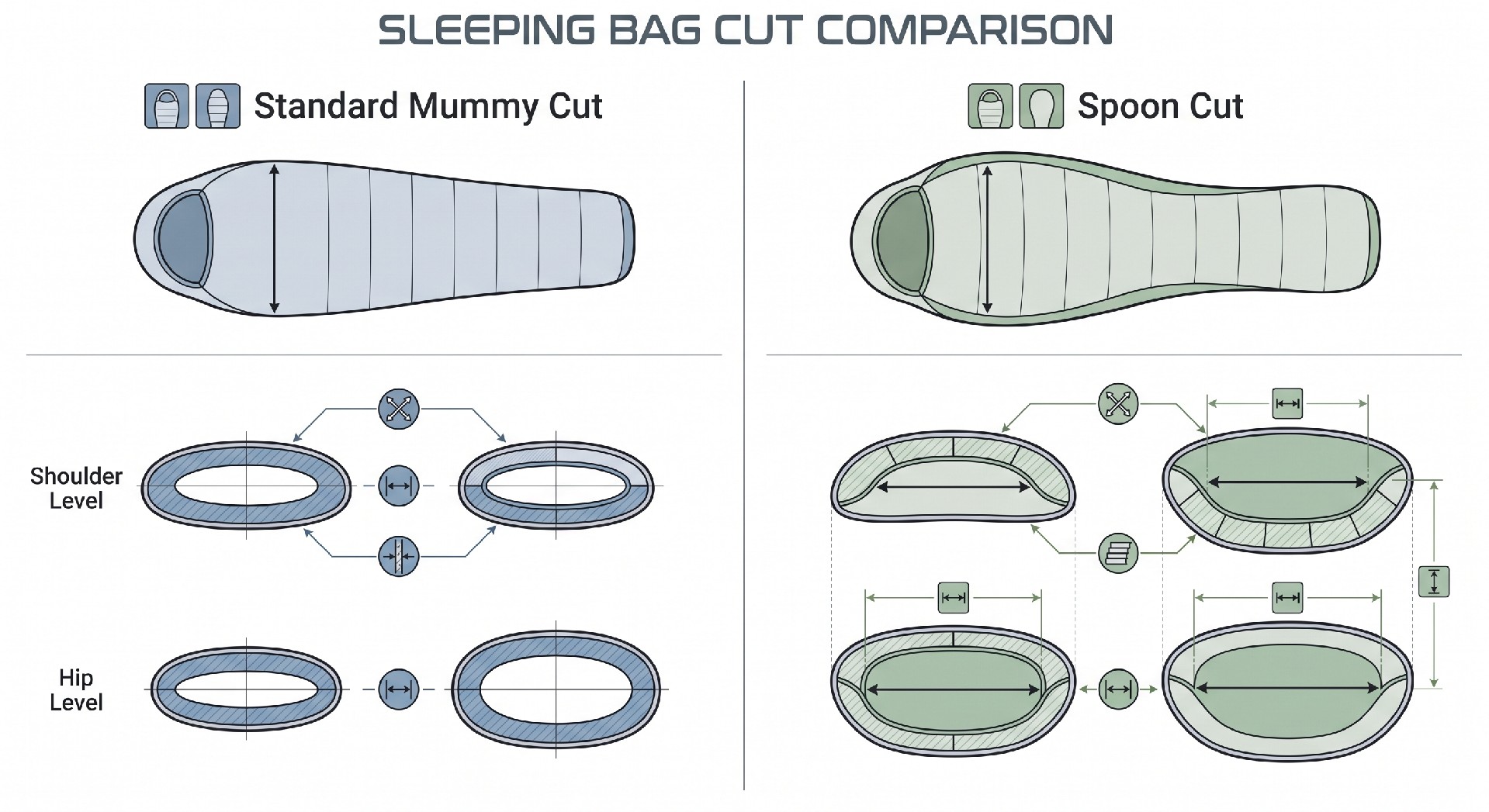
A sleeping bag is considered suitable for side sleepers when its design allows the user to shift from back to side without losing thermal efficiency or creating uncomfortable pressure points. The key difference is not just width, but cut geometry and the fill distribution. Unlike back sleepers who require a relatively flat profile, side sleepers need extra volume in the hips, knees, and shoulders. This means the bag must have a differentiated shape—often a ‘spoon’ or ‘barrel’ cut—rather than a uniform tube. The internal circumference at the torso and footbox must allow the knees to bend naturally and the shoulders to rotate forward without exposing the back or neck to cold air.
Key Anatomical Considerations
Shoulder and Hip Girth: The bag must provide 61-71 cm (24-28 inches) of girth at the shoulders and similar dimensions at the hips to allow lateral movement. This prevents the ‘tent effect’ where the bag lifts off the body.
Footbox Shape: A vertical or asymmetrical footbox allows side sleepers to keep their feet stacked comfortably, which is more natural than having feet forced flat.
Draft Collar and Hood: The collar must be adjustable but also flexible enough to accommodate a head turned to the side. A fixed, tight hood that forces the face straight ahead is a primary source of discomfort for side sleepers.
Architecture and Fill: The Interplay of Shape and Material
Simply adding extra width is insufficient. If the fill (down or synthetic) is not adequately baffled to stay in place when the user rolls, the down will shift, and synthetics will compress, creating cold spots. The construction of the shell and the internal baffle system is critical.
Shell Construction and Cut Types
Mummy Cut: Generally unsuitable for most side sleepers due to its restrictive 50-56 cm shoulder girth. This cut minimizes pack size but sacrifices sleep quality for this demographic.
Spoon Cut: This is the optimal commercial choice. It adds 10-15% more girth around the hips and knees compared to a standard mummy, preserving the slightly tapered footbox while allowing natural movement.
Rectangular Cut: While providing maximum space, these bags are inefficient for warmth-to-weight. They require higher fill weights to achieve a comparable temperature rating, making them heavier and bulkier. They are often suitable for car camping but less ideal for trekking scenarios.
Fill Types and Loft Retention
For side sleepers, fill “pull” or “recovery” is essential. When compressed at the shoulder and hip, the fill must spring back to maintain loft elsewhere. For commercial B2B considerations:
Down (Duck/Goose): Offers the best compressibility and loft recovery, often with a fill power of 650-850. However, the baffle design must be “multi-chambered” or “box-wall” to prevent down from migrating to the sides of the bag, leaving the top (or bottom) uninsulated. This migration is a common failure point in cheap down bags.
Synthetic (Hollow-fiber or Continuous Filament): Retains loft much better when wet and is often more uniform, but it is heavier and less compressible than down. For side sleepers, a “synthetic sheet” or “quilted” construction is preferred over loose fill, as it ensures the insulation stays on top of the user.
Pertex Quantum/Shield: Outer fabric choices with micro-ribbing or stretch can improve movement, but the primary factor remains the fill type and baffle construction.
Commercial Acceptance Criteria and Specifications
For procurement managers, a list of specification targets helps standardize evaluations across different brands.
| Specification Item | Commercial Target for Side Sleepers | Why It Matters | Verification Method |
|---|---|---|---|
| Shoulder Girth (Internal) | 61-66 cm (24-26 inches) | Allows shoulder rotation without compressing insulation | Verify via supplier's cut pattern and sample measurement |
| Hip/Knee Girth | 55-58 cm (22-23 inches) | Prevents the bag lifting off the hips and knees during lateral sleep | Check the spoon or anatomical cut against a standard mummy bag |
| Footbox Shape | Vertical/Asymmetrical | Allows natural foot stacking for side sleeping, reducing pressure | Inspect the footbox construction for defined space |
| Fill Type Target | Down (650+ FP) or Synthetic Sheet | Down offers best loft recovery at shoulder/hip pressure points | Supplier lab report on fill weight and baffle design |
| Draft Collar Type | Wraparound with elastic cinch | Prevents drafts from the neck area when the head is turned | Check for an insulated fill behind the collar |
| Zipper Action | Anti-snag #5 or #8 with full draft tube | Ensures durability and prevents the zipper from opening under rolling stress | Test zip under lateral pressure |
| EN/ISO Comfort Rating | Use Comfort (not Limit) rating minus 5°C | Accounts for side sleeper compression on insulation vs. the back-sleeping test manikin | Reference the ISO 23537-1 certification for derating |
Temperature Ratings: A Complex Equation
The EN (European Norm) 13537 or ISO 23537-1 temperature rating system is typically established using a manikin sleeping on its back on an insulated pad. A bag rated to 0°C for a back sleeper may feel significantly colder for a side sleeper because their back, shoulders, and knees experience higher compression on the pad. For commercial applications, we recommend derating the bag by 5-8°C for side sleepers. A ‘comfort’ rating for a woman (often a side-sleeping demographic) is usually more representative than a lower limit rating. For B2B buyers, prioritize the “Comfort” temperature over the “Extreme” or “Limit” ratings when outfitting for comfort.
Pad Compatibility
A sleeping bag for side sleepers must be paired with a sleeping pad with a sufficient R-value (minimum 3.0-4.0 for three-season use). The bag should feature “pad loops” or an “integrated sleeve” to prevent the user from rolling off the pad during the night. This is a critical commercial oversight; if the user rolls off, they lose insulation from the ground and complain of a cold bag, even if the bag is technically sound.
Draft Prevention and Zipper Design
For side sleepers, drafts are a constant risk due to the pressure placed on the zipper. A “back to back” or “two-way” zipper system is recommended to allow foot ventilation without fully unzipping. However, for side sleepers, a draft tube behind the zipper is non-negotiable. The tube must be adequately filled (typically with synthetic fill that won't compress) to withstand the weight of the shoulder rolling onto the zipper.
Left vs. Right Zip: Ensure consistency in your fleet. If you manage a rental fleet, standardizing on a single zipper side can cause issues for couples wishing to zip bags together. For B2B purchases, specifying a “zip together” compatibility system between different models offers commercial advantage.
Hook and Loop (Velcro) Tabs: Many modern bags lack these, but for side sleepers, a tab at the neck prevents the zipper from sliding down accidentally overnight, which is a primary cause of drafts. Verify this detail on the specification sheet.
Zipper and Closure Hardware
The mechanical reliability of the zipper is critical. For commercial fleets, “YKK” is the benchmark. However, a heavy #10 zipper is overkill and adds weight; a #5 or #8 YKK is standard. The “anti-snag” zipper webbing is crucial for wear and tear, especially when side sleepers are rolling in and out of the bag. A gusset at the foot allows the bag to expand with foot movement, reducing stress on the zipper line. Fleets should specify a zipper length of at least 70% of the bag's length for adequate ventilation.
Commercial Impact: Hygiene and Care
Side sleepers tend to “live” in their bags longer, leading to higher moisture and dirt accumulation in the hip and shoulder zones. For commercial operators, this means specifying a bag with a shell that is easily washed (synthetic) or a detachable liner.
Warranty and Repairability: A bag designed for side sleepers will experience more stress on the zippers and seams due to rotational movement. Check the warranty terms on the seams and zippers.
Pack Size vs. Inflation: Side sleeper bags often have a larger pack size than mummy bags. For resorts that provide bedding, this is less critical, but for trekking operators, the extra volume must be accounted for in the client’s load.
The Final Decision: Supplier Selection
When you have verified the cut and fill specifications, the final commercial test is the “Test Sleep.” For bulk procurement, request a sample bag and have a team member (or a selection of body types) test it overnight. This prevents the common error of relying solely on a “comfort rating” printed on the packaging. The bag must allow the user to rotate through 90 degrees (from back to side) without causing the hood to pull, the zipper to gap, or the pad to slide. If you are sourcing for a private-label brand, providing a clear “Side Sleeper Specification Sheet” (including the metrics in the table above) to the OEM is essential.
For commercial procurement, prioritize internal circumference over fill power. A high fill power rating is wasted if the baffles are simple horizontal tubes that allow the down to migrate to the sides, leaving only the nylon shell protecting the hip and shoulder. Choose a bag with vertical or multi-chambered baffles designed to hold insulation in place during movement.
Ultimately, the right camping sleeping bag for side sleepers is not a wider standard bag. It is a fundamentally different design, specifically optimized with a spoon cut, differential fill, robust baffles, and resilient fill materials to mitigate the specific compression points associated with lateral sleeping. By applying these criteria in your procurement process, you will reduce client discomfort, extend the service life of your equipment, and make decisions based on engineering realities rather than marketing temperatures.
