

Introduction: Why Water Temperature Testing Is a Non-Negotiable Safety Step for Baby Pools
For B2B buyers in the inflatable pool and containment sector—particularly those supplying resorts, daycare centers, or commercial aquatic facilities—the question of how to test inflatable pool water temperature for baby comfort is not a minor detail. It is a critical safety and liability control point. A baby's thermoregulation system is far less efficient than an adult's. Water that feels pleasantly warm to an adult can quickly become dangerously cold or uncomfortably hot for an infant, leading to distress, hypothermia, or scalding.
This guide is designed for commercial facility managers, resort buyers, and procurement teams who need a reliable, repeatable method for testing and verifying water temperature in portable inflatable pools intended for infant and toddler use. We will move beyond simple tactile checks to define a defensible testing protocol, explore appropriate measurement equipment, and examine how pool design factors—like volume, depth, and shade—affect temperature stability. This is a practical specification blueprint for ensuring safety and comfort, from initial fill to peak usage hours.
Understanding the Thermal Environment of a Small Inflatable Pool
Before we discuss how to test, we must understand the variables that make temperature management in an inflatable pool uniquely challenging. Unlike a permanent, in-ground pool with a circulation system and heater, a portable inflatable pool is a relatively small, shallow volume of water. This makes it highly susceptible to ambient temperature changes. On a sunny day, a 10-inch deep pool can warm several degrees per hour. Conversely, a sudden breeze or cloud cover can drop the temperature rapidly.
For the B2B market, the key design dimensions relevant to temperature are the water volume and total depth. A larger volume of water (e.g., a 1,000-liter pool versus a 200-liter pool) has greater thermal mass and will resist temperature changes longer. However, for baby pools, the volume is typically small. The wall height of the pool and the floor material also play a role; a pool with a thick PVC floor placed on cold concrete will lose heat more quickly than one on a warm, sunny lawn. The commercial consideration here is that you are not just buying a pool; you are buying a thermal system. Understanding this helps in selecting the correct pool size for the intended duration of use.
Selecting the Right Testing Equipment: Commercial vs. Consumer Grade
The primary search intent behind the keyword “how to test inflatable pool water temperature for baby comfort” is troubleshooting and problem-solving. The secondary intent is establishing a safe workflow. The choice of testing equipment is the first decision. For commercial applications, a standard consumer-grade float thermometer is often insufficient. Its accuracy can drift, it is easily damaged, and its response time—how quickly it registers the water temperature—is slow. In a commercial setting where you may be filling and testing multiple pools, a slow response time is an operational bottleneck.
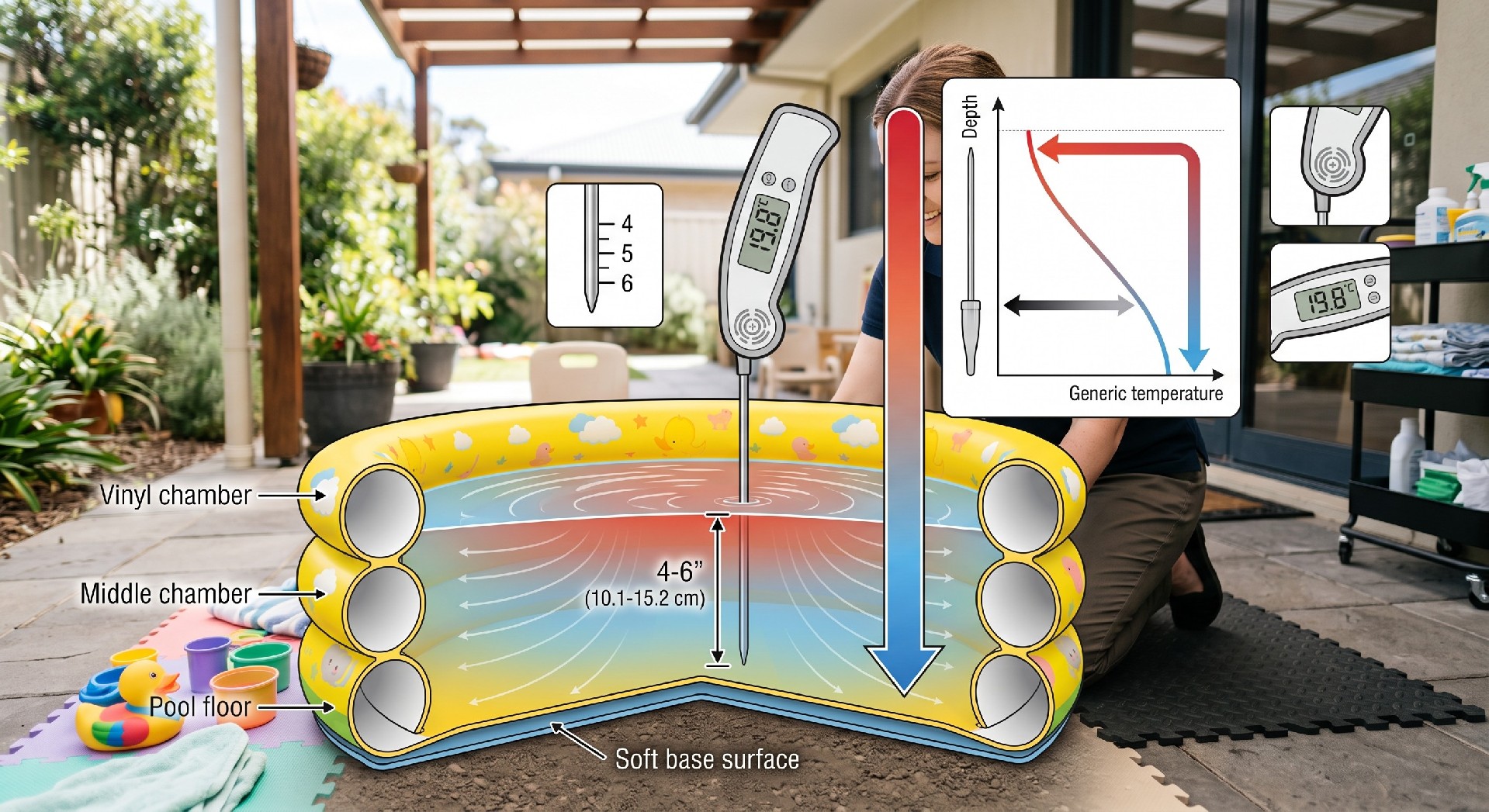
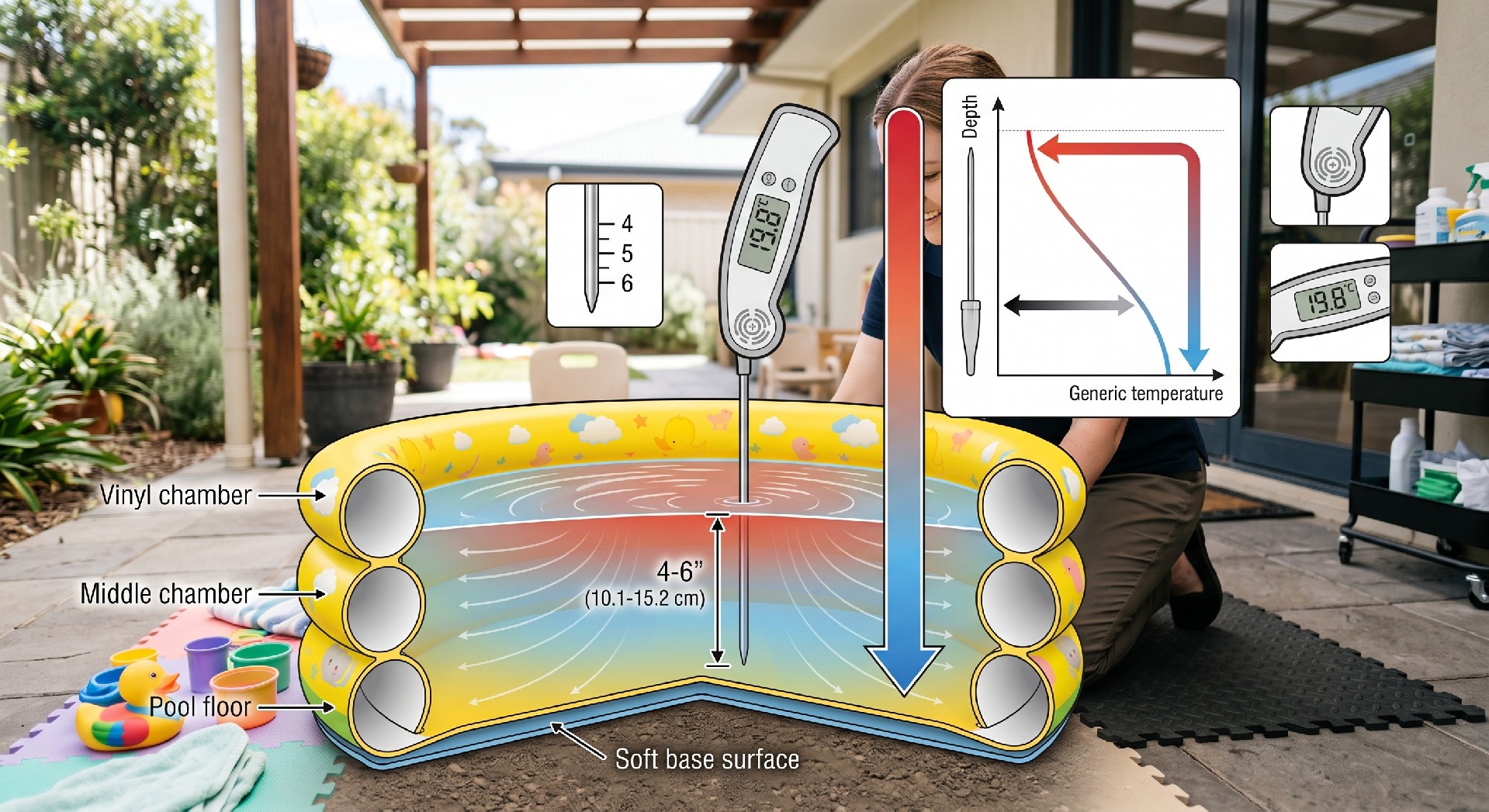
For a commercial facility, we recommend specifying an instant-read digital thermometer with a stainless steel probe. Look for models with an accuracy of ±0.5°F (±0.3°C). This is a common specification for food-service thermometers, and they translate well to pool testing. The benefit is threefold: speed (reading in under 5 seconds), precision, and the ability to test multiple points in the pool (surface, middle, bottom). The probe’s length (typically 4-6 inches) is adequate for the shallow depths of a baby pool. Crucially, ensure the device has an IPX7 or higher water-resistance rating to survive incidental splashes.
Infrared Thermometers: A Useful Tool with a Major Limitation
Infrared (IR) thermometers are popular because they are fast and non-contact. They measure the temperature of the water's surface. However, for a baby pool, this is a significant limitation. The surface temperature can be several degrees warmer than the water at a baby's depth, especially if the pool is in direct sunlight. Relying solely on an IR thermometer could lead you to believe the water is safe when the actual temperature at depth is cooler. An IR thermometer is best used as a quick screening tool to spot abnormal temperatures, but it must be validated with a probe thermometer for an accurate reading at the 4-6 inch depth where a seated baby would be immersed.
Defining an Actionable Temperature Protocol
A simple temperature test is not just a one-time action; it is a protocol. For a commercial buyer, the protocol must be documented, repeatable, and defensible. We recommend the following sequence as a minimum standard:
Step 1: Pre-Placement Check: Before filling the pool on the designated surface, measure the surface temperature. A hot concrete surface can rapidly heat water from below. If the surface is above 90°F (32°C), consider using an insulating mat under the pool.
Step 2: Initial Fill Verification: Once the pool is filled, let the water settle for 2-3 minutes to allow for mixing, as the incoming hose water may be a different temperature. Then, insert the probe into the center of the pool at a depth of roughly 4-6 inches. Record this as the starting temperature.
Step 3: Zonal Testing: Move the probe to the shallow end (if the pool has an incline) and to the edge closest to the sun. Record readings from each zone. Temperature variation across the pool of more than 2°F indicates poor circulation or uneven heating and is a risk factor.
Step 4: Operational Monitoring: For pools used continuously for more than 30 minutes, we recommend a temperature check every 15-20 minutes. The frequency should be increased if the ambient temperature is changing rapidly (e.g., a partly cloudy day).
This protocol turns an abstract safety concept into a tangible operational task. For the commercial operator, this is the difference between a subjective check and a recorded compliance measure.
What is the Optimal Temperature Range?
Defining the “comfortable” range is the core of the buyer’s decision. Medical and pediatric guidelines generally recommend a water temperature of 87°F to 94°F (30.5°C to 34.4°C) for infants and young children. This range minimizes the risk of cold shock and overheating. It is vital to be strict with the upper and lower limits. Water below 87°F can cause rapid heat loss in a baby, leading to shivering and blue lips within minutes. Conversely, water above 95°F (35°C) can lead to lethargy and overheating. For commercial liability, we advise setting a protocol that treats the threshold of 87°F and 94°F as hard limits. If the pool is outside this range, it should not be used until the temperature is adjusted by adding hot or cold water, or by waiting.
| Decision Factor | Commercial Target for Baby Pool | Why It Matters | Buyer Check |
|---|---|---|---|
| Water Temperature (Probe Test) | 87°F – 94°F (30.5°C – 34.4°C) | Maintains thermal comfort and prevents hypothermia or overheating. This is the primary safety metric. | Calibrate thermometer weekly. Test at 4-6 inch depth in multiple zones. |
| Temperature Variation | < 2°F (1°C) across the pool | Excessive variation indicates poor water mixing and creates hot/cold spots, increasing discomfort risk. | Test at shallow/deep ends and sun/shade edges. If variation > 2°F, agitate water manually or wait for thermal equilibration. |
| Testing Frequency (Continuous Use) | Every 15-20 minutes | Small water volumes change temperature rapidly. Frequent checks are the only way to ensure consistent safety. | Assign staff a timed rotation for checks. Log all readings. |
| Ambient Surface Temperature | < 90°F (32°C) under the pool | A hot floor (concrete/deck) acts as a heater from below, skewing the water temperature and potentially causing localized hot spots. | Use an IR thermometer to scan the floor. Place insulating mats or foam tiles under the pool if the surface is too hot. |
| Equipment Accuracy | Accuracy: ±0.5°F (±0.3°C) or better | Inaccurate equipment invalidates the protocol. A ±2°F drift could make an unsafe pool seem safe. | Specify and use only instant-read thermometers with a current calibration certificate. Perform an ice-water check weekly. |
Calibration and Maintenance of Testing Equipment
An often-overlooked aspect of the testing protocol is the verification of the testing tool itself. A digital thermometer can drift out of calibration over time. We recommend a simple two-point verification method: an ice-water bath and boiling water. The ice-water bath should read 32°F (0°C), and boiling water should read 212°F (100°C) at sea level. If the readings are off by more than ±1°F, the device needs recalibration or replacement. Include this verification step in your weekly safety checklist. From a product designer’s perspective, specifying a thermometer with an easy recalibration feature (usually a small dial or push-button) is a smart buy for a rental or facility fleet.
Compliance and Documentation for B2B Buyers
For resort or facility buyers, the ability to document temperature checks is not just a courtesy; it's often a requirement for liability insurance. A simple log sheet with timestamps, pool location, temperature reading, and the staff member’s initials provides a robust audit trail. This documentation is critical in the event of an incident. It shows a “duty of care” was exercised. When selecting a pool, consider the ease of access for testing. A high wall height can make it difficult to reach the center of the pool with a thermometer. For a commercial setting, look for a pool design where the center is easily accessible or consider a probe with a longer cord. This is a subtle but important commercial specification.
Environmental Factors and Pool Placement
How you test is only half the equation; where you place the pool dramatically affects how you test. A pool in direct sunlight will require more frequent testing and may often be too warm. A pool in full shade might struggle to reach the minimum comfortable temperature on a cool day. The ideal placement is a location that receives partial shade or is shielded from direct wind. For commercial installers, this means having a placement plan before the pool arrives. Remember, the water temperature is a dynamic value. The test is a snapshot in time. The commercial decision is not just testing the water, but also managing the environment to keep the water in the safe zone. This could involve adding shade sails or scheduling fill times to align with optimal daily temperatures.
Final Recommendation: A Hybrid Workflow for Temperature Assurance
For commercial operators, the most effective workflow is a hybrid approach. Use an IR thermometer for rapid, frequent surface screening. This allows a single staff member to check multiple pools quickly. However, any pool that registers at 89°F or 93°F on the IR scanner should be verified with a probe thermometer at depth. This saves time while maintaining accuracy. The probe thermometer should be considered the “source of truth” for the official log.
Ultimately, the question of how to test inflatable pool water temperature for baby comfort is solved by defining a clear, measurable, and documented process rather than relying on the subjective feel of the water. The correct method is to invest in reliable equipment, standardize the testing protocol, and train staff to treat temperature limits as non-negotiable safety barriers. For the B2B buyer, the pool itself is just the vessel; the real value is in the safety system that surrounds its operation.
