

The Financial Case for UV Protection Spray in Commercial Outdoor Gear
For B2B buyers managing fleets of outdoor equipment—from inflatable paddleboards and kayaks to heavy-duty marine platforms and shelter systems—ultraviolet degradation is a predictable, measurable expense. UV radiation causes photodegradation of polymer-based materials like PVC, TPU, and Hypalon/CSM, leading to surface chalking, reduced tensile strength, and eventual failure of seams and coating layers. A UV protection spray, applied as a surface treatment, can reduce this degradation rate by roughly 50% over a typical commercial season. This translates to doubling the effective lifespan of many outdoor assets, shifting the replacement cycle from 3-4 years to 6-8 years for items with moderate UV exposure. The calculation is straightforward: a well-selected, properly applied UV protection spray is not a luxury or an afterthought; it is a lifecycle-cost control measure with a demonstrable ROI.
Defining the Enemy: How UV Radiation Damages Commercial Outdoor Equipment
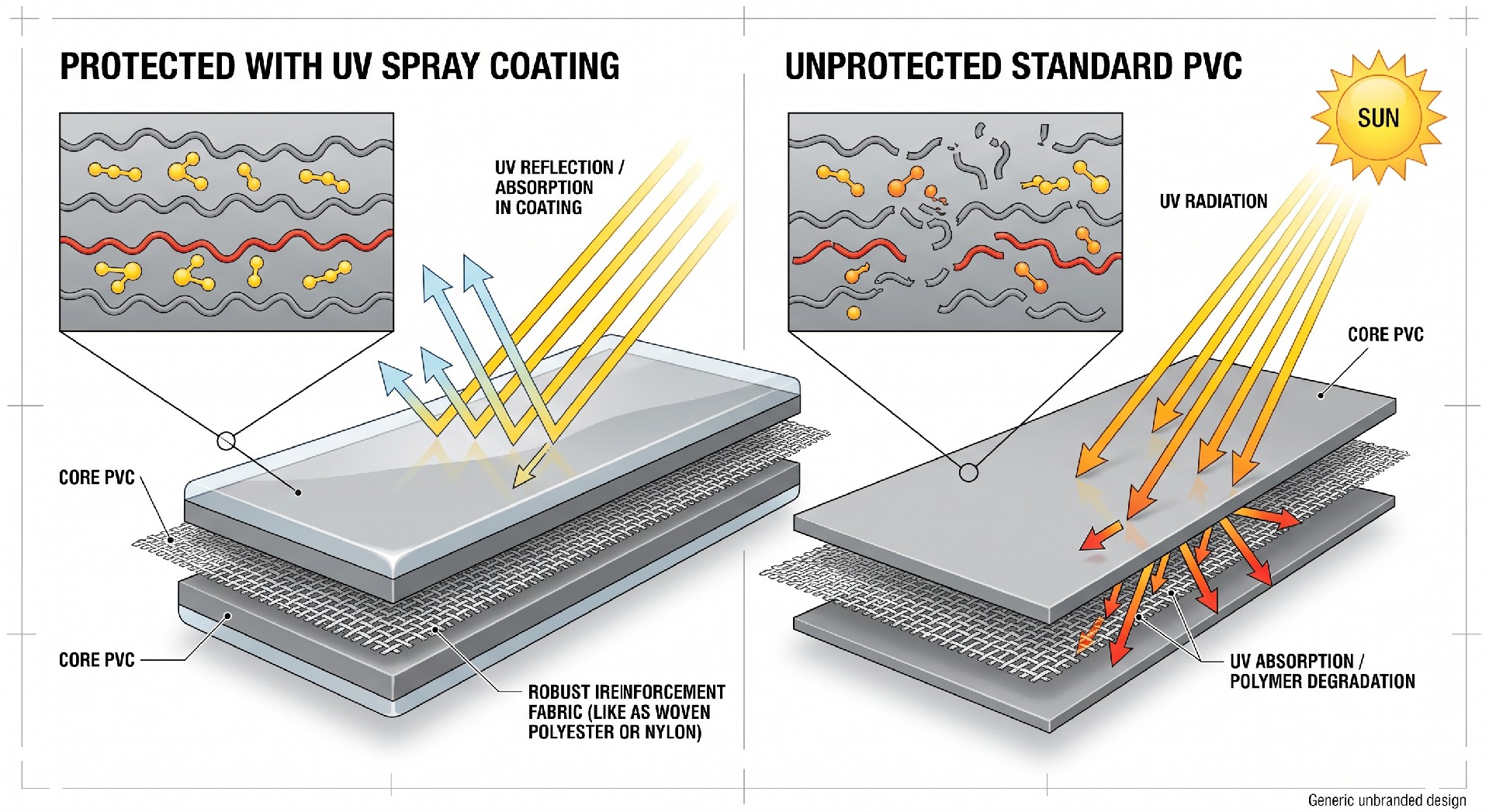
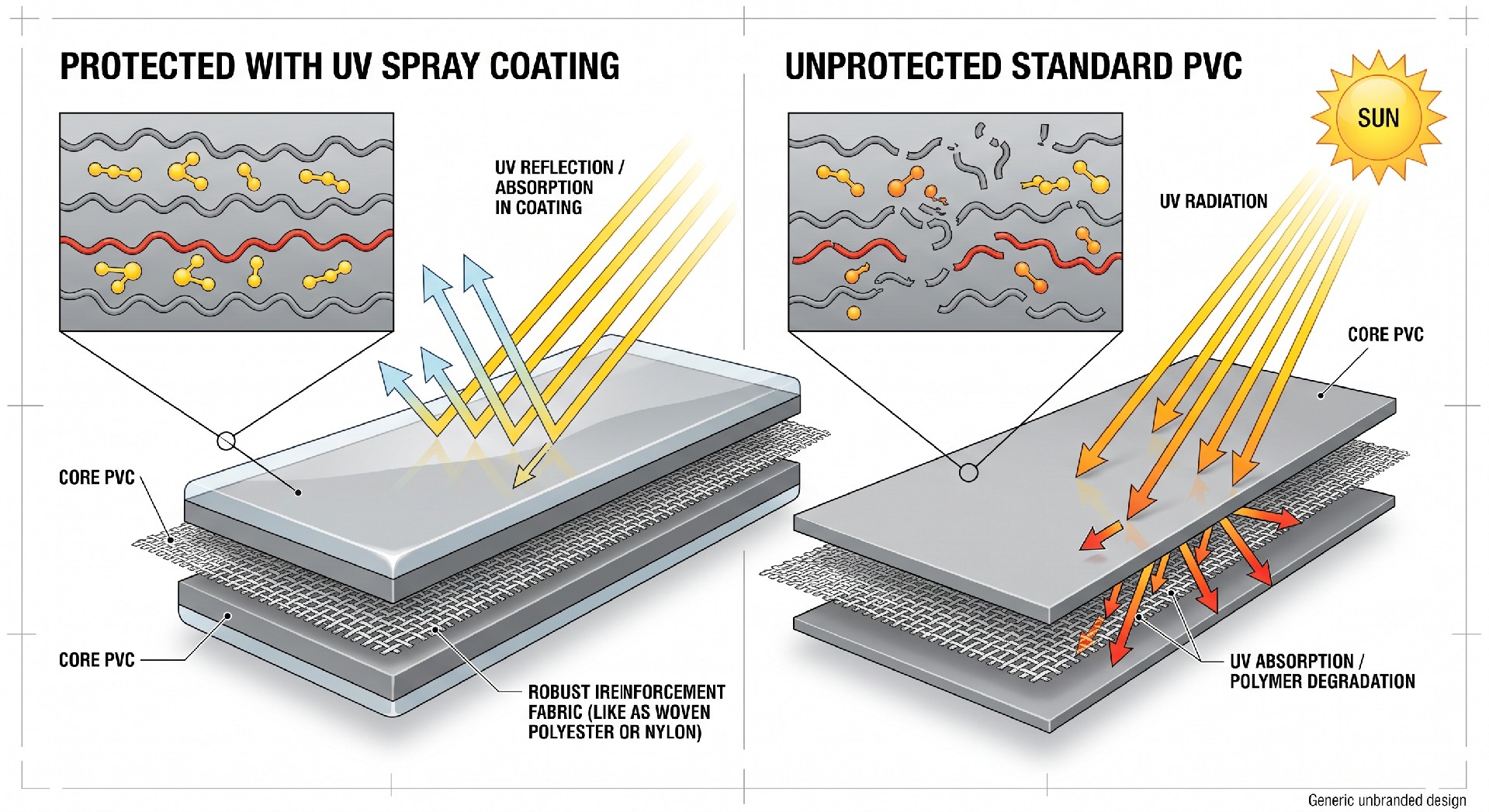
Sunlight is not uniform in its destructive capacity. Ultraviolet A (UVA) and ultraviolet B (UVB) radiation catalyze oxidation reactions within the polymer matrix of common outdoor gear fabrics and coatings. For materials like PVC (polyvinyl chloride) and TPU (thermoplastic polyurethane), this reaction breaks carbon-chlorine and carbon-hydrogen bonds. Over time, the material loses plasticizers—the compounds that keep it flexible—leading to stiffness, micro-cracking, and a visible chalky residue on the surface. For Hypalon/CSM (chlorosulfonated polyethylene), UV exposure causes cross-linking and surface hardening, which reduces the material's ability to flex and absorb impact. The cumulative effect on an inflatable watercraft, for example, is not merely cosmetic. A UV-weakened tube is more prone to puncture from minor abrasion, seam tape adhesive degrades, and the material's tensile strength can drop by 30-40% in a single season of constant exposure. This degradation is often uneven, concentrating on the upper surfaces of the gear, which complicates repair efforts and often forces premature replacement of the entire assembly.
The Photodegradation Timeline Under Commercial Use
While the exact rate depends on specific material composition, UV intensity, and environmental conditions, a typical commercial timeline is consistent enough to plan around. For a fleet of rental SUPs stored outdoors in a moderate climate, the surface material will begin to show signs of gloss loss within 30-60 days of continuous exposure. After 90 days, micro-cracks may appear, and by the end of a single season, the material's surface integrity is significantly compromised. For a marine platform that remains deployed in a marina environment, the degradation can be even more rapid due to the combined effect of UV and saltwater immersion, which accelerates the leaching of stabilizers from the material. UV protection spray acts as a sacrificial shield, absorbing or reflecting UV radiation before it can initiate the degradation process. The benefit is not just in preserving the surface; it is in maintaining the material's mechanical properties for a longer period, allowing commercial buyers to operate the equipment at its designed performance level for longer.
Product Class and Specific Application: A Focus on Inflatable Watercraft
For this analysis, the product class is inflatable watercraft, including SUPs, kayaks, and small rafts. These are among the most UV-exposed items in a commercial rental fleet or resort inventory. They are stored outside, transported on roof racks, and used in direct sunlight on water, which reflects UV rays, effectively doubling the exposure on the underside of the board. The financial impact of UV degradation on this class is acute. A single high-quality inflatable SUP represents a capital investment of several hundred to over a thousand dollars. Replacing a fleet of 20 boards every three years represents a significant and recurring cost. The application of a UV protection spray—a process that costs between $5 and $15 per board and takes 10-15 minutes—can extend that replacement cycle to six years, effectively halving the annualized depreciation cost. This is a primary driver for rental operators and resort buyers, who often operate on tight margins and need to maximize asset longevity.
Material Composition and UV Resistance: PVC, TPU, and Hypalon
The effectiveness of a UV protection spray can vary with the base material. Standard PVC is a popular material for its cost-effectiveness and ease of repair, but it is inherently more susceptible to UV degradation than TPU or Hypalon/CSM. UV protection sprays formulated with Hindered Amine Light Stabilizers (HALS) or benzotriazole-based UV absorbers are particularly effective on PVC, as they can replenish the stabilizers that are depleted during UV exposure. TPU, often used for its excellent abrasion and tear strength, also benefits from UV sprays, though the spray's compatibility with the polyurethane base is critical. Hypalon/CSM is generally more UV-resistant than PVC or TPU; however, it is not impervious. A UV protection spray can significantly extend its already good UV resistance, making it an excellent choice for a proactive maintenance strategy in any commercial fleet. It is important to verify the spray's compatibility with the specific material of the equipment. A spray designed for PVC may not be suitable for TPU, and vice versa. Commercial buyers should always cross-reference the spray's manufacturer specifications with the equipment's material datasheet.
Commercial ROI: Calculating the Lifecycle Savings
The financial case for integrating UV protection spray into a maintenance schedule hinges on simple but impactful arithmetic. Consider a rental fleet of 30 inflatable kayaks, with an average purchase cost of $800 per unit. The total fleet capital expenditure is $24,000. Without a UV protection protocol, the expected service life, given typical outdoor storage and daily use, is approximately four years. This means the fleet requires replacement every four years, costing $24,000 per cycle. Over a 12-year horizon, this is three replacement cycles, for a total capital cost of $72,000. If a UV protection spray application is introduced, performed twice a season at a cost of $10 per application per kayak, the service life can be extended to eight years. The spray costs for the fleet are $30 (kayaks) x $10 (cost) x 2 (applications per season) x 8 years = $4,800. The number of replacement cycles over 12 years drops to 1.5 (purchasing 30 units at year 0 and 15 units at year 8), yielding a total capital cost of $24,000 (initial) + $12,000 (replacement) = $36,000. Adding the spray cost, the total lifecycle cost is $40,800, compared to $72,000 without it. This represents a direct savings of $31,200, or a 43% reduction in total lifecycle cost. This calculation underscores that the spray is not an expense but a highly effective cost-control measure.
| Cost Driver | Without UV Spray (4-Year Cycle) | With UV Spray (8-Year Cycle) | Financial Effect |
|---|---|---|---|
| Initial Fleet Cost (30 Kayaks) | $24,000 | $24,000 | Same initial investment |
| Replacement Cost (Years 4 & 8) | $24,000 | $12,000 (Year 8) | Reduced capital outlay |
| UV Spray Cost (12 Years) | $0 | $4,800 | New controllable expense |
| Total 12-Year Capital Cost | $72,000 | $36,000 | $36,000 savings |
| Total 12-Year Lifecycle Cost | $72,000 | $40,800 | $31,200 total savings |
Application Protocol and Best Practices for Commercial Fleets
For a commercial operator, the application of UV protection spray must be systematic and efficient. The process typically involves cleaning the equipment to remove salt, dirt, and grime; allowing it to dry completely; applying the spray evenly to all exposed surfaces; and letting it cure. The cleaning stage is critical because dirt and salt can both degrade the material and reduce the spray's adhesion and effectiveness. A spray that is applied to a dirty surface will not adhere properly, and the underlying dirt will continue to abrade the material. The drying stage is equally crucial; applying the spray to a damp surface can trap moisture, which can lead to hydrolysis and material breakdown. The application itself should be performed in a well-ventilated area, away from direct sunlight, as the spray can evaporate too quickly if applied in hot, direct sun, reducing its coverage. For a fleet, the entire process can be integrated into a standard off-season or weekly maintenance routine. This is a low-labor, low-skill task that can be delegated to junior staff, making it a highly accessible and scalable maintenance practice.
Frequency of Application and Product Selection
The recommended application frequency is typically twice a season for equipment in active use—once at the beginning of the season and once at the midpoint—or at the intervals specified by the UV spray manufacturer. For equipment stored outdoors year-round, a more frequent application may be necessary, potentially every three months. The selection of the spray itself must be B2B-grade. Consumer-grade sprays may offer insufficient UV protection or may be incompatible with industrial materials. A commercial-grade spray should provide a clear, non-tacky, non-yellowing finish that does not alter the equipment's appearance or texture. It should also be formulated to be compatible with high-frequency welding and seam adhesives, as applying the spray to the seam area could, in theory, affect the adhesive bond if not fully cured. It is advisable to test the spray on a small, inconspicuous area of the equipment to check for any adverse reactions before applying it to the entire fleet. This is a standard precautionary step that any commercial buyer should implement.
Decision Checklist for Commercial Buyers and Fleet Operators
Integrating UV protection spray into a commercial maintenance strategy requires a clear decision framework. The following checklist is designed to guide the procurement and deployment of such a program, ensuring that the investment delivers the expected lifespan extension and financial return.
Material Compatibility: Verify the spray is explicitly formulated for the equipment's primary material (e.g., PVC, TPU, Hypalon/CSM). Check the spray's product datasheet for compatibility and test on a small area.
Frequency of Use: Assess the fleet's actual UV exposure. Equipment in constant direct sunlight requires more frequent applications. Plan for twice-a-season applications as a baseline.
Storage Protocol: UV protection spray works best as part of a comprehensive care package. Clean and dry equipment before storage and use a UV-protective cover if practical. The spray is not a substitute for proper storage but an enhancement.
Application Equipment: For fleets, a large-volume sprayer (e.g., a pump-style garden sprayer) can significantly speed up the application process compared to using individual aerosol cans. This reduces labor costs and ensures more consistent coverage.
Cost Benchmarking: Establish a clear per-unit cost for the spray application, including material and labor. This should be compared to the cost of replacing the fleet prematurely to determine the actual ROI.
Supplier Audit: When sourcing a UV protection spray, demand batch-specific quality control records and a clear material safety data sheet (MSDS). Verify the product's stated UV absorption capacity (e.g., percent blocking) through independent test data, if available.
Warranty Considerations: Some equipment manufacturers may specify compatible maintenance products. Check whether using a third-party UV spray could affect the equipment warranty. The spray manufacturer should also provide a guarantee of compatibility and performance.
The Lifecycle Management Verdict
For B2B buyers across all outdoor equipment categories—from rental fleets to resort operations and emergency services—a UV protection spray is a strategic acquisition. It is not a marketing gimmick but a proven engineering solution to a well-understood degradation mechanism. The direct financial outcome is an extended service life, which directly translates to delayed capital expenditures and a lower total cost of ownership. The operational benefit is a more reliable and longer-lasting asset base, reducing downtime caused by material failures. The decision is not about whether to use a spray but about which one to choose and how to deploy it effectively in a commercial setting. The best choices are those formulated with proven UV absorbers and light stabilizers, compatible with the specific material, and supported by transparent supplier documentation. In a commercial environment where every dollar counts, a UV protection spray is a high-ROI investment that demonstrably increases the lifespan and value of your outdoor equipment portfolio.
