

The Loft Preservation Problem: Why Storage Method Matters for Commercial Buyers
For rental fleet operators, outdoor equipment suppliers, and resort buyers, the question "What Is the Right Way to Store Sleeping Bags to Preserve Loft?" is not merely a matter of convenience—it is a direct determinant of asset lifespan and customer satisfaction. Loft, the thickness and fluffiness of a sleeping bag's insulation, is the primary driver of its thermal performance. Compromised loft leads to cold complaints, premature replacement, and increased operating costs. The correct storage protocol is a preservation strategy, not a housekeeping task.
Understanding Loft: The Commercial Performance Metric
Before specifying a storage protocol, buyers must understand what loft represents. Loft is the ability of the insulation material (down or synthetic) to trap dead air space, which creates a thermal barrier. For down sleeping bags, loft is measured in cubic inches per ounce (in³/oz), with commercial-quality fill powers typically ranging from 550 to 900+ in³/oz. For synthetic sleeping bags, loft is determined by the fiber structure and density, typically specified in grams per square meter (g/m²) for the insulation layer.
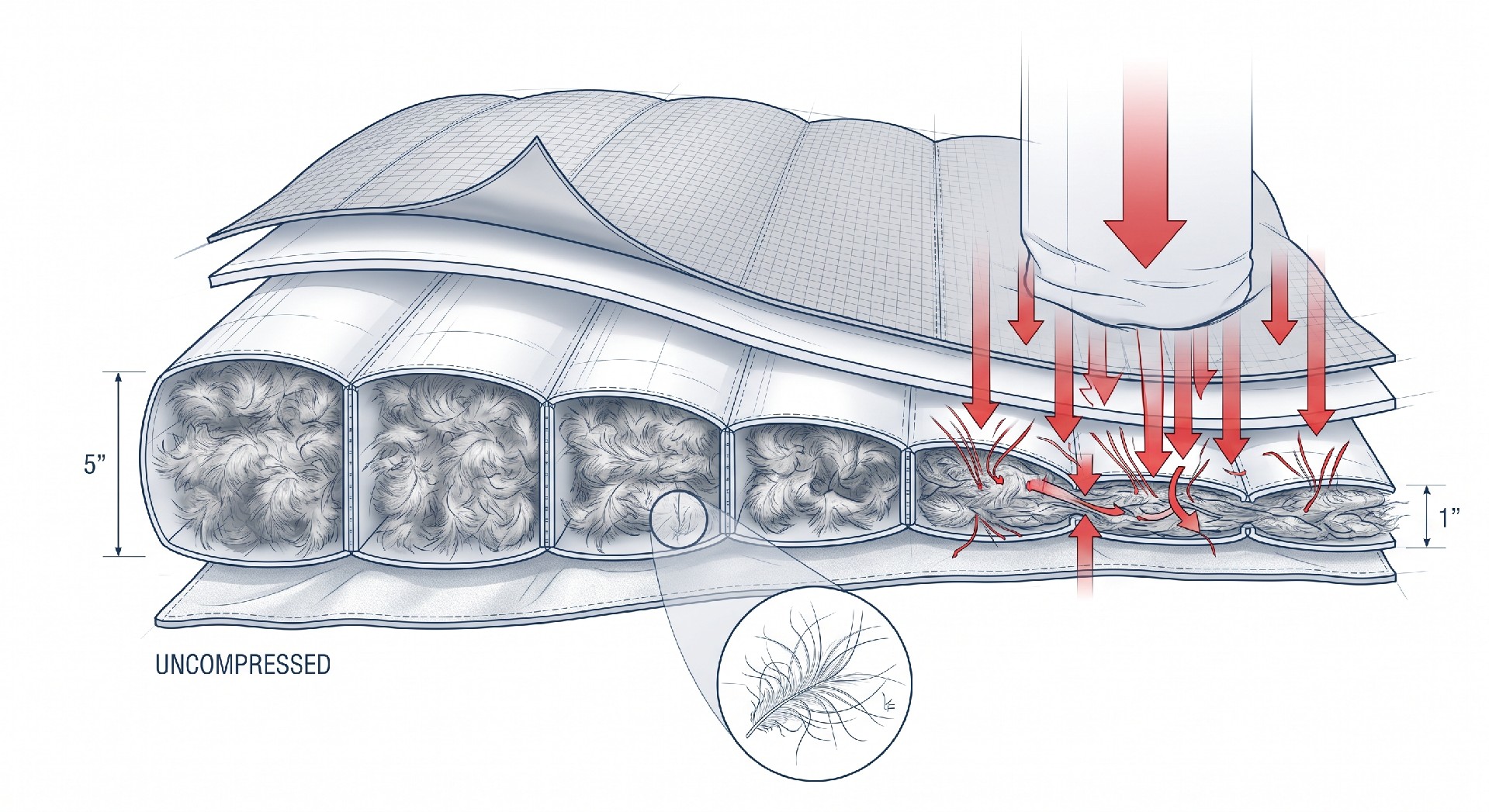
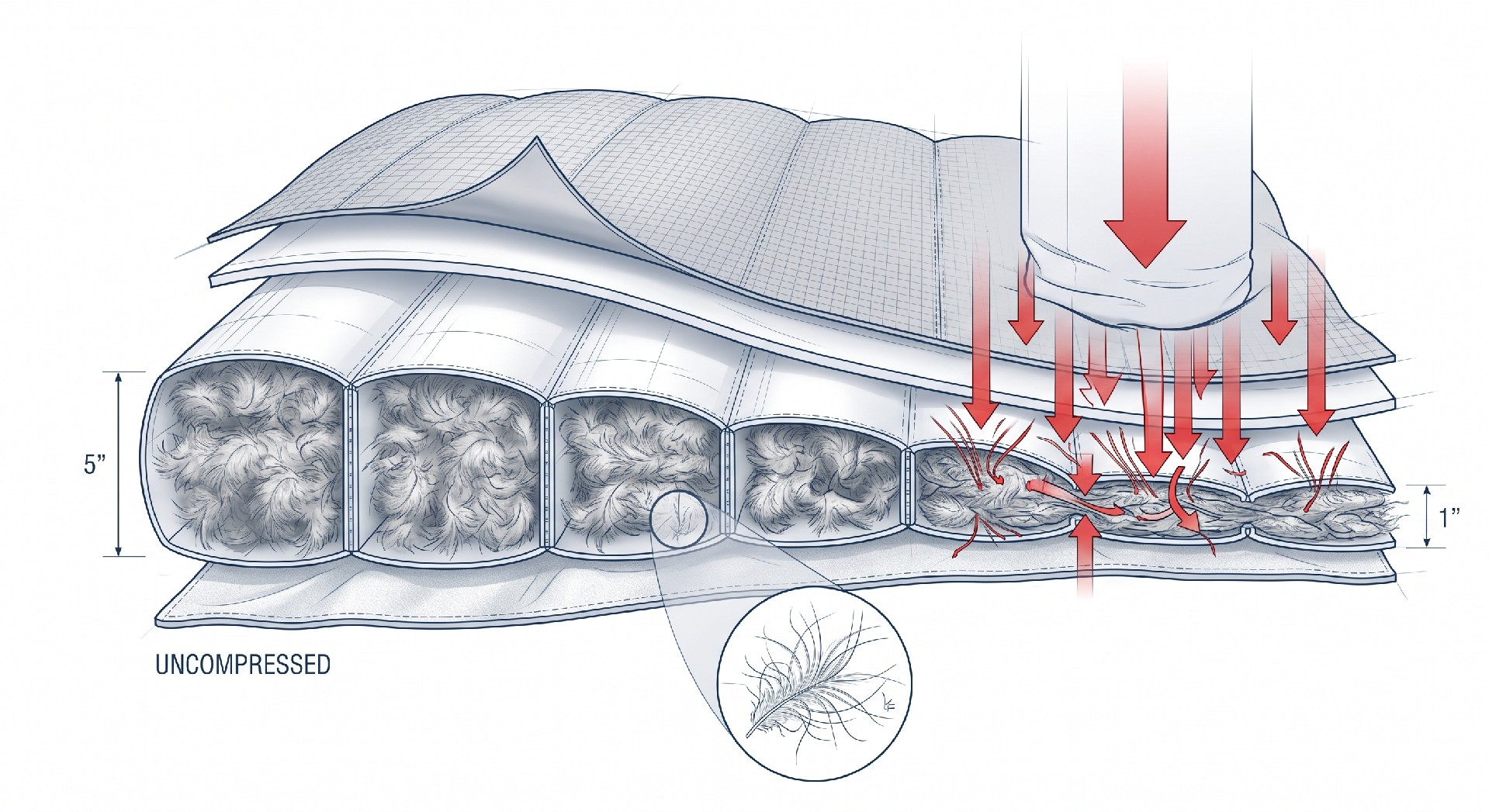
When a sleeping bag is compressed for extended periods, the insulation's structural integrity degrades. In down, the microscopic barbs on the plumage that create clumps and trap air become damaged or break. In synthetic insulation, the continuous filaments are crushed or snapped, reducing their ability to rebound. For a commercial operation, this translates to a predictable decline in the bag's temperature rating. A bag originally rated to 0°C may lose 5-10°C of comfort range after several seasons of improper storage, rendering it unsuitable for its intended application.
Compression Damage vs. Normal Use
It is important to differentiate between temporary compression from normal packing and permanent compression from long-term storage. A sleeping bag is designed to be compressed for transport; the fill material has a recovery time. However, when a bag is left in a compression stuff sack for weeks or months, the recovery capacity diminishes. The commercial threshold for safe compression is typically under 24-48 hours for storage conditions. For long-term storage (off-season, between rentals, or in warehouse inventory), the bag must be stored completely uncompressed or in a large cotton or mesh storage sack that allows the insulation to breathe and maintain its full volume.
Product Architecture: How Design Influences Storage
The storage protocol is not a one-size-fits-all approach. The bag's construction—continuous baffles, box baffles, offset quilting, or sewn-through construction—dictates how insulation migrates and settles. Box baffle constructions (common in high-end down bags) have a lower risk of cold spots but require uniform loft across all chambers. Improper storage can cause down to shift to one side of a baffle, creating thin areas that negate the design's thermal efficiency. Sewn-through construction (common in budget synthetic bags) has no baffles; the insulation is sewn directly through the shell and lining. While these bags are simpler to manufacture, they are inherently prone to compression damage because the insulation has no independent chamber to support its structure.
For rental fleet operators, the bag's face fabric also plays a role. Nylon and polyester ripstop fabrics are the industry standard. A higher denier fabric (e.g., 40D vs. 20D) offers better abrasion resistance but may also restrict the insulation's ability to fully loft because the fabric is heavier and less breathable. This is a design tradeoff to consider when specifying sleeping bags for high-turnover commercial environments.
Buyer Acceptance Criteria: Storage Protocol for Commercial Assets
To preserve loft and maximize commercial lifecycle, buyers should verify the following storage procedures with their operations team or suppliers:
Long-term storage: Sleeping bags must be stored loosely in large cotton, mesh, or breathable nylon storage sacks. The volume of the storage sack should be at least 2-3 times the volume of the bag when fully lofted to avoid any compression.
Short-term storage (between rentals): If a bag is not being immediately re-issued, it should be hung on a wide, padded hanger or laid flat on a shelf. Hanging allows for air circulation and prevents the insulation from settling at the bottom of the bag.
Avoiding common mistakes: Never store a bag in a compression stuff sack or its original compact packaging. Never store a bag under other heavy equipment or folded in a way that creates a sharp crease.
| Storage Method | Effect on Loft | Commercial Best Practice | Risk of Damage |
|---|---|---|---|
| Compression stuff sack (>48 hrs) | Permanent loss of fill power, reduced rebound time | Use only for transport, not long-term storage | High risk of requiring premature replacement |
| Loose cotton / mesh storage sack | Preserves full loft, allows moisture escape | Standard for off-season and warehouse storage | Minimal risk; monitor for dust accumulation |
| Folded and stacked horizontally | Causes localized compression at fold points | Not recommended for any duration | High risk of structural damage to the insulation layer |
| Hanging on narrow wire hanger | Can cause insulation to settle at the bottom | Use wide, padded hangers with a support bar | Moderate risk if hanger is not appropriate for the bag's weight |
| Stored damp or in humid environment | Clumping of down, mildew in synthetics | Store in climate-controlled environment (15-25°C,<50% RH) | Critical risk; may cause immediate and irreversible damage |
Failure Modes and Inspection Criteria
Storage issues are a leading cause of premature failure in commercial sleeping bag fleets. The symptoms are measurable and impact the user experience:
Thinned Insulation Zones
When inspecting a bag, palpate the insulation across the entire surface. Look for areas where the insulation feels significantly thinner than the rest of the bag. This is a sign of insulation migration or crushing. If the thinning is uniform across the bag, it indicates general compression damage from improper storage. If the thinning is localized, it suggests the bag was stored folded in a specific pattern.
Reduced Rebound Time
A simple field test is the rebound test. Fully unzip the sleeping bag and lay it flat on a table for at least one hour. Then, press your hand firmly into the center of the bag and release. In a properly lofted bag, the insulation should rebound to its original thickness within 30 seconds. A bag with degraded loft will show a delay or fail to fully rebound.
Odor and Moisture Accumulation
Storing a damp sleeping bag is catastrophic to loft. Moisture causes down clumps to stick together, losing their ability to trap air. For synthetics, moisture can encourage mildew growth, which degrades the fiber structure. Commercial storage areas must be climate-controlled (typically 15-25°C with humidity below 50% RH).
Supplier Questions and Sample Checks
When evaluating a sleeping bag supplier for a commercial fleet, buyers should incorporate storage and loft preservation into the specification review. Key questions to ask include:
What is the recommended maximum compression duration for your product?
Do you offer a storage sack that is appropriately sized for the bag's volume?
What is the fill power of the down (or specification of the synthetic fiber) and how is it tested for compression resistance?
Can you provide a sample for a 30-day storage test under our conditions to validate loft retention?
For sample evaluation, the buyer should store the sample bag in a stuff sack for 48 hours, then remove it and allow it to loft for two hours. Measure the thickness at five key points (chest, hips, foot, and two midpoints) before and after the test. A loss of more than 15% thickness is a red flag for the supplier's material or construction quality.
Purchase Recommendation by Buyer Type
The optimal storage strategy depends on your operational capacity and investment horizon:
Rental fleet operators: Invest in a dedicated storage room with ample shelving or hanging racks. Train all staff on the "10-minute rule"—never leave a bag compressed for more than 10 minutes after a rental ends. Budget for replacing storage sacks annually and inspect every bag before the peak season.
Resort or attraction buyers: For glamping or high-end camping experiences where guest satisfaction is critical, prioritize storage protocols that maintain maximum loft. Consider purchasing a higher fill-power down bag because the investment in a premium bag is protected by the storage strategy.
Importer or distributor: Ensure your warehousing team understands that storage conditions are a quality control issue. Include clear storage guidelines in your product documentation and consider offering a storage sack as a value-add or recommended accessory.
E-commerce or private-label sellers: Provide clear, simple storage instructions on the product page and in the packaging. A customer who destroys the loft of a sleeping bag due to improper storage is likely to leave a negative review, affecting your brand reputation.
Lifecycle Management: The Replacement Decision
A sleeping bag's commercial lifecycle is directly linked to its loft. When a bag's loft is degraded to the point where it no longer meets the temperature rating expected by the end-user, it is time to retire it. For commercial fleet operators, this typically occurs after 3-5 years of regular use and proper storage, or 2-3 years with improper storage. The replacement trigger is a combination of measurable loft loss and customer feedback regarding warmth.
The cost of replacing a sleeping bag is often less than the cost of a negative review or a customer's compromised experience. Therefore, a proactive storage and inspection strategy is not a cost center—it is a customer retention tool. The right storage protocol answers the question "What Is the Right Way to Store Sleeping Bags to Preserve Loft?" by turning a passive maintenance task into an active commercial advantage.
