

Why Mildew Smell Returns After Storage—and What Actually Stops It
Mildew odor in a stored sleeping bag is not a cleaning failure. It is a moisture-retention failure that begins the moment the bag is packed. The musty smell comes from microbial activity in residual moisture trapped in insulation, shell fabric, and seam tape. For commercial operators, rental fleets, and outdoor programs, the cost is not the smell itself—it is the replacement cycle, the guest complaint, and the labor spent on repeated washing that never fully solves the problem.
The real decision is where to interrupt the moisture cycle: at the end of each use, during drying, or during storage. This article covers inspection, drying protocols, storage architecture, and repair-versus-replace criteria for sleeping bag mildew prevention in commercial and multi-user settings.
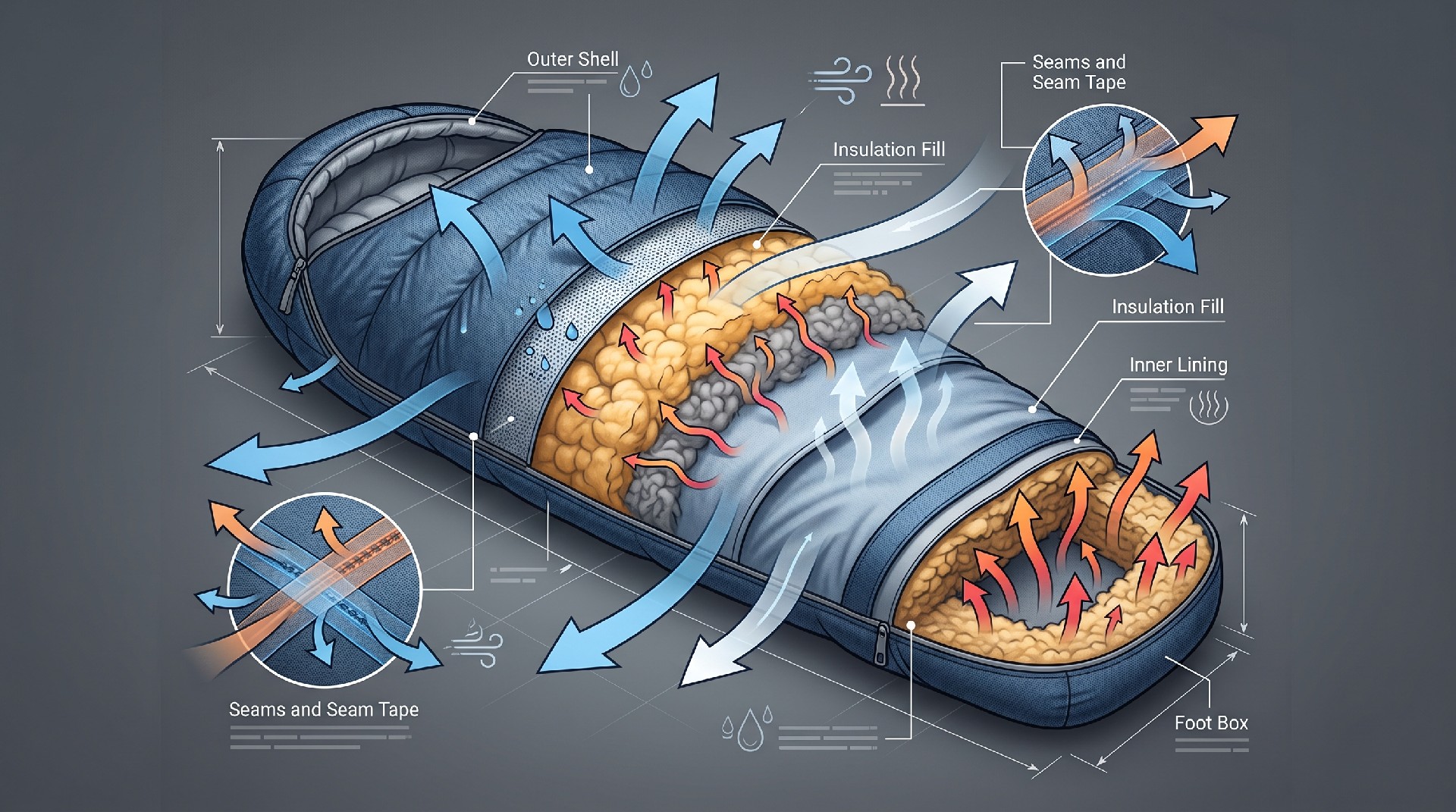
Where Mildew Actually Forms in a Sleeping Bag
Mildew does not form evenly. It concentrates in four zones where moisture lingers longest:
Foot box and lower shell—condensation from body heat and boot contact accumulates here first.
Hood and collar—breath moisture and skin oils create a nutrient-rich film.
Seam tape and stitch lines—adhesive layers and thread wicks moisture and dries slowly.
Compression sack contact points—fabric pressed against itself restricts airflow during storage.
In synthetic-fill bags, moisture migrates into the loft structure and can remain there for days. In down bags, moisture clumps the fill and creates localized humid pockets. Both cases produce the same outcome: microbial growth that generates volatile organic compounds responsible for the musty smell.
Material and Construction Factors That Affect Drying Time
Drying time is not uniform across sleeping bag types. A 20D nylon shell with a DWR finish sheds surface moisture quickly but can trap vapor inside the insulation. A coated polyester shell may resist external moisture but reduce breathability, pushing condensation inward. The table below outlines typical drying and storage behavior by construction type.
| Sleeping Bag Construction | Typical Drying Time After Use | Storage Risk | Buyer Action |
|---|---|---|---|
| Synthetic fill, 20D nylon shell | 4–8 hours with airflow | Moisture trapped in loft if compressed early | Use breathable storage sack, never compression sack |
| Down fill, 600–800 fill power | 12–24 hours depending on humidity | Clumping and mildew if stored damp | Use down-specific cleaner, dry fully before storage |
| Coated polyester shell, synthetic fill | 6–10 hours with airflow | Reduced breathability increases internal condensation | Monitor seam tape and hood area for odor |
| Cotton or flannel lining, synthetic fill | 8–12 hours with airflow | Lining retains moisture longer than nylon | Inspect lining separately before bagging |
| Hybrid shell, water-resistant finish | 4–6 hours with airflow | DWR finish can mask internal moisture | Test foot box and hood by hand before storage |
Drying Protocol: The Step Most Operators Skip
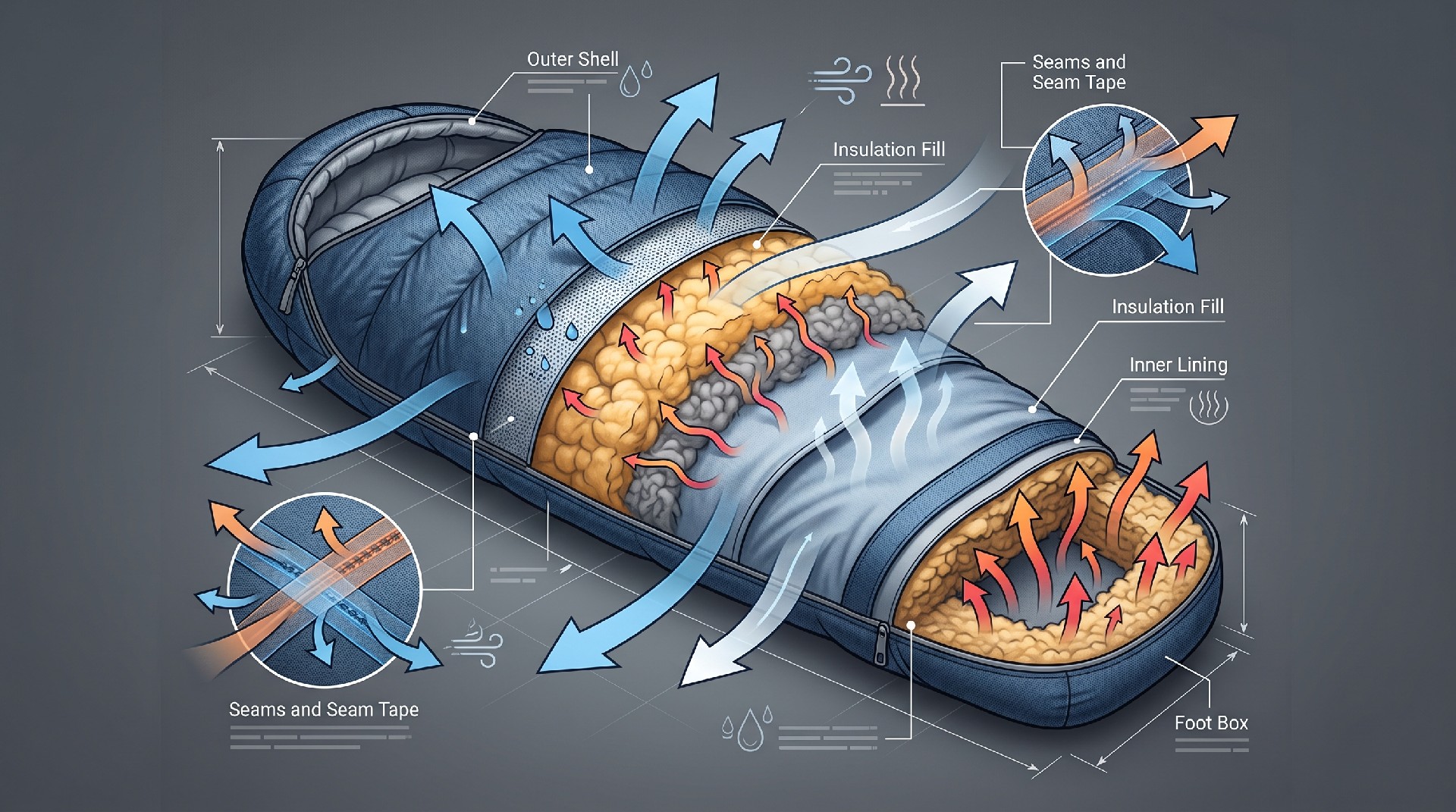
Air-drying a sleeping bag on a line for an hour is not a drying protocol. It is a delay tactic. Effective drying requires three conditions: air movement, surface exposure, and time.
Commercial Drying Sequence
Turn the bag inside out and hang it fully open—not folded over a line.
Use a fan-driven drying room or a well-ventilated space with continuous airflow across both shell surfaces.
Target a minimum 4–8 hour drying window for synthetic bags after heavy use; down bags often require 12–24 hours depending on humidity and fill power.
Check the foot box and hood with a moisture meter or hand-feel test before declaring the bag dry.
Do not compress or bag the sleeping bag until it has returned to ambient temperature and feels dry throughout.
For rental fleets, a dedicated drying rack system with labeled positions reduces cross-contamination and ensures every bag receives the same treatment. Skipping this step is the single most common cause of recurring mildew smell.
Storage Architecture: Loft, Airflow, and Moisture Control
Storage is not a passive phase. A sleeping bag stored in a compressed stuff sack creates a microclimate where residual moisture cannot escape. The correct storage method depends on whether the bag is in active rotation or seasonal storage.
Active Rotation Storage
Store bags loose in a breathable cotton or mesh storage sack—never in the original compression sack.
Hang bags vertically on a wide hanger if space allows; this preserves loft and maximizes surface airflow.
Maintain storage room relative humidity below 50% where possible; use a dehumidifier in damp climates.
Keep bags off concrete floors and away from exterior walls where condensation forms.
Seasonal Storage
Clean and fully dry the bag before seasonal storage—even if it was only used once.
Store in a climate-controlled environment with stable temperature and humidity.
Inspect every 60–90 days for any sign of moisture, odor, or pest activity.
Never store a sleeping bag in a plastic bin or vacuum-sealed bag; trapped moisture cannot escape.
Inspection, Cleaning, and When to Retire a Bag
Mildew prevention is a lifecycle discipline, not a one-time fix. For commercial operators, the decision to clean, repair, or retire a sleeping bag should be based on observable criteria rather than smell alone.
Inspection Checklist Before Storage
Shell fabric: check for dark spots, discoloration, or a persistent damp feel along seams.
Insulation: feel for clumping, flat spots, or uneven loft that indicates moisture damage.
Zipper and seam tape: look for lifting tape, mold growth in stitch lines, or corrosion on metal components.
Odor test: a sharp musty smell after drying indicates microbial growth has already colonized the fill or shell.
Cleaning That Actually Removes Mildew
Surface wiping is insufficient once mildew has penetrated the fill. A gentle machine wash with a technical detergent, followed by a full drying cycle, is often required. Avoid bleach and fabric softeners—they damage DWR finishes and leave residues that attract moisture. For down bags, use a down-specific cleaner and dry with dryer balls on low heat until completely dry.
Repair vs. Replace Decision
Clean and return to service: minor surface odor, no visible mold, loft intact after drying.
Repair and monitor: localized seam tape damage or a single compromised zone; treat with a technical cleaner and re-inspect after 30 days.
Retire: persistent odor after two cleaning cycles, visible mold throughout the fill, or compromised loft that affects thermal performance.
For rental fleets, retiring a bag early is often cheaper than the labor and guest dissatisfaction associated with repeated cleaning cycles. A documented retirement threshold prevents bags with irreversible mildew damage from re-entering rotation.
Buyer Decision Framework for Commercial Sleeping Bag Programs
Preventing mildew smell is ultimately a procurement and operations decision. When specifying sleeping bags for rental, camp, or institutional use, buyers should prioritize:
Shell and lining materials that balance breathability with moisture resistance.
Insulation type matched to the drying infrastructure available at the site.
Storage sack design that allows airflow during transport and storage.
Cleaning instructions and repair access documented by the supplier.
Spare-parts and replacement policy that supports a multi-season lifecycle.
Best for: operations with controlled drying and storage environments. Not ideal for: high-humidity field camps without drying infrastructure, where a synthetic-fill bag with quick-dry properties and a strict rotation schedule is a more realistic choice. Verify drying time and storage requirements against the final product datasheet before committing to a fleet purchase.
