

The Future of Resistance: Defining the Water Injection Fitness Device Market
What: This article provides an in-depth technical analysis of water injection fitness devices, exploring the principles of hydro-dynamic resistance and unstable load training.
Why: As the B2B fitness market shifts towards functional and rehabilitative solutions, understanding the unique biomechanical advantages and ROI of fluid-based equipment is crucial for facility owners and equipment distributors.
How: Readers will gain actionable insights into the mechanics of fluid inertia, compare these devices against traditional static weights, analyze market growth trends, and learn key criteria for selecting commercial-grade equipment.
Introduction: The Paradigm Shift towards Hydro-Dynamic Resistance
The fitness industry is undergoing a significant transformation, moving beyond the uni-dimensional focus on absolute strength towards a more holistic approach emphasizing functional movement, stability, and neuromuscular efficiency. At the forefront of this shift is the emergence of the water injection fitness device, a category of equipment that utilizes water as the primary source of resistance. Unlike traditional static weights (like iron dumbbells or barbells) which offer a predictable center of gravity, water-filled devices introduce the element of fluid dynamics into resistance training.
This is not merely a novelty; it represents a fundamental change in how force is applied to the human body during exercise. The core principle relies on the inertia of water. As the device is moved, the water inside "sloshes," creating a chaotic and unpredictable load. This forces the user's body to constantly adjust and stabilize, recruiting a higher percentage of motor units—particularly in the core and stabilizer muscles—compared to lifting a static object of equivalent weight. For B2B buyers, from commercial gym chains to elite sports performance centers, understanding this biomechanical distinction is key to capitalizing on the next wave of functional training equipment.
Core Technology and Biomechanical Benefits of Water-Filled Equipment
The efficacy of a water injection fitness device lies in the concept of "unstable load training." The science behind this is rooted in neuromuscular adaptation. When a user lifts a stable weight, the brain quickly learns the most efficient pathway to complete the movement. Over time, this can lead to decreased activation of stabilizing muscles as the primary movers take over.
Conversely, the active fluid resistance of water creates a "live weight." The center of mass is in constant flux. According to research published in the Journal of Strength and Conditioning Research, training with unstable loads significantly increases muscle activation in the trunk stabilizers compared to stable loads, forcing the neuromuscular system to remain in a heightened state of engagement throughout the entire range of motion (Source: JSCR, 2023).
Unstable Load Training and Neuromuscular Adaptation
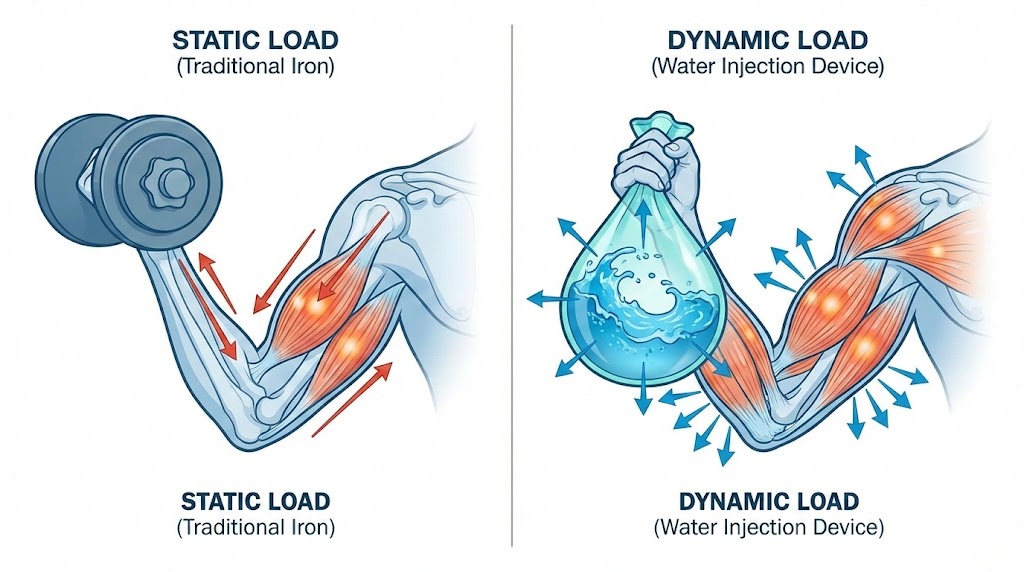
The turbulence created by the moving water generates forces in multiple planes—sagittal, frontal, and transverse—simultaneously. To counteract these unpredictable forces, the body must engage deep stabilizing muscles that are often dormant during traditional weightlifting. This process, known as reactive stability, is crucial for real-world functional strength and athletic performance.
The image below visually demonstrates the stark contrast in muscle recruitment between static iron weights and dynamic water resistance.
Injury Prevention and Joint-Friendly Impact
Another critical advantage, particularly relevant for physical therapy and rehabilitation clinics, is the reduced impact on joints. Because the load is fluid, there is a natural deceleration phase at the end of ranges of motion, reducing the "jerk" forces often associated with stopping a heavy iron weight. The resistance is accommodating; the harder the user pushes, the more turbulence (and resistance) is created, but it rarely exceeds the user's immediate capability, thereby lowering the risk of acute injury.
Comparative Analysis: Traditional Iron vs. Fluid Resistance Systems
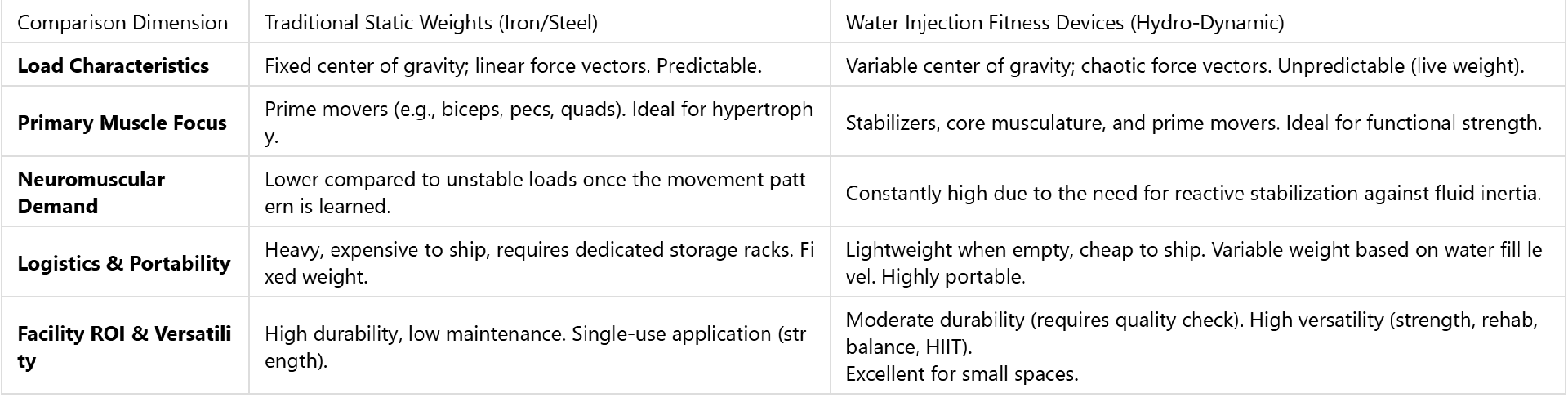
For facility owners deciding on inventory, it is vital to understand how water injection fitness devices stack up against traditional modalities. The following table provides a detailed B2B comparison.
B2B Applications and Market Trends for Aqua Strength Training
The adoption of water-based resistance equipment is no longer confined to niche athletic training. It is rapidly entering the mainstream commercial fitness market. This growth is driven by a consumer demand for more engaging, functional, and joint-friendly workout options.
Integrating Water Devices into Commercial Gyms and Rehabilitation Centers
For commercial gyms, water injection devices offer a high-yield solution for functional training zones. They replace the need for multiple sets of fixed-weight kettlebells or medicine balls, saving valuable floor space. In rehabilitation settings, physiotherapists utilize the adjustable nature of the load (simply add or remove water) to safely progress patients from acute recovery to return-to-play protocols, leveraging the low-impact nature of fluid resistance.
Global Market Growth Projections for Innovative Fitness Gear
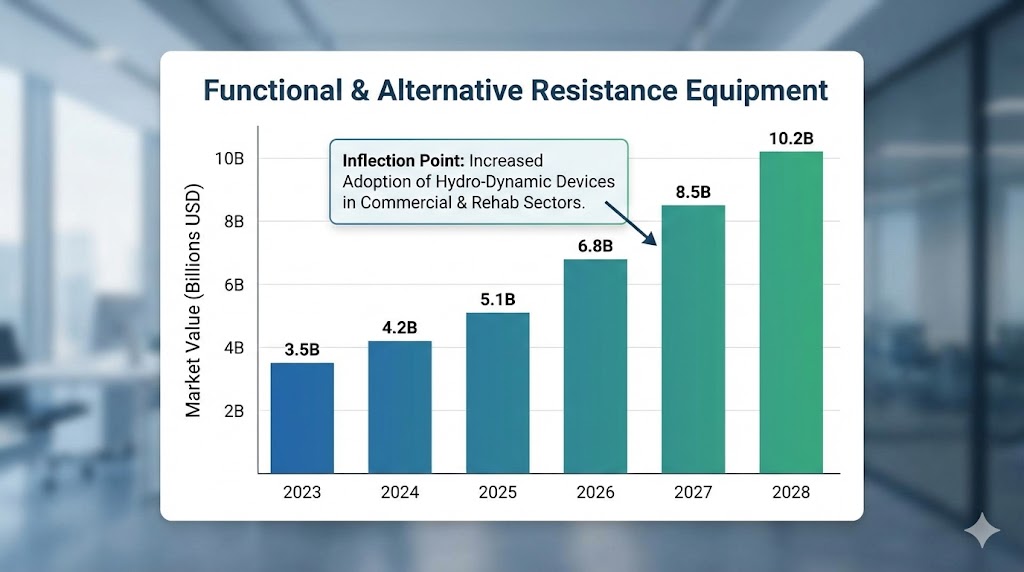
The market for functional fitness equipment is projected to grow significantly in the coming years. Analysts suggest that equipment offering versatility and technological innovation will outpace traditional categories. The ability of water injection devices to serve multiple demographics—from aging populations requiring balance training to elite athletes seeking performance edges—positions them as a key growth driver.
The chart below illustrates the projected upward trajectory of this market segment.
Selecting the Right Water Injection Fitness Device: Key Considerations
Not all water-filled devices are created equal. For B2B procurement, quality and durability are paramount to prevent leakage and ensure longevity in a high-traffic environment.
Material Durability and Sealing Technology
Commercial-grade devices must be constructed from robust materials, typically high-grade, reinforced PVC (polyvinyl chloride) or TPU (thermoplastic polyurethane). The thickness of the material determines its resistance to punctures and bursts. Crucially, the welding seams and the valve technology must be leak-proof. Look for devices with double-welded seams and secure, screw-top valves with rubber gaskets designed to withstand high pressure from internal water movement.
Variable Loading Capacities and Ergonomics
A major advantage is adjustable weight. A single device can range from 5kg to over 40kg depending on the water level. Ensure the device has clear water level indicators. Ergonomics also matter; handles should be durable (e.g., reinforced nylon webbing) and strategically placed to allow for a variety of grips for different exercises like snatches, cleans, or rotational presses.
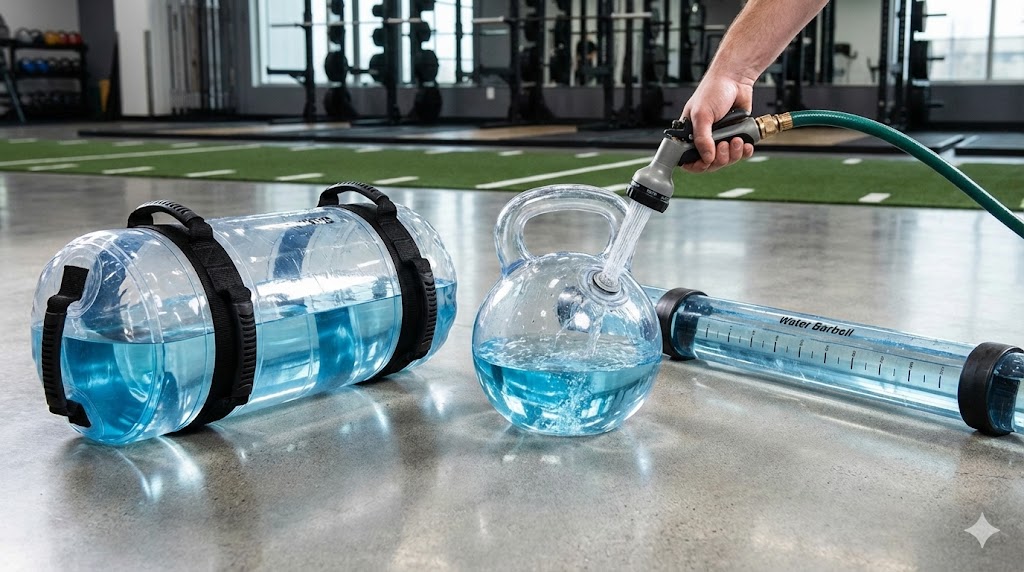
The image below showcases the variety of professional-grade devices available and the simple method of preparation.
Frequently Asked Questions (FAQs) on Water Resistance Training
What are the main benefits of a water injection fitness device?
The primary benefit is "unstable load training." The moving water creates unpredictable forces, requiring increased engagement from core and stabilizing muscles to maintain balance. This improves functional strength, coordination, and neuromuscular efficiency more effectively than static weights.
Is water-filled equipment suitable for beginners?
Yes, but with guidance. Because the load is unstable, beginners should start with a low water level to master movement patterns before increasing the volume. The impact on joints is lower than iron weights, making it a safe entry point for functional training if coached correctly.
How durable are these water devices for commercial gym use?
Commercial-grade devices made from thick, reinforced PVC or TPU with high-quality welded seams are designed to withstand significant impact and pressure. However, cheap consumer models may leak or burst under heavy commercial use. Always check the material specifications.
Can I build muscle mass (hypertrophy) with water weights?
While possible, they are not the optimal tool for maximal hypertrophy compared to heavy static iron. Their strength lies in building functional, athletic muscle and stability. They are better suited for conditioning, core strength, and metabolic circuits rather than pure bodybuilding protocols.
How do I fill and maintain the device?
Most professional devices come with a valve adapter that connects to a standard hose or faucet. You simply add water to the desired weight level, often marked on the side. Maintenance involves periodically checking the valve seal and occasionally draining and airing the device to prevent mold growth.
Is it necessary to add air along with the water?
Yes, for most larger devices like aqua bags. Leaving some air space is crucial as it allows the water to slosh freely, creating the desired turbulence and instability. A fully filled bag acts more like a static weight, negating the unique benefits.
What types of exercises can be performed?
They are incredibly versatile. Common movements include squats, lunges, overhead presses, and deadlifts. However, they excel at dynamic, multi-planar movements like rotational swings, cleans, snatches, and carry variations (e.g., farmer's walks) where the water's inertia is most challenging.
How does the cost compare to traditional free weights?
A single high-quality water device is generally more expensive than a single dumbbell of equivalent max weight. However, because one water device can replace an entire rack of fixed-weight kettlebells (e.g., from 5kg to 25kg), the overall cost per unit of resistance and floor space savings offers a superior ROI for gyms.
Conclusion: Embracing the Fluid Future of Fitness
The integration of the water injection fitness device into the fitness landscape represents more than just a trend; it's an evolution based on sound biomechanical principles. By moving away from rigid, linear resistance patterns and embracing the chaotic, dynamic nature of fluid dynamics, facilities can offer their members a more comprehensive, functional, and engaging training experience.
For B2B buyers, these devices provide a compelling value proposition: they are space-efficient, versatile enough for diverse client needs, and align perfectly with the growing demand for functional health solutions. As the market data indicates, the shift towards innovative, non-traditional resistance is accelerating. Investing in high-quality hydro-dynamic equipment is a strategic move to future-proof your facility and stay ahead of the curve in a competitive industry.
Ready to modernize your facility's training options? Contact our commercial team today for a consultation on integrating professional-grade water resistance equipment into your gym.
