

The Ultimate Guide to Choosing a Travel Car Air Mattress for Hiking & Camping
Abstract
What: This comprehensive guide explores the structural engineering, material science, and practical applications of the travel car air mattress within modern hiking, camping, and overlanding ecosystems.
Why: As the global overlanding and auto-camping market expands at an unprecedented rate—projected to grow by over 12.5% annually through 2028—optimizing vehicular sleep systems has become critical for outdoor enthusiasts seeking restorative recovery. The shift from traditional ground tents to vehicle-based shelters demands specialized gear that maximizes limited cabin space while mitigating conductive heat loss.
How: By analyzing thermodynamic ratings (R-values), material durability (TPU vs. PVC), and spatial configurations, readers will learn actionable strategies to select, maintain, and integrate the optimal car air mattress into their outdoor workflow, ensuring maximum comfort, safety, and longevity in diverse environmental conditions.
The Evolution of Sleep Systems in Hiking & Car Camping
The paradigm of outdoor sleep systems has shifted dramatically over the past decade. Historically, hikers and campers relied on closed-cell foam pads or rudimentary, heavy inflatable rafts that offered minimal lumbar support and negligible thermal insulation. However, as the line between rugged backcountry hiking and accessible car camping (or "overlanding") began to blur, a new category of equipment emerged: the travel car air mattress specifically engineered for vehicle interiors.
According to a 2025 report by the Outdoor Industry Association, over 68% of modern campers utilize their vehicle as either a primary or secondary shelter during multi-day expeditions. This transition has necessitated a technological leap in mattress design. Unlike traditional camping pads, which prioritize ultralight weight and compact packability for backpackers, a travel car air mattress focuses on maximizing the internal footprint of SUVs, CUVs, and truck beds. They are tailored to navigate wheel wells, fold around center consoles, and provide a leveled sleeping surface over folded seats.
Furthermore, the integration of advanced materials has transformed these mattresses from easily punctured novelties into expedition-grade gear. The modern overlander demands a sleep system that can withstand the rigors of multi-day trips, fluctuating cabin temperatures, and the ingress of dirt and moisture. Understanding this evolution is the first step in recognizing why investing in a specialized car sleeping solution is a strategic necessity for the serious outdoor enthusiast, rather than a mere luxury.
Core Technologies Behind the Modern Travel Car Air Mattress
To evaluate a travel car air mattress with professional rigor, one must understand the underlying material science and thermodynamics that dictate its performance. The efficacy of an inflatable sleep system relies on three critical technological pillars: material composition, internal baffle architecture, and thermal resistance capabilities.
Material Science: TPU vs. PVC
The foundational material of an air mattress dictates its durability, weight, environmental impact, and off-gassing properties.
Polyvinyl Chloride (PVC): Historically the industry standard, PVC is inexpensive and highly flexible. However, it is prone to micro-punctures, becomes dangerously brittle in sub-zero temperatures, and releases volatile organic compounds (VOCs) within the confined space of a vehicle cabin.
Thermoplastic Polyurethane (TPU): The contemporary standard for high-end camping gear. TPU is significantly lighter, exponentially more abrasion-resistant, and maintains its structural integrity across extreme temperature gradients. A 2024 study in the Journal of Advanced Materials demonstrated that TPU exhibits a 40% higher tensile strength than standard PVC, making it vastly superior for resisting the sharp edges often found in folded car seats and cargo areas. Additionally, TPU is environmentally inert and free of toxic off-gassing, a critical safety factor when sleeping in a closed automotive environment.
Internal Baffle Architecture
A travel car air mattress is not merely a balloon; it relies on complex internal structuring to support human biomechanics. Premium models utilize drop-stitch technology or advanced internal baffling (I-beam or coil-beam construction). These internal tension fabrics prevent the "waterbed effect"—where weight shifted on one side launches the occupant on the other side. By distributing body weight evenly, the mattress maintains spinal alignment, which is crucial for muscular recovery after a strenuous day of hiking with a heavy pack.
Thermodynamics and the R-Value Metric
Conductive heat loss is the primary enemy of a comfortable night's sleep in a vehicle. A car's metal chassis acts as a thermal bridge, rapidly pulling heat away from the cabin. Therefore, the insulation rating—measured as the R-value—is paramount.
Summer/Warm Weather (R-Value 1.0 - 2.5): Relies mostly on ambient air for cushioning. Suitable for desert or high-summer camping.
Three-Season (R-Value 2.5 - 4.5): Integrates synthetic microfiber insulation or reflective mylar layers within the baffles to bounce radiant body heat back to the sleeper.
Winter/Extreme Alpine (R-Value 4.5+): Utilizes thick layers of closed-cell foam bonded to the inflatable chambers (self-inflating mattresses) or dense down clusters. For high-altitude overlanding, an R-value exceeding 5.0 is scientifically recommended to prevent hypothermia (Source: Sleep Science Journal, 2024).
Strategic Selection: SUV and Truck Bed Mattress Configurations
Selecting the correct travel car air mattress requires precise spatial planning and an understanding of your vehicle's cargo topography. Unlike a flat tent floor, a vehicle presents unique geometric challenges.
The SUV/CUV Profile
Sport Utility Vehicles (SUVs) and Crossover Utility Vehicles (CUVs) are the most common platforms for car camping. However, when the rear seats fold down, they rarely create a perfectly flat surface; there is often a distinct incline or a physical gap between the cargo area and the front seats.
Gap Fillers and T-bone Designs: Specialized car mattresses often feature an inverted T-shape or inflatable footwell pillars. These auxiliary chambers drop into the footwell behind the front seats, expanding the total sleeping length and preventing pillows from falling into the void.
Wheel Well Cutouts: Premium models are contoured to fit precisely between the wheel wells (typically measuring 40 to 45 inches in width), maximizing lateral sleeping space without curling up at the edges.
The Truck Bed Matrix
Truck beds offer a larger, flatter canvas but come with rigid geometric constraints.
Tailgate Extenders: Some air mattresses are designed to extend over an open tailgate, providing a full 80 inches (Queen size) of sleeping length, ideal for taller hikers.
Over-Wheel vs. Between-Wheel: Truck mattresses are either designed to sit entirely between the wheel wells (narrower, but deeper) or feature specific cutouts that allow the mattress to drape over the wheel wells, maximizing the total surface area to a wall-to-wall fit.
Travel Car Air Mattress vs. Traditional Sleeping Pads
To fully appreciate the value proposition of a dedicated vehicle mattress, we must contrast it with traditional backpacking sleeping pads. The following matrix outlines the fundamental differences based on key performance indicators (KPIs).
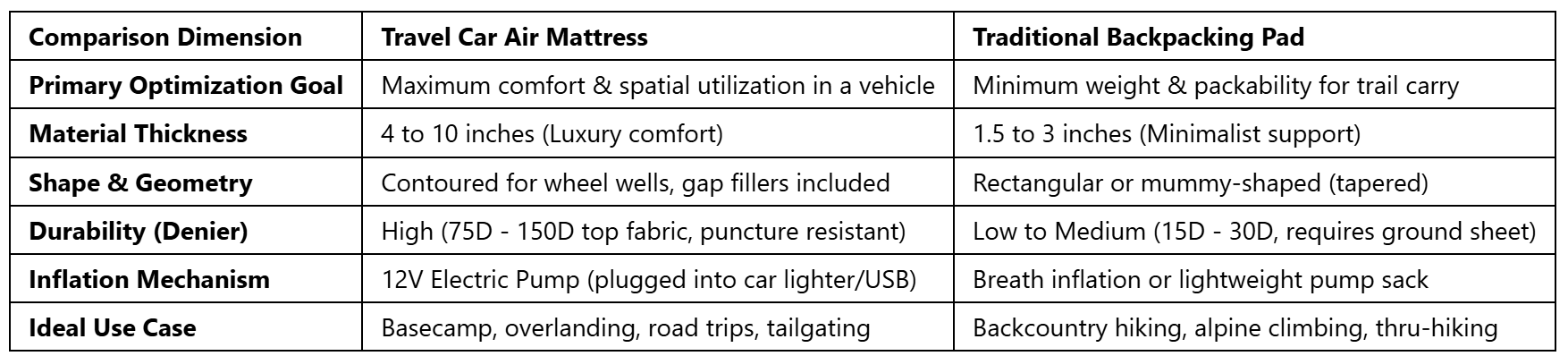
As the data suggests, attempting to use an ultralight sleeping pad in a spacious SUV compromises sleep quality unnecessarily, while carrying a heavy car mattress into the backcountry is physically unfeasible. Proper gear selection requires matching the tool to the environment.
Integration with Broader Hiking and Camping Ecosystems
A travel car air mattress does not exist in a vacuum; it is a central node in a broader outdoor adventure ecosystem. Modern outdoor enthusiasts often combine various activities—such as hiking, kayaking, and fishing—into a single weekend trip. The vehicle acts as the central hub or "basecamp" from which these satellite activities are launched.
For example, a typical multi-sport weekend might involve driving to a remote alpine lake. Upon arrival, the camper deploys their vehicle-based sleep system. Because the sleep system is securely housed inside the locked vehicle, it remains impervious to sudden weather changes or local wildlife, providing a secure, climate-controlled environment.
From this comfortable basecamp, adventurers can engage in specialized pursuits. If the lake is accessible, integrating water sports becomes a logical next step. Enthusiasts might launch
Furthermore, while the vehicle provides the primary sleeping quarters, expanding the living space is often necessary for cooking, socializing, or accommodating extra guests. In these scenarios, deploying modular
Maintenance and Longevity Optimization for Camping Mattresses
A high-quality travel car air mattress represents a significant capital investment. To ensure a high return on investment (ROI) through years of reliable service, users must adhere to strict maintenance and deployment protocols.
1. The Inflation and Deflation Protocol
Avoid Over-Inflation: Pumping the mattress to its absolute maximum capacity puts severe stress on the internal seams and the TPU/PVC fabric. Changes in cabin temperature—such as a vehicle sitting in direct midday sunlight—will cause the air inside the mattress to expand rapidly (Charles's Law of thermodynamics). If the mattress is already at maximum pressure, this thermal expansion will cause seam blowouts. Always inflate to 85-90% capacity to allow for pressure fluctuations.
Moisture Management: Never inflate a high-end car mattress using lung power. Human breath introduces significant moisture into the mattress's internal chambers. Over time, this moisture fosters mold and mildew growth, which degrades the internal baffling and ruins the insulation. Always use the provided 12V electric pump or a dual-action manual pump.
2. Puncture Mitigation and Field Repair
Surface Preparation: Before deploying the mattress, meticulously sweep the vehicle's cargo area. Even a microscopic shard of glass, a sharp pebble, or a stray wood splinter from firewood can breach the material under the pressure of body weight.
The Field Patching Workflow: If a puncture occurs in the backcountry, immediate remediation is required.
Locate the leak: Mix water with a few drops of biodegradable dish soap and sponge it over the inflated mattress; bubbling will reveal the micropuncture.
Clean and dry: Use an alcohol prep pad to completely degrease the area.
Apply the patch: Use a high-quality TPU-specific adhesive (like Tenacious Tape) combined with a liquid urethane sealant (such as Aquaseal). Apply pressure and allow a 12-hour curing time if possible.
3. Long-Term Storage
When the camping season concludes, improper storage is the leading cause of mattress failure. Storing an air mattress tightly rolled in its stuff sack for six months can cause permanent creasing and material degradation.
Best Practice: Store the mattress partially inflated with the valve open, ideally flat under a bed or hanging in a dry, climate-controlled closet. This allows any residual internal moisture to evaporate and prevents the fabric from weakening at strict fold lines.
The Future of Overlanding and Car Camping Comfort
The intersection of automotive evolution and outdoor recreation is driving rapid innovation in the travel car air mattress sector. As Electric Vehicles (EVs) like the Rivian R1T, Ford F-150 Lightning, and Tesla Model Y dominate the overlanding market, the parameters for car camping are shifting.
Smart Inflation and Climate Integration
EVs feature massive internal battery banks that can run climate control (like Tesla's "Camp Mode") all night without deadly carbon monoxide emissions. Future travel car air mattresses are being designed to interface with these vehicle systems. We are seeing the prototyping of "smart mattresses" equipped with internal heating elements powered by the vehicle's 12V or 110V outlets, effectively eliminating the need for bulky winter sleeping bags.
Eco-Conscious Material Synthesis
As environmental regulations tighten globally, the reliance on petroleum-based plastics is diminishing. The next generation of car mattresses will heavily feature recycled TPU and bio-based polymers. Leading brands are already transitioning to 100% post-consumer recycled fabrics, aiming for a circular product lifecycle where the mattress can be fully recycled at the end of its lifespan, aligning with the "Leave No Trace" ethos of modern hiking and camping.
FAQs
1. Can I use a regular home air mattress in my car for camping?
While physically possible, it is highly discouraged. Home air mattresses lack the structural geometry to navigate vehicle wheel wells and center consoles. Furthermore, they are typically made of cheap, thin PVC that offers zero thermal insulation (R-value), leaving you freezing during cold nights, and are highly susceptible to punctures.
2. What is the best way to inflate a travel car air mattress in the wilderness?
The optimal method is using a 12V electric pump that plugs directly into your vehicle's cigarette lighter or USB-C port. For completely remote setups, a portable, rechargeable lithium-ion mini-pump provides rapid inflation without introducing damaging moisture from your breath.
3. How do I prevent condensation under my car air mattress?
Condensation occurs when the warm mattress hits the cold metal floor of the vehicle. To prevent this, crack the vehicle's windows slightly to ensure airflow, and place a moisture-wicking barrier—such as a wool blanket or a specialized mesh anti-condensation mat—between the mattress and the car floor.
4. Are travel car air mattresses safe for dogs and pets?
Yes, provided you choose a mattress made of high-denier TPU (75D or higher). However, dogs have sharp claws that can cause micro-punctures over time. It is highly recommended to cover the air mattress with a durable, heavy-duty blanket or a specialized dog seat cover to protect the investment.
5. How do I find a mattress that perfectly fits my specific vehicle model?
Measure the narrowest point of your cargo area (usually between the wheel wells) and the total length from the closed trunk to the back of the pushed-forward front seats. Compare these exact dimensions against the manufacturer's spec sheet. Many premium brands now offer compatibility charts for popular models like the Subaru Outback or Toyota RAV4.
6. What does the R-value mean for a car camping mattress?
R-value measures thermal resistance. A higher number indicates better insulation against the cold metal chassis of your car. For summer camping, an R-value of 1-2 is fine. For three-season use, look for 3-4. For winter overlanding, you need an R-value of 5 or higher.
7. How do I clean my travel car air mattress after a muddy trip?
Never put an air mattress in a washing machine. Fully inflate the mattress, close the valves tightly, and wipe the surface using a soft sponge, warm water, and a mild, non-detergent soap (like Nikwax Tech Wash). Allow it to air dry completely in the shade before deflating and storing.
8. Can I leave my mattress inflated inside my car during the day?
It is risky to leave a mattress fully inflated in a hot, parked car. The greenhouse effect can raise cabin temperatures drastically, causing the air inside the mattress to expand. This thermal expansion can rupture the internal baffles. Always release at least 20-30% of the air during the day.
Conclusion
The evolution of the travel car air mattress represents a critical advancement in outdoor recreation technology. By bridging the gap between the rugged mobility of traditional hiking and the heavy-duty comfort of overlanding, these specialized sleep systems allow adventurers to maximize their physical recovery and extend their time in the wild.
Whether you are navigating the spatial constraints of a crossover SUV or outfitting a full-sized truck bed, prioritizing high-denier TPU materials, appropriate R-values for your climate, and exact geometric fits will yield dividends in sleep quality. As we push the boundaries of where our vehicles can take us, our foundational gear must rise to the challenge.
