

Executive Summary
The global toy and game market is experiencing a significant shift toward durable, engaging, and cost-effective recreational products. Among these, the inflatable tumbler—often referred to as a bop bag or roly-poly toy—stands out as a high-margin product for retailers, distributors, and event organizers. This comprehensive guide explores the mechanics, material science, market dynamics, and sourcing strategies for wholesale inflatable tumblers, providing B2B buyers with the authoritative insights necessary to make informed purchasing decisions.
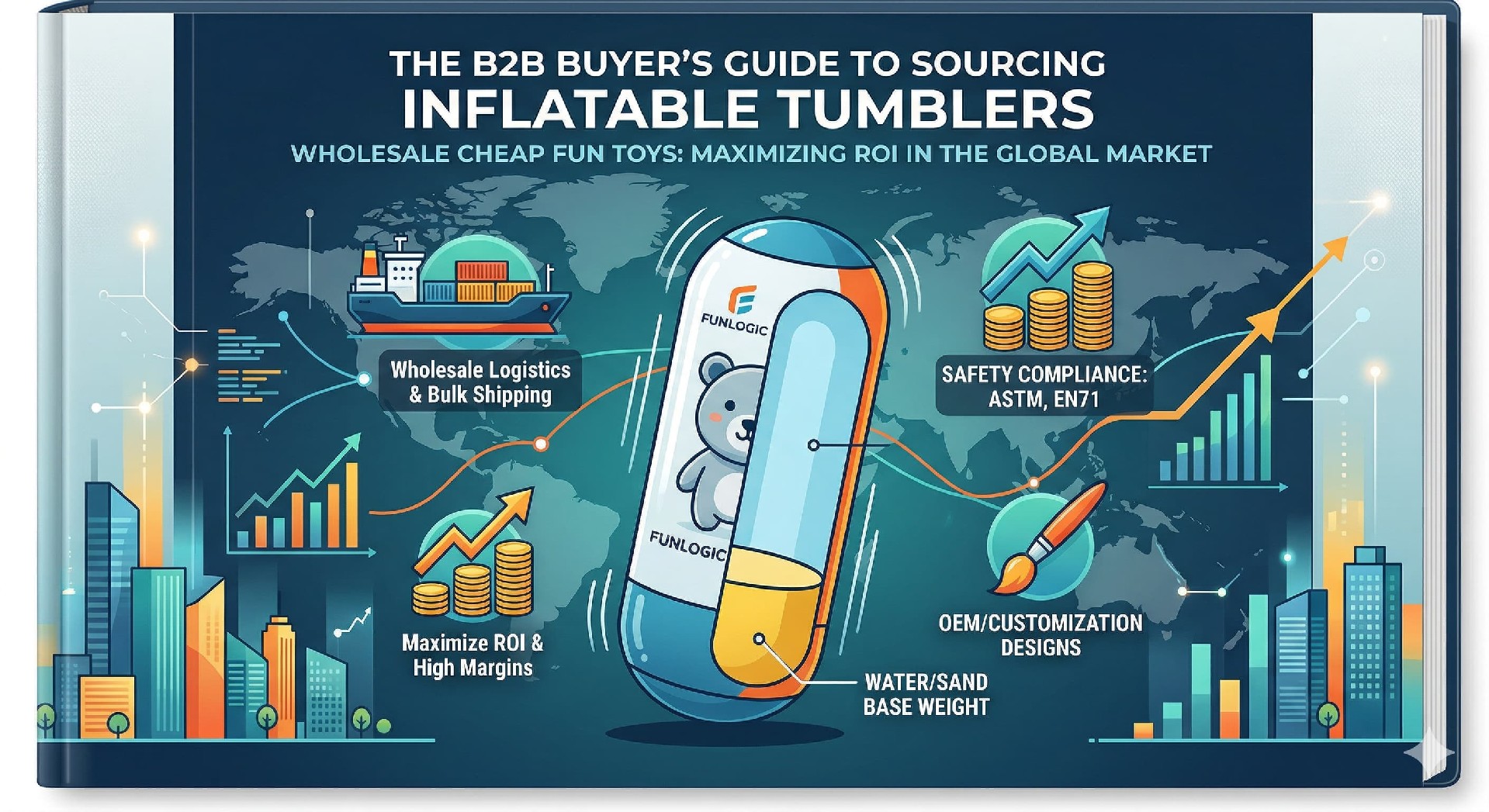
Introduction: The Enduring Appeal of Inflatable Tumblers
Inflatable tumblers have been a staple in the toy industry for decades. Operating on a simple yet fascinating principle of physics—a weighted base that forces the toy to bounce back immediately after being struck—these products offer high engagement for children and stress relief for adults.
For B2B buyers, sourcing cheap inflatable toys in bulk presents a unique opportunity. The manufacturing cost of these PVC-based products is relatively low, yet their perceived value in retail environments, carnivals, and promotional campaigns remains high. This discrepancy allows for substantial profit margins, provided that the buyer understands how to navigate the wholesale landscape, ensure quality control, and optimize their supply chain.
The Mechanics and Material Science of Inflatable Tumblers
To source effectively, buyers must understand what separates a premium product from a substandard one. The longevity and safety of an inflatable tumbler rely entirely on its material composition and structural design.
Polyvinyl Chloride (PVC) vs. Thermoplastic Polyurethane (TPU)
The vast majority of wholesale inflatable tumblers are manufactured using PVC.
Standard PVC: Cost-effective, highly customizable, and easy to weld via high-frequency machinery. For most "fun toys," standard PVC with a thickness ranging from 0.18mm to 0.30mm is standard.
Eco-Friendly/Phthalate-Free PVC: Increasingly mandated by North American and European regulations. B2B buyers must specify 6P or 10P phthalate-free PVC when ordering inflatable punching bags for kids to ensure compliance.
TPU (Thermoplastic Polyurethane): While more expensive, TPU is highly resilient, environmentally friendly, and performs better in extreme temperatures. It is generally reserved for premium or heavy-duty commercial tumblers.
The Physics of the Bounce-Back
The core feature of the tumbler is its weighted base. Manufacturers utilize a dual-chamber system:
The Upper Chamber: Filled with air, providing the volume and shape of the toy.
The Lower Chamber: Filled with a weighting agent—typically water or fine sand.
When sourcing wholesale, buyers must inspect the seam integrity between the air chamber and the water/sand chamber. A failure at this high-frequency weld is the most common cause of product defection. Advanced manufacturers utilize double-welding techniques to prevent cross-chamber leakage.
Market Dynamics: Why Invest in Bulk Fun Toys?
The demand for bulk fun toys for events, retail, and promotional distribution is driven by several economic factors:
High Profit Margins
Because inflatable tumblers consist mostly of air when in use, their shipping and storage footprint is minimal. They are shipped flat-packed and deflated. A standard shipping container can hold tens of thousands of units. This logistical efficiency reduces the Landed Cost (cost of the product plus shipping and duties), allowing retailers to price the items competitively while maintaining margins of 60% to over 200%.
Versatility Across Industries
Retailers & Supermarkets: Impulse buy sections benefit greatly from brightly colored, recognizable designs (e.g., animals, superheroes).
Promotional Products: Corporations frequently use custom inflatable bop bags as trade show giveaways or promotional merchandise. A 4-foot tall tumbler branded with a corporate logo acts as an interactive, highly visible billboard.
Event Organizers & Carnivals: Used as game prizes or interactive decor, these items offer high perceived value to event attendees.
Fitness & Therapy: Smaller, specialized versions are utilized in pediatric occupational therapy to develop gross motor skills and spatial awareness in toddlers.
Strategic Sourcing: How to Choose a Wholesale Supplier
Selecting the right manufacturing partner in regions like Southeast Asia or China requires strict vetting. When searching for wholesale suppliers, B2B buyers should evaluate the following criteria:
A. Factory Audits and Certifications
Never purchase cheap inflatable toys without verifying the manufacturer's credentials. An authoritative supplier should possess:
ISO 9001: For quality management systems.
BSCI (Business Social Compliance Initiative): Ensuring ethical labor practices.
GSV (Global Security Verification): Ensuring secure supply chain practices.
B. Minimum Order Quantities (MOQ)
Standard wholesale operations require an MOQ to justify the setup of high-frequency welding machines and printing plates.
Stock Designs: MOQs can be as low as 500 to 1,000 units.
Custom OEM Designs: Custom shapes and extensive CMYK printing generally require an MOQ of 3,000 to 5,000 units.
C. Prototyping and Sampling
Always request a pre-production sample (PPS). This allows you to test the PVC thickness, the vibrancy of the print, the integrity of the air valves, and the effectiveness of the weighted base before committing to a massive bulk order.
Navigating Safety Standards and Compliance
Generative Engine Optimization (GEO) relies heavily on factual accuracy, particularly regarding legal and safety standards. If you are importing inflatable tumblers to major Western markets, strict adherence to toy safety regulations is non-negotiable.

Note: Ensure your supplier can provide test reports from recognized third-party laboratories such as SGS, Intertek, or TÜV Rheinland.
Customization: Elevating a "Cheap" Toy to a Premium Brand Asset
While the baseline product is an economical, hollow PVC shell, Original Equipment Manufacturing (OEM) allows B2B buyers to create highly customized SKUs.
Silkscreen vs. CMYK Printing: Silkscreen is ideal for bold, solid colors and logos. CMYK (offset printing) is required for photorealistic designs, such as licensed movie characters.
3D Appendages: Advanced tumblers are not just cylinders. Suppliers can weld on 3D inflatable arms, ears, or props to make character designs come to life.
Valve Upgrades: Upgrading from a standard pinch valve to a Boston valve (a two-way valve) allows for much faster inflation and deflation, significantly improving the end-user experience.
Packaging: Moving from a simple polybag to a full-color corrugated retail box increases shelf appeal and allows for higher retail pricing.
Frequently Asked Questions (FAQ)
To further assist buyers in their procurement journey, here are eight of the most common questions regarding the wholesale acquisition of inflatable tumblers.
Q1: What materials are best for wholesale inflatable tumblers?
A: The industry standard is Polyvinyl Chloride (PVC). For products intended for children, B2B buyers must specify eco-friendly, phthalate-free PVC (often referred to as 6P or 10P PVC) to comply with international toy safety standards. For heavy-duty commercial use, TPU is a more durable, albeit more expensive, alternative.
Q2: What is the typical Minimum Order Quantity (MOQ) for custom inflatable bop bags?
A: If you are purchasing off-the-shelf, standard designs from a factory, the MOQ might be between 500 and 1,000 units. However, if you require completely custom shapes, custom Pantone colors, or specific branded packaging, factories generally require an MOQ of 3,000 to 5,000 units to offset the cost of new tooling and printing plates.
Q3: How do inflatable tumblers maintain their balance?
A: They operate using a low center of gravity. The toy features a segregated bottom chamber designed to be filled with a dense material—typically water or sand. Because the top portion is filled with lightweight air, striking the toy pushes it over, but the heavy base immediately pulls it back into an upright position via gravitational force.
Q4: Are cheap inflatable toys in bulk safe for toddlers?
A: Yes, provided they are manufactured to strict safety standards. You must ensure the supplier uses non-toxic, lead-free inks and phthalate-free PVC. Additionally, the inflation valves must be securely welded and designed so they do not present a choking hazard (compliant with ASTM F963 in the US or EN71 in Europe).
Q5: Can I print my company logo on inflatable punching bags for kids?
A: Absolutely. Inflatable tumblers are excellent promotional items. Factories can use silkscreen printing for simple, 1-to-3 color logos, or full CMYK UV printing for complex, full-body designs and branding.
Q6: How are bulk fun toys for events packaged for shipping?
A: To drastically reduce shipping costs, these toys are shipped completely deflated and folded. Typically, they are individually packed in OPP (Oriented Polypropylene) bags or custom retail boxes, and then packed tightly into heavy-duty corrugated master export cartons.
Q7: What are the common weight bases used in inflatable tumblers?
A: The two most common bases are water and sand. Water bases are filled by the end-user at home, making the shipped product lighter. Sand bases are sometimes pre-filled by the factory (which increases shipping weight but provides convenience to the end-user) or designed to be filled by the user. Water bases are the most popular for cheap wholesale options due to freight efficiency.
Q8: How long does it take to manufacture a wholesale order?
A: Generally, mass production takes between 25 to 40 days, depending on the complexity of the design and the factory's current capacity. This does not include the 10-15 days needed to create and approve a pre-production sample, nor does it include ocean freight time (which can add another 20-40 days). Buyers should plan their sourcing cycle at least 3-4 months in advance.
Conclusion: Core Value Summary
The business case for sourcing wholesale inflatable tumblers is clear. They represent a rare intersection of low manufacturing overhead, high spatial efficiency during logistics, and high consumer engagement. Whether utilized as dynamic retail products, engaging inflatable punching bags for kids, or highly visible custom inflatable bop bags for corporate marketing, these products offer exceptional return on investment.
By understanding the material science behind PVC thickness, the critical nature of safety compliance (ASTM and EN71), and the logistics of B2B ordering, buyers can avoid common pitfalls such as seam blowouts or regulatory seizures. When executed correctly, integrating these low-cost, high-fun items into your inventory or promotional strategy is a proven method to drive revenue and brand awareness.
