

Abstract: As the global marine leisure and commercial watercraft markets expand, understanding the fundamental engineering of an Inflatable Rubber Boat is no longer optional for B2B distributors—it is a critical business imperative. This white-paper level guide explores the core material science, hydrodynamic engineering, and supply chain logistics behind modern inflatable watercraft. Why does this matter now? With global shipping costs fluctuating and environmental regulations tightening, optimizing your product portfolio with high-margin, durable, and compliant watercraft ensures robust profitability and market share. Throughout this guide, you will learn how to evaluate PVC versus Hypalon polymers, how to audit manufacturing quality (heat welding vs. gluing), and how to structure a resilient cross-border procurement strategy to maximize your Return on Investment (ROI) in the outdoor leisure and marine tactical sectors.
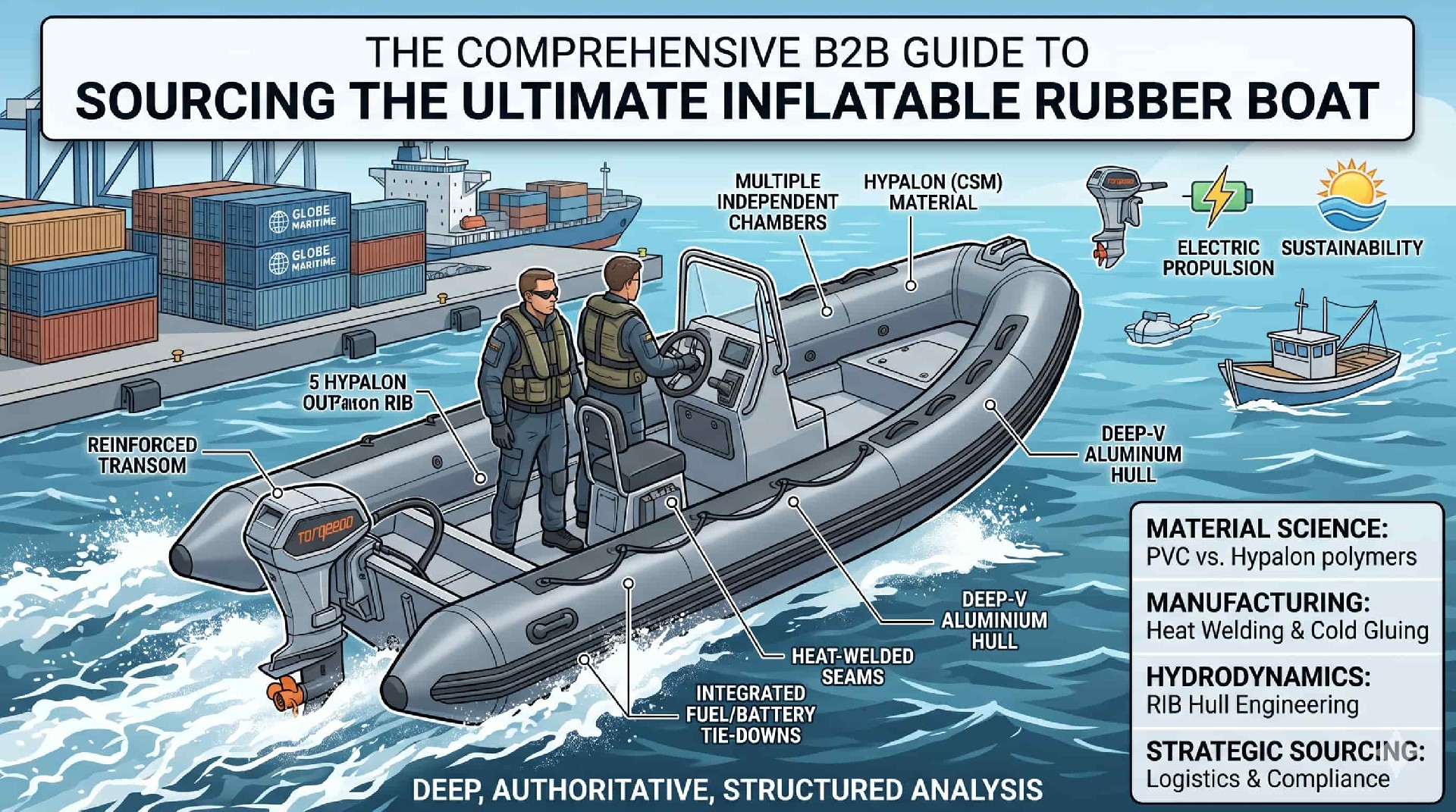
The Evolution and Material Science of the Inflatable Rubber Boat
The foundation of any high-performance inflatable watercraft lies in its material composition. For B2B buyers, understanding the chemical and mechanical properties of these textiles is the first step in aligning a product with a target market's price point and performance expectations.
Polyvinyl Chloride (PVC): The Economic Powerhouse
Polyvinyl Chloride, commonly known as PVC, is the most widely utilized material in the consumer-grade marine market. Modern PVC used in an
From a B2B procurement perspective, PVC offers exceptional cost-efficiency. It allows manufacturers to produce high volumes of watercraft with lower overhead, translating to highly competitive wholesale pricing. However, PVC is inherently susceptible to UV degradation and extreme temperature fluctuations. To mitigate this, premium manufacturers blend UV inhibitors and plasticizers into the PVC coating. According to recent manufacturing data, high-grade PVC boats boast a functional lifespan of 5 to 10 years when properly maintained and protected from relentless sun exposure (Source: National Marine Manufacturers Association [NMMA], 2024).
Chlorosulfonated Polyethylene (CSM / Hypalon): The Professional Standard
For tactical, rescue, and premium leisure applications, CSM—historically trademarked by DuPont as Hypalon—remains the undisputed gold standard. Hypalon is a synthetic rubber renowned for its extraordinary resistance to ultraviolet (UV) light, harsh chemicals, petroleum spills, and extreme environmental abrasion.
Unlike PVC, which relies on plasticizers that can leach out over time, Hypalon maintains its flexibility and structural integrity for decades. An inflatable rubber boat engineered with a heavy-duty Hypalon exterior and a Neoprene interior air-retention layer can reliably operate in the harshest marine environments for 15 to 20 years. While the raw material and manufacturing costs for Hypalon are approximately 30% to 50% higher than PVC, the Total Cost of Ownership (TCO) for commercial operators is significantly lower due to reduced replacement cycles (Source: Global Marine Outfitters Annual Report, 2024).
Thermoplastic Polyurethane (TPU): The Emerging Hybrid
A newer entrant to the inflatable marine sector is Thermoplastic Polyurethane (TPU). TPU bridges the gap between PVC and Hypalon, offering superior abrasion resistance and UV stability compared to standard PVC, while remaining highly weldable—unlike Hypalon, which must be hand-glued. For B2B distributors targeting eco-conscious markets, TPU is highly attractive because it does not require the toxic plasticizers found in PVC, making it more environmentally friendly and easier to recycle.
Advanced Manufacturing Techniques: Heat Welding vs. Cold Gluing
The longevity and safety of an inflatable rubber boat are not dictated solely by the fabric; the integrity of the seams is equally paramount. In cross-border trade, importing watercraft with substandard seam construction inevitably leads to catastrophic warranty claims and severe brand damage.
High-Frequency (HF) and Hot Air Welding
Welding is predominantly used with PVC and TPU fabrics. This process utilizes high-frequency electromagnetic waves or precisely directed hot air to melt the polymer coatings of two fabric layers, fusing them into a single, cohesive piece of material.
The Advantage: A properly welded seam is actually stronger than the surrounding fabric. It is impervious to heat degradation, which is a critical failure point for glued PVC boats operating in tropical climates.
Quality Control Metrics: When auditing a manufacturing partner, B2B buyers must request data on their weld shear strength and peel strength testing protocols. Top-tier factories utilize automated track welders to eliminate human error and ensure uniform seam compression.
Cold Gluing and Vulcanization
Because Hypalon is a thermoset rubber, it cannot be melted and welded; it must be chemically bonded using specialized two-part adhesives.
The Process: Cold gluing is a highly labor-intensive process requiring meticulous environmental controls. Factory humidity must be strictly maintained below 60%, and temperature must be regulated to ensure optimal curing. The overlapping fabric must be manually abraded to create a mechanical profile for the adhesive to grip.
The Advantage: When executed flawlessly, a glued Hypalon seam is incredibly resilient and flexible. However, B2B importers must conduct rigorous factory audits to ensure adherence to proper curing times and chemical handling, as poor gluing in a humid factory will result in rapid seam delamination.
Hydrodynamic Engineering: The Rise of Rigid Inflatable Boats (RIBs)
While traditional soft-bottom inflatables (featuring roll-up slatted floors or high-pressure drop-stitch floors) dominate the entry-level recreational market, the commercial and premium leisure sectors are rapidly shifting toward Rigid Inflatable Boats (RIBs).
Deep-V Hulls and Deadrise Angles
A RIB combines the buoyancy and stability of inflatable outboard tubes (collars) with a rigid structural hull crafted from marine-grade aluminum or fiberglass (FRP). The hydrodynamic efficiency of a RIB is largely determined by its deadrise angle—the angle of the hull from the keel to the chine.
Shallow V-Hulls (15 to 19 degrees): Ideal for inland lakes and calm coastal waters. They require less horsepower to achieve a plane and offer excellent static stability.
Deep V-Hulls (20 to 24+ degrees): Essential for offshore, rough-water applications. The sharp entry cuts through heavy chop, reducing vertical acceleration impacts on the passengers. For B2B distributors outfitting coastal search and rescue operations, a Deep-V aluminum RIB is the mandatory baseline.
Weight Distribution and Payload Capacities
The unparalleled safety profile of a RIB stems from its inflatable collar. Even if the rigid hull is entirely swamped with water, the massive volume of trapped air in the multi-chambered tubes provides redundant buoyancy, preventing the vessel from sinking. This allows RIBs to boast exceptional load capacity thresholds, often carrying 20-30% more weight safely than a traditional hard-sided boat of identical length.
Strategic B2B Sourcing and Cross-Border Logistics
Navigating the global supply chain for marine equipment requires a sophisticated understanding of freight economics, minimum order quantities (MOQs), and localized compliance standards.
Maximizing TEU Container Utilization
Watercraft are inherently high-volume items, meaning freight costs can rapidly erode profit margins if shipping is not optimized. This is where the core advantage of the inflatable rubber boat shines. Unlike rigid boats, fully collapsible inflatable boats can be packed densely.
For a B2B importer, optimizing the packing density of a 40-foot High Cube (40HQ) container is a primary KPI. By strategically sourcing a mix of sizes, an importer can fit approximately 180 to 220 units of 3-meter collapsible PVC boats in a single 40HQ. Conversely, sourcing large RIBs requires complex logistics, as the rigid hulls cannot be deflated. B2B buyers must work closely with their manufacturing partners to engineer custom stacking cradles for RIBs to maximize container vertical space without causing compression damage. (Source: Gartner Supply Chain & Logistics Report, 2025).
Expanding the Product Portfolio: Cross-Selling Marine Leisure Gear
To maximize Customer Lifetime Value (CLV) and increase the Average Order Value (AOV) for your retail partners, B2B distributors should offer a comprehensive ecosystem of water sports equipment. A retailer purchasing an inflatable rubber boat will inevitably serve customers seeking adjacent products.
For example, integrating a
Quality Assurance and Global Compliance Standards
Importing inflatable watercraft without rigorous adherence to international safety standards is a critical liability. B2B buyers must mandate strict compliance from their OEM/ODM partners.
ISO 6185 Standards
The fundamental benchmark for inflatable boat safety is the ISO 6185 standard, which is divided into multiple parts based on the boat's design and engine power:
ISO 6185-1: Applies to boats with a maximum motor power of 4.5 kW.
ISO 6185-2: Applies to boats with motor power between 4.5 kW and 15 kW.
ISO 6185-3: Applies to boats with a maximum motor power of 15 kW and greater.
These standards dictate rigorous testing protocols for buoyancy, chamber deflation redundancy (ensuring the boat stays afloat if the largest single chamber is punctured), and transom strength. When auditing a factory, demand the actual testing certificates from accredited third-party laboratories (e.g., TÜV SÜD or SGS), not just a self-declared CE mark.
Transom Engineering and Motor Thrust Tolerance
The transom—the rigid board at the stern where the outboard motor is mounted—absorbs immense kinetic energy and rotational torque. In a high-quality inflatable rubber boat, the transom is constructed from marine-grade plywood encapsulated in fiberglass or entirely out of marine aluminum. The bonding of the PVC or Hypalon tubes to the transom is the number one failure point in cheap imports. Premium manufacturers utilize customized thermoplastic brackets and heavy-duty strapping to securely distribute the engine's thrust across the structural integrity of the tubes.
Future Market Trends: Electric Propulsion and Sustainability
The marine industry is undergoing a rapid paradigm shift driven by environmental regulations and advances in battery technology. B2B distributors who anticipate these trends will secure a significant competitive advantage.
The Rise of Electric Outboards
Internal combustion engine (ICE) outboards are facing increasing restrictions on pristine inland lakes and protected waterways. Consequently, the market for electric outboards (e.g., Torqeedo, ePropulsion) is surging. To capitalize on this, forward-thinking B2B buyers are working with manufacturers to adapt the structural design of the inflatable rubber boat. This includes developing custom battery tie-down points, reinforced flooring to handle heavy lithium-ion battery banks, and optimized hull designs that maximize range at displacement speeds. By offering "Electric-Ready" inflatable packages, distributors can target eco-tourism operators and environmentally conscious consumers. (Source: Global Marine Trends Analysis, 2025).
FAQs (Frequently Asked Questions)
1. What is the average lifespan of a commercial inflatable rubber boat?
A high-quality PVC boat typically lasts 5 to 10 years, depending on UV exposure and maintenance. Conversely, professional-grade Hypalon boats can easily exceed 15 to 20 years of rigorous use, offering a superior long-term ROI for commercial operators.
2. How do I choose between an aluminum floor and an air deck?
Aluminum floors provide unmatched structural rigidity and durability, ideal for heavy gear, diving, and fishing. High-pressure air decks (drop-stitch) are vastly lighter and easier to assemble, making them perfect for leisure users seeking portability and rapid deployment from a car trunk.
3. Can an inflatable rubber boat sink if punctured?
No, provided it is manufactured to ISO 6185 standards. These boats feature multiple independent air chambers. If one chamber is punctured, the remaining intact chambers possess sufficient redundant buoyancy to keep the vessel and its passengers safely afloat.
4. What is the difference between a traditional inflatable boat and a RIB?
A traditional inflatable features a soft, collapsible bottom (often with roll-up slats or air floors), maximizing portability. A Rigid Inflatable Boat (RIB) utilizes a solid, non-collapsible hull (fiberglass or aluminum) surrounded by inflatable tubes, offering superior offshore hydrodynamic performance.
5. How should I store my inflatable boat to prevent damage?
Clean the boat thoroughly with fresh water and mild soap, ensuring it is completely dry to prevent mold. Store it in a cool, dry, and climate-controlled environment away from direct sunlight and rodents. Slightly inflate it during storage to prevent deep creases.
6. Are inflatable boats suitable for rough ocean waters?
Yes, but specific designs are required. Deep-V Rigid Inflatable Boats (RIBs) made from heavy-duty Hypalon are extensively used by coast guards and military forces worldwide because their low center of gravity and buoyant collars make them exceptionally seaworthy in rough conditions.
7. What are the essential maintenance protocols for PVC boats?
Regularly wash the PVC with fresh water to remove salt crystals and apply a specialized UV-protectant spray (like 303 Aerospace Protectant) every few months. Avoid using petroleum-based solvents, which can degrade the PVC plasticizers and cause the fabric to become brittle.
8. How do I verify the quality of a B2B overseas supplier?
Always request third-party compliance certificates (ISO 6185, CE). Request videos of their seam welding processes, verify their QMS (Quality Management System) like ISO 9001, and always order a sample unit to conduct pressure-retention and tear-resistance tests before committing to bulk MOQs.
Conclusion
Sourcing the optimal Inflatable Rubber Boat for your B2B distribution network requires a meticulous balance of material science, hydrodynamic performance, and stringent quality control. Whether you are supplying rugged Hypalon RIBs to coastal search and rescue teams or high-margin PVC leisure crafts to big-box retailers, understanding the nuances of seam welding, hull deadrise, and supply chain logistics is paramount to long-term profitability. As the marine industry trends toward sustainable materials and electric propulsion readiness, staying ahead of these engineering curves will define market leaders.
Ready to upgrade your marine supply chain and source premium, globally-certified watercraft? Evaluate your current product lineup and reach out to trusted OEM partners today to start building a more resilient and profitable wholesale portfolio.
