

Abstract: In the rapidly expanding global outdoor recreation market, understanding the technical and commercial nuances of aquatic gear is paramount for B2B distributors and wholesalers. This comprehensive whitepaper explores the engineering, material science, and global supply chain strategies behind sourcing a high-quality fishing boat with motor. We analyze the hydrodynamic principles that dictate vessel performance, compare modern propulsion technologies, and decode the complex material science differentiating entry-level products from professional-grade marine equipment. Why is this critical now? With the recreational boating market projected to grow exponentially, distributors who master cross-border procurement and quality control will capture significant market share. How will this guide help you? By reading this analysis, procurement managers and B2B buyers will learn actionable strategies for optimizing international logistics, navigating compliance standards (CE/ISO), evaluating OEM/ODM manufacturing capabilities, and ultimately maximizing Return on Investment (ROI) in the competitive water sports and leisure equipment sector.
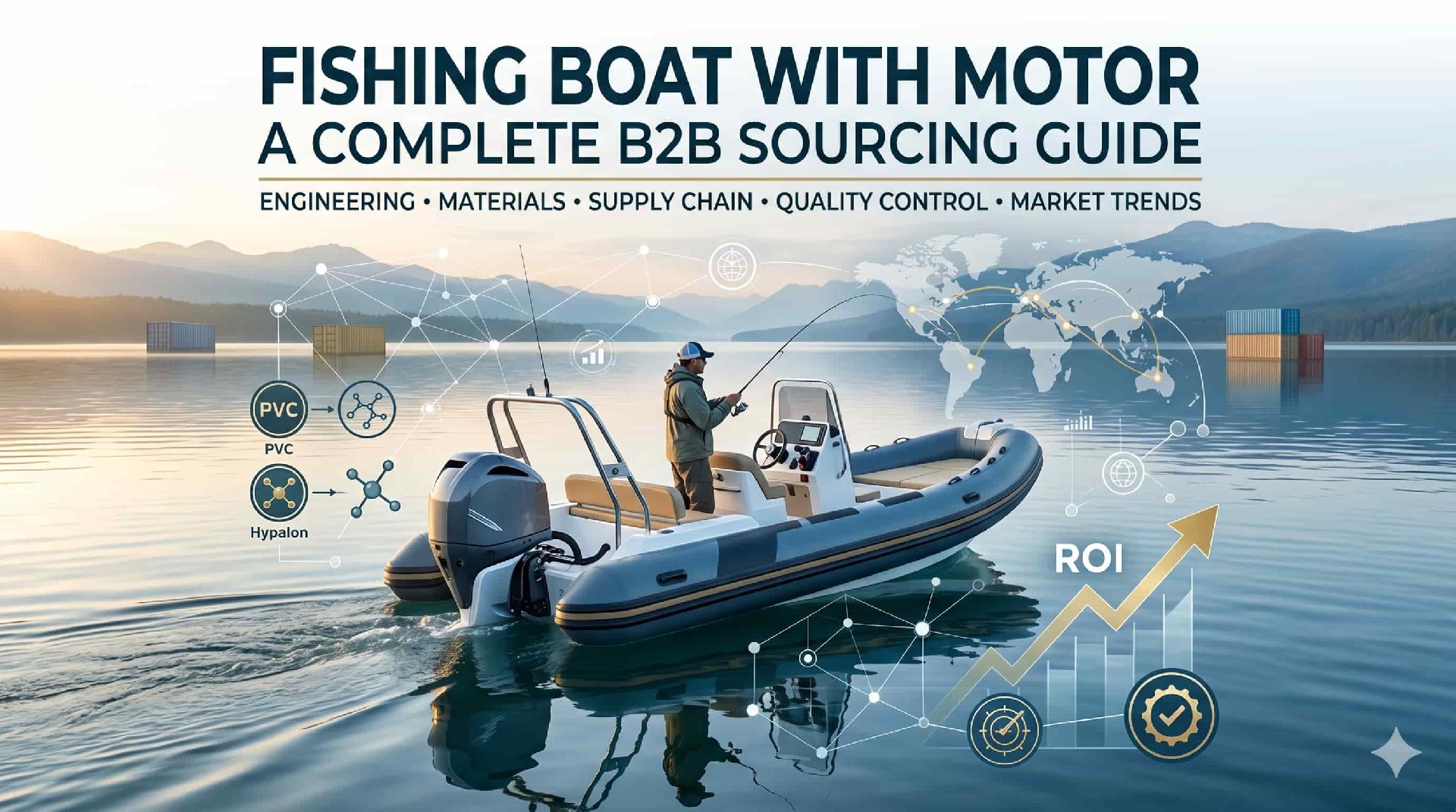
The Evolution and Mechanics of Motorized Fishing Vessels
The transformation of traditional angling vessels into highly efficient, motorized fishing platforms represents a significant leap in marine engineering. For B2B wholesale buyers, understanding the mechanical underpinning of these vessels is essential for communicating value to downstream retailers and end-users. A modern motorized fishing vessel is not merely a hull with an attached engine; it is a meticulously engineered system designed to balance buoyancy, drag, torque, and fuel efficiency.
Hydrodynamics and Hull Design Principles
The primary function of any fishing boat hull is to displace water efficiently while maintaining stability. When integrating a motor, the hydrodynamic dynamics shift dramatically. The hull must counteract the immense rotational torque generated by the propeller and the forward thrust that alters the vessel's center of gravity. For rigid hull boats, variations such as the V-hull, flat-bottom, and cathedral hull offer distinct advantages. A deep V-hull slices through choppy offshore waters, reducing impact forces on the passengers, whereas a flat-bottom design provides unparalleled stability in shallow, calm freshwater environments, making it ideal for casting.
In the realm of inflatables, the engineering relies heavily on the integration of drop-stitch flooring and rigid inflatable boat (RIB) designs. To calculate the theoretical maximum speed of a displacement hull before it begins to plane, marine architects use the formula for hull speed: $v = 1.34 \times \sqrt{LWL}$, where $v$ is the velocity in knots and $LWL$ is the waterline length in feet. While motorized fishing boats often utilize planing hulls to exceed this limit, understanding this foundational metric helps distributors assess the power-to-weight ratio required for optimal performance. (Source: Society of Naval Architects and Marine Engineers, 2023).
Integrating Trolling and Outboard Motors
The selection between electric trolling motors and traditional internal combustion outboard engines dictates the vessel's target market. Combustion engines, typically ranging from 2.5 HP to over 300 HP, provide the raw thrust necessary for rapid transit across large bodies of water. These engines operate on complex localized fuel delivery systems, requiring robust transom reinforcement to handle vibration and sheer stress.
Conversely, the rise of lithium-ion technology has revolutionized the electric outboard and trolling motor sector. Electric motors provide silent propulsion, which is a critical advantage for anglers stalking easily spooked fish species. Furthermore, they align perfectly with the growing consumer demand for eco-friendly outdoor recreation. A premium
Material Science in Modern Aquatic Recreation Gear
For cross-border trade professionals, the bill of materials (BOM) is the most critical determinant of a product's wholesale cost, durability, and warranty liability. The marine industry relies on highly specialized polymers and composites that must withstand ultraviolet (UV) radiation, saltwater corrosion, and mechanical abrasion.
PVC vs. Hypalon: The Inflatable Dilemma
When sourcing inflatable motorized fishing vessels, the choice between Polyvinyl Chloride (PVC) and Chlorosulfonated Polyethylene (commonly known by the trademark Hypalon) dictates the product's market positioning.
PVC is the industry standard for entry-to-mid-level boats. It is lightweight, highly flexible, and allows for thermal welding of seams—a manufacturing process that essentially melts two pieces of fabric into a single continuous barrier, virtually eliminating seam failure. Modern PVC fabrics are measured in Denier (typically 1000D to 2000D for marine applications) and are coated with UV stabilizers to prevent premature degradation.
Hypalon, on the other hand, is an elastomer that offers superior resistance to extreme temperatures, hydrocarbon exposure (fuel/oil spills), and intense UV radiation. However, Hypalon cannot be thermally welded; it must be cold-glued by hand in a labor-intensive process. This drives up the manufacturing cost and, consequently, the wholesale price. Distributors targeting tropical climates or commercial guide services generally opt for Hypalon, while those focusing on the broader consumer recreational market find highly-denier PVC to offer the best ROI. (Source: Global Inflatable Boat Market Report, Grand View Research, 2024).
The Role of Aluminum and Fiberglass in Transoms and Decking
Even in inflatable models, rigid components are necessary to support the motor and provide a stable casting platform. Marine-grade aluminum (such as 5052 or 6061 alloys) is frequently utilized for floorboards and transoms. Aluminum offers an exceptional strength-to-weight ratio and is inherently resistant to oxidation, especially when treated with anodization or powder-coating processes.
Fiberglass reinforced plastic (FRP) is another common material, particularly in the construction of RIBs. FRP provides a smooth, hydrodynamically efficient surface that drastically reduces drag. When evaluating a factory's capabilities, B2B buyers must inspect the lamination schedules and the type of resins (polyester, vinylester, or epoxy) used in the fiberglass components to ensure longevity and resistance to osmotic blistering.
B2B Wholesale and Cross-Border Trade Strategies
Successfully importing bulk shipments of fishing boats requires a deep understanding of international trade mechanisms, logistics optimization, and stringent quality assurance protocols. Unlike small consumer goods, marine equipment is bulky, heavily regulated, and requires significant capital outlay.
Navigating Minimum Order Quantities (MOQ) and OEM/ODM Services
In the B2B landscape, manufacturers operate on economies of scale. The Minimum Order Quantity (MOQ) for motorized fishing boats can range from 10 units for high-end RIBs to over 100 units for standard PVC inflatables. Buyers must negotiate these terms based on their warehousing capacity and cash flow.
Original Equipment Manufacturer (OEM) and Original Design Manufacturer (ODM) services are the lifeblood of cross-border marine trade. OEM allows distributors to place their proprietary branding on existing factory designs, offering a fast route to market. ODM involves collaborating with the factory's R&D department to create custom hull designs, specific material layups, or unique motor integration systems. Developing a proprietary line protects distributors from direct price competition and builds long-term brand equity in the outdoor recreation market.
Optimizing Container Logistics and Incoterms
Shipping air-filled or rigid structures across oceans requires masterful logistics. Inflatable boats offer a massive advantage here; they can be deflated and packed densely. A standard 40-foot High Cube (40HQ) shipping container might hold 10-15 fully rigid aluminum boats, but it can accommodate upwards of 150-200 deflated inflatable fishing boats. This drastic reduction in per-unit freight cost is a primary driver of the inflatable market's profitability.
Understanding Incoterms (International Commercial Terms) is non-negotiable. Most cross-border marine trade operates on FOB (Free On Board) or CIF (Cost, Insurance, and Freight) terms. Under FOB, the buyer assumes all risks and costs once the goods are loaded onto the vessel at the port of origin (e.g., FOB Shanghai). This gives the B2B buyer total control over their freight forwarder and shipping rates, which is crucial when dealing with oversized cargo where freight fluctuations can destroy profit margins.
Analyzing Global Market Trends and Consumer Demand
The outdoor and aquatic recreation sector has experienced a profound renaissance. As urbanization increases, consumers are aggressively seeking out nature-based leisure activities. This macro-trend has directly influenced the demand for specialized marine equipment.
The Surge in Accessible Aquatic Recreation
The demographic of the modern angler is shifting. Historically, boat ownership required substantial disposable income, dedicated trailer storage, and a large towing vehicle. The advent of highly durable, portable motorized fishing boats has democratized access to the water. Urban dwellers can now store a deflated boat in a closet, transport it in the trunk of a sedan, and assemble it at the water's edge in under 20 minutes using high-pressure electric pumps.
According to a 2024 analysis, the global recreational boating market is expected to grow at a Compound Annual Growth Rate (CAGR) of 5.8% through 2030, with portable and inflatable segments outpacing traditional rigid vessels. (Source: Recreational Boating Market Analysis, Fortune Business Insights, 2024). This data signals a clear directive for B2B wholesalers: the future of high-volume sales lies in portability without sacrificing performance.
Expanding the Product Portfolio for Cross-Selling
Savvy distributors do not rely solely on one product category. Building a comprehensive catalog of aquatic gear maximizes the Average Order Value (AOV) from retail partners. For instance, while a motorized boat serves as the flagship product, offering an
Similarly, incorporating a
Quality Control and International Compliance Standards
Importing a fishing boat with a motor involves stringent regulatory compliance. Because these products are categorized as vehicles meant for human transport on water, they are subject to intense safety scrutiny by government bodies worldwide.
The Importance of ISO and CE Certification
For distributors targeting the European Economic Area (EEA), the CE mark is legally required. For recreational craft, this falls under the Recreational Craft Directive (RCD) 2013/53/EU. This directive mandates rigorous testing for stability, freeboard, buoyancy, and flotation, as well as the structural integrity of the transom where the motor is mounted.
Globally, the International Organization for Standardization (ISO) provides the benchmark. ISO 6185 specifically dictates the safety requirements for inflatable boats. Part 1 covers boats with a maximum motor power of 4.5 kW, while Part 3 covers boats up to 15 kW. B2B buyers must demand legitimate, third-party verified test reports (from agencies like SGS or TUV Rheinland) from their manufacturing partners. A failure to comply can result in shipments being seized by customs, destroying capital and supply chain momentum.
Implementing Rigorous Factory Audits
Pre-shipment inspection (PSI) is a critical step in the procurement cycle. Relying solely on factory-provided photos is a catastrophic error in international trade. B2B wholesalers should employ independent inspection agencies to conduct Level II AQL (Acceptable Quality Limit) inspections.
For motorized fishing boats, inspectors must conduct 24-hour inflation tests to detect micro-leaks in the pontoons. They must physically inspect the thermo-welded or glued seams for delamination. Furthermore, the transom-to-tube bonding area—the most heavily stressed part of a motorized inflatable—must undergo stress testing to ensure it can withstand the torque of an outboard motor pushing through heavy currents.
Maximizing ROI: Pricing Strategies and After-Sales Support
Generating a sustainable profit margin in B2B wholesale requires more than just negotiating low factory prices; it requires a strategic approach to market positioning, tariff mitigation, and establishing robust after-sales infrastructure.
Cost Breakdown and Profit Margin Engineering
The Landed Cost of a fishing boat includes the factory EXW (Ex Works) price, domestic transport to the port, sea freight, marine insurance, import duties, and customs clearance fees. In the United States, for example, marine equipment falls under specific Harmonized System (HS) codes (e.g., 8903 for yachts and other vessels for pleasure or sports). Buyers must navigate potential Section 301 tariffs if importing from specific regions.
To maintain healthy gross margins (typically targeting 35-50% in B2B wholesale for recreational gear), distributors must optimize their container loads. A poorly packed container where dead space is shipped across the ocean eats directly into net profits. Furthermore, bulk purchasing of common accessories—such as aluminum oars, high-pressure foot pumps, and patch kits—can be negotiated at near-cost from the manufacturer, allowing the distributor to bundle them as high-value add-ons for retailers.
Monetizing After-Sales Service and Spare Parts
A major pain point for consumers buying imported marine gear is the lack of after-sales support. B2B wholesalers can turn this into a massive competitive advantage. By importing an extra 5% of inventory strictly in the form of spare parts (valves, transom mounts, PVC/Hypalon repair fabric, replacement air floors), a distributor can offer rapid warranty fulfillment.
This capability makes the distributor highly attractive to major retail chains, who dread handling complex customer returns. Furthermore, offering specialized repair services for motor mounts or air leaks creates an additional, high-margin revenue stream long after the initial product sale has been finalized.
The Future Landscape of Motorized Fishing Technology
As we look toward the next decade, the intersection of marine engineering and digital technology is creating a new paradigm for outdoor recreation. The modern fishing boat is becoming a smart, interconnected platform.
Smart Navigation and Sonar Integration
The days of manual sounding and basic GPS are fading. Today's premium fishing vessels are designed to integrate seamlessly with sophisticated fish finders, side-scan sonar, and live-imaging transducers. Manufacturers are now molding specific through-hull fittings and dedicated battery compartments into the floorboards of inflatable and rigid boats alike to accommodate these electronics without cluttering the deck.
Furthermore, GPS-enabled electric trolling motors can now communicate directly with the boat's main sonar unit. This allows for features like "Spot-Lock," where the motor automatically adjusts its thrust and direction to hold the boat in an exact GPS coordinate, fighting wind and current while the angler focuses entirely on casting.
Sustainable Propulsion and Advanced Materials
Environmental regulations on internal combustion engines are tightening globally, particularly on inland lakes and protected waterways. This regulatory pressure is rapidly accelerating the adoption of high-voltage electric outboards. Future iterations of these boats will likely feature flexible solar panels integrated directly into the bimini tops or even the pontoon fabric itself, providing trickle charges to the lithium battery banks to extend range indefinitely.
In terms of material science, researchers are developing next-generation thermoplastics (TPE/TPU) that offer the UV resistance of Hypalon, the weldability of PVC, and are 100% recyclable at the end of their lifecycle. B2B distributors who secure early supply chain access to these eco-friendly materials will dominate the procurement contracts of environmentally conscious retailers.
Frequently Asked Questions (FAQs)
1. What is the standard MOQ when sourcing a fishing boat with a motor from overseas factories?
Minimum Order Quantities (MOQ) typically range from 20 to 50 units for standard PVC inflatables to optimize container space. For high-end aluminum or fiberglass rigid hull boats, factories may allow MOQs as low as 5 to 10 units, depending on customization levels.
2. How do I choose between PVC and Hypalon for wholesale distribution?
PVC is highly cost-effective, easily mass-produced via thermal welding, and ideal for standard recreational markets. Hypalon is significantly more expensive and labor-intensive but offers superior UV and chemical resistance, making it strictly necessary for commercial guide services or extreme tropical climates.
3. What HS code is used for importing inflatable motorized fishing boats?
Inflatable vessels for pleasure or sports are generally classified under the Harmonized System (HS) code 8903.10. However, adding an internal combustion or electric motor may alter the classification or require separate declarations; always consult a licensed customs broker.
4. Are CE and ISO certifications mandatory for importing these vessels?
If you are distributing within the European Economic Area (EEA), CE certification under the Recreational Craft Directive is legally mandatory. In the US, compliance with USCG (United States Coast Guard) manufacturing standards and NMMA certification is highly recommended for retail acceptance.
5. How much thrust is required for an electric motor on a 10-foot inflatable boat?
A general industry rule is 2 pounds of thrust for every 100 pounds of total vessel weight (boat, gear, and passengers). For a fully loaded 10-foot inflatable fishing boat, a 55-lb thrust 12V electric trolling motor provides optimal speed and handling in standard conditions.
6. What is drop-stitch technology in modern inflatable fishing boats?
Drop-stitch technology involves thousands of fine polyester threads connecting the top and bottom interior surfaces of an air chamber. When inflated to high pressure (often 10-15 PSI), it creates a rock-hard, rigid surface, allowing anglers to stand and cast securely.
7. How can B2B buyers ensure the quality of factory production before shipping?
Never bypass third-party inspections. Employ an independent agency to conduct Level II AQL pre-shipment inspections. Mandate 24-hour inflation retention tests, visual inspections of all welded seams, and mechanical stress tests on the transom motor mounts.
8. What are the best shipping terms (Incoterms) for importing bulk marine gear?
FOB (Free On Board) is generally preferred by experienced B2B buyers. It allows you to control the freight forwarder, negotiate your own sea shipping rates, and maintain visibility over logistics once the factory delivers the goods to the origin port.
Conclusion
Successfully navigating the B2B landscape of aquatic recreation gear requires a synthesis of technical product knowledge and masterful supply chain management. From understanding the hydrodynamic variations between hull types to selecting the optimal polymer fabrics that balance cost with durability, sourcing a high-quality fishing boat with motor is a complex but highly rewarding endeavor. By enforcing strict quality control protocols, securing proper international certifications, and leveraging the logistical advantages of inflatable designs, wholesale distributors can realize substantial profit margins. As consumer trends continue to favor portable, eco-friendly, and technologically integrated outdoor gear, positioning your brand at the forefront of these innovations is critical.
Are you ready to elevate your B2B marine procurement strategy? Begin auditing your current supply chain today, demand higher transparency from your manufacturing partners, and diversify your catalog to capture the expanding global market for motorized fishing and aquatic recreation.
