

Abstract
What: This comprehensive technical whitepaper explores the advanced polymer engineering, international regulatory compliance frameworks, and global supply chain dynamics governing the commercial manufacturing of the
Why: Navigating the cross-border wholesale market in 2026 requires unprecedented technical precision. With the global pool float products market reaching USD 1.98 billion this year and shifting rapidly toward eco-compliance and commercial premiumization, B2B distributors face immense pressure. Procurement teams must strategically balance volatile raw material costs with rigorous chemical legislation—such as strict REACH orthophthalate bans—and highly compressed seasonal inventory cycles.
How: Wholesale buyers, brand managers, and procurement engineers will master actionable strategies for evaluating Polyvinyl Chloride (PVC) versus Thermoplastic Polyurethane (TPU) performance characteristics, executing zero-defect Quality Control (QC) protocols based on ISO 2859-1 AQL 2.5 standards, and optimizing OEM/ODM Minimum Order Quantities (MOQs) to significantly reduce landed costs and eliminate compliance liabilities at international customs.
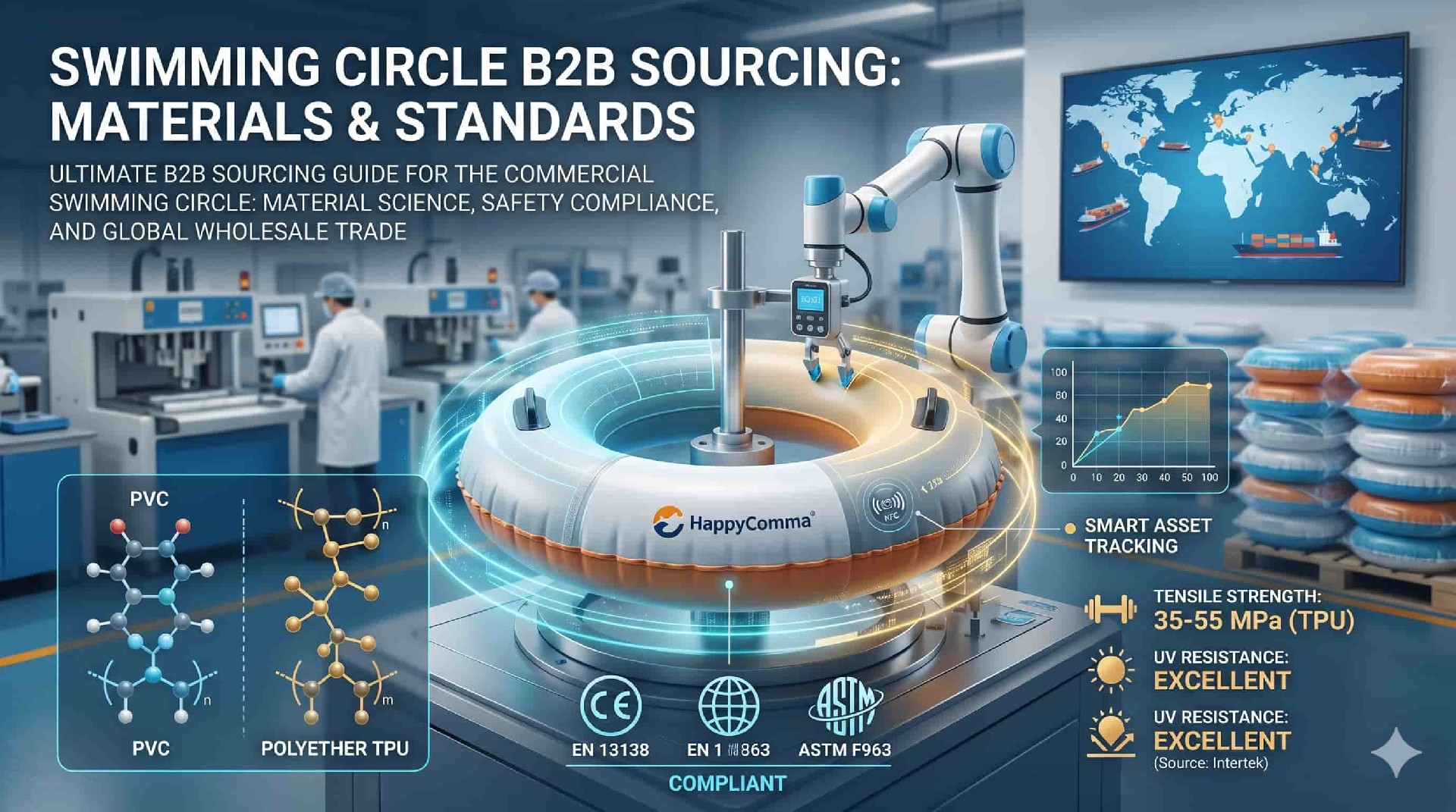
Global Market Dynamics & Wholesale Economics of B2B Inflatable Swim Rings
The global landscape for aquatic recreational equipment has transitioned from low-cost, disposable novelties into a highly regulated, high-margin commercial sector. Valued at USD 1.85 billion in 2025, the global pool float products market reached USD 1.98 billion in 2026 and is projected to expand at a Compound Annual Growth Rate (CAGR) of 5.8%, reaching USD 3.12 billion by 2034 (Source: Intel Market Research, 2026). This robust trajectory is largely driven by the premiumization of resort amenities, massive expansions in municipal aquatic centers, and heightened consumer demand for highly durable, multi-season performance gear.
Understanding the underlying wholesale economics requires analyzing the extreme seasonality inherent to this vertical. Industry data indicates that approximately 78% of annual retail sell-through occurs between May and August in Northern Hemisphere markets (Source: Global Market Insights, 2026). For B2B distributors and cross-border wholesalers, this compresses the primary procurement and manufacturing window into a highly critical timeframe. Bulk orders must be finalized in Q3 or early Q4 of the preceding year to allow for raw material extrusion, high-frequency welding, exhaustive quality retention testing, and multi-week ocean transit.
Furthermore, the commercial sector—encompassing luxury hotel chains, water parks, and recreational rental fleets—commands profit margins that are typically 200% to 300% higher than standard consumer retail options. However, these commercial clients impose rigorous longevity demands. A commercial-grade
Simultaneously, shifting geographic demand is reshaping cross-border supply chains. While North America and Western Europe remain the dominant revenue generators due to high household pool ownership rates (exceeding 68% in warm-climate zones), the Asia-Pacific (APAC) region represents the fastest-growing frontier. Driven by rapid urbanization and the continuous development of luxury coastal infrastructures, market penetration in emerging economies like India and Southeast Asia is expanding rapidly from a historical base of under 15% (Source: Intel Market Research, 2026). Wholesalers positioned to supply compliance-verified, commercial-grade aquatic products to these emerging hospitality sectors stand to capture significant market share over the next decade.
Polymer Engineering & Material Science: PVC vs. TPU in Swimming Float Manufacturing
Selecting the appropriate polymer substrate is the most critical decision in the engineering lifecycle of an inflatable aquatic device. The raw material dictates not only the physical durability and maximum load capacity of the product but also its global regulatory viability and total cost of manufacturing. The industry primarily relies on two major polymer classifications: Polyvinyl Chloride (PVC) and Thermoplastic Polyurethane (TPU).
Polyvinyl Chloride (PVC) Optimization
Standard unplasticized PVC is inherently rigid and brittle. To transform it into the flexible membrane required for an inflatable ring, manufacturers blend the base resin with liquid plasticizers. Historically, low-cost orthophthalates such as Di-2-ethylhexyl phthalate (DEHP), Dibutyl phthalate (DBP), and Benzyl butyl phthalate (BBP) were universally utilized. However, extensive global legislation, including the European Union’s REACH Annex XVII and the United States Consumer Product Safety Improvement Act (CPSIA), has strictly prohibited these compounds due to their documented endocrine-disrupting properties.
Modern commercial procurement mandates the use of non-toxic, eco-compliant plasticizers. Dioctyl terephthalate (DOTP) and various bio-based ester plasticizers have emerged as the industry standard, offering excellent processing efficiency without chemical leaching risks. In terms of structural dimension, material thickness (gauge) must be meticulously matched to the intended B2B application. While entry-level consumer floats utilize films ranging from 0.18mm to 0.22mm, a commercial-grade
Thermoplastic Polyurethane (TPU) Dynamics
TPU represents the pinnacle of premium inflatable material science. Unlike PVC, TPU achieves its remarkable elasticity and structural flexibility entirely through its internal block-copolymer molecular architecture, requiring zero chemical plasticizers. This completely eliminates the risk of plasticizer outgassing, surface migration, or embrittlement over extended operational lifespans.
When specifying TPU for aquatic applications, buyers must distinguish between two primary chemical formulations:
Polyether-Based TPU: Exhibits exceptional resistance to hydrolysis (chemical breakdown caused by prolonged immersion in water) and excellent low-temperature flexibility. This makes it the superior choice for high-end aquatic safety gear and commercial water sports equipment.
Polyester-Based TPU: Offers higher mechanical cut and tear resistance but is highly susceptible to hydrolytic degradation over time when continuously exposed to moisture. It should generally be avoided for permanent aquatic deployment.
The primary friction point for widespread TPU adoption in bulk B2B procurement is cost. Polyether TPU raw material indices typically command a 200% to 300% premium over equivalent heavy-duty PVC formulations. Consequently, TPU is strategically reserved for specialized niches, including professional swim training institutes, medical rehabilitation facilities, and ultra-luxury consumer lifestyle brands.
| Material Metric / Property | Heavy-Duty Calendered PVC | Polyether-Based TPU | Bio-Attributed EVA Blends |
| Typical Gauge Thickness | 0.30mm – 0.45mm | 0.20mm – 0.35mm | 0.40mm – 0.55mm |
| Tensile Strength (MPa) | 15 – 25 MPa | 35 – 55 MPa | 12 – 18 MPa |
| Hydrolysis Resistance | Moderate (Degrades over years) | Excellent (No degradation) | High (Inert to water) |
| Cold Crack Tolerance | -10°C | -30°C | -20°C |
| UV Degradation Resistance | Requires high TiO2 additives | Excellent native resistance | Moderate surface chalking |
| Chemical Leaching Risk | Low (If DOTP certified) | Zero (No plasticizers) | Zero |
| Raw Material Cost Index | 1.0x (Baseline) | 2.8x – 3.5x | 1.4x – 1.8x |
| Primary B2B Application | Commercial resorts, wholesale | Premium safety, luxury brands | Eco-conscious consumer lines |
International Compliance, Safety Certifications, and Testing for Aquatic Recreational Equipment
Navigating the complex matrix of international safety standards is mandatory for cross-border distributors. A major point of liability arises from misclassifying products at customs. Standard aquatic toys designed for shallow-water lounging are governed by relatively simple toy directives. However, any
European Framework: EN 13138 Standards
Category 2 PPE compliance requires a formal EU Type examination executed by an independent Notified Body (such as SGS, TUV Rheinland, or Intertek). The primary governing standard is EN 13138-1: Buoyant aids for swimming instruction - Part 1: Safety requirements and test methods for buoyant aids to be worn. Securing this certification requires passing highly rigorous mechanical and physical testing protocols:
Clause 5.2 (Conspicuity): The device must exhibit strong positive visual contrast against water surfaces under varied lighting conditions to ensure rapid detection by lifeguards. Subtle or highly camouflaged pantone schemes often fail this evaluation.
Clause 5.5 (Structural Integrity & Fastenings): Attached valves, seams, and structural components must undergo severe mechanical stress. The standard mandates that no small parts (which could pose choking hazards) detach when subjected to a direct, sustained axial pull force of 90N.
Clause 5.6 (Puncture & Pressure Resistance): The internal air chambers must maintain absolute airtight integrity after undergoing automated cyclic pressure evaluations. Furthermore, the material must resist complete depressurization when subjected to controlled puncture tests utilizing calibrated steel needles.
Clause 3.3 (Thermal Endurance): Devices are placed in specialized environmental chambers and subjected to sustained heat at 60°C for 4 hours. Following thermal exposure, the float must not suffer a loss of physical buoyancy exceeding 10% of its initial baseline value (Source: Intertek Total Quality Assurance, 2025). (Note: Compliant verification requires rigorous pre-testing of prototype batches prior to mass extrusion).
North American Framework: ASTM F963 & USCG Protocols
In the United States, standard recreational floats must comply with ASTM F963 (Standard Consumer Safety Specification for Toy Safety), which enforces stringent limits on heavy metal migration (lead, cadmium, barium) and physical edge sharpness. However, if the product makes explicit life-saving or active drowning-prevention claims, it shifts under the direct jurisdiction of the United States Coast Guard (USCG) as a Personal Flotation Device (PFD), requiring complex foam-core redundancy or specialized dual-chamber automated inflation mechanisms.
Valve Engineering and Safety Redundancy
A critical point of failure evaluated across all international protocols is the air retention valve. Importers must ensure their factory partners utilize non-return, dual-action safety valves rather than archaic single-plug designs. A compliant dual-action valve incorporates an internal elastomer check-flap that instantly seals the aperture when the external inflation nozzle is removed, preventing rapid air loss even if the primary external cap is accidentally popped open during aggressive aquatic play. Furthermore, the valve housing must be engineered to recess entirely flush with the outer polymer surface to eliminate skin abrasion liabilities.
Supply Chain Logistics & Quality Control Protocols for Durable PVC Swimming Circles
Executing a profitable cross-border importing operation requires highly synchronized quality control frameworks at the factory floor combined with optimized freight packing logistics. Inflatables are inherently prone to hidden manufacturing defects; therefore, post-production auditing must be highly systematic.
High-Frequency (HF) Dielectric Welding Mechanics
Mass production of durable PVC and TPU floats relies almost exclusively on High-Frequency (HF) Dielectric Welding, rather than standard conductive thermal sealing. In an HF welding line, two overlapping sheets of polymer are clamped between precision-machined brass or aluminum dies. An automated generator passes a highly concentrated alternating radio frequency field—typically operating at an internationally reserved ISM frequency of 27.12 MHz—through the substrate.
This intense electromagnetic field forces the polarized molecules within the polymer (specifically the carbon-chlorine dipoles in PVC) to oscillate millions of times per second. The resulting internal intermolecular friction generates instantaneous, localized heat right at the interface of the two sheets, melting the polymers together. Once the current ceases, a hydraulic press holds the dies shut while the material cools, forging an absolute molecular bond. When engineered correctly, an HF weld is physically stronger than the surrounding virgin sheet. Faulty welds—caused by improper die leveling, incorrect dwell times, or fluctuating RF voltage—result in micro-voids that manifest as slow leaks during field deployment.
High-Frequency Dielectric Welding Interface
=================================================================
[ Upper Precision Brass Welding Die ]  ---> Applies Hydraulic Pressure
-----------------------------------------------------------------
  Polymer Sheet A (Polarized Molecules Oscillating at 27.12 MHz)
  ~~~~~~~~~~~~~~~~~~~ intermolecular friction ~~~~~~~~~~~~~~~~~~~
  Polymer Sheet B (Polarized Molecules Oscillating at 27.12 MHz)
-----------------------------------------------------------------
[ Lower Grounded Automated Platen   ]
=================================================================
Quality Control (QC) Sampling and Testing Frameworks
To guarantee batch integrity before authorizing international wire transfers, B2B buyers must implement strict pre-shipment inspections governed by ISO 2859-1 sampling standards. Procurement teams should mandate an Acceptable Quality Level (AQL) of AQL 2.5 for Major Defects and AQL 4.0 for Minor Defects.
Critical Defects (AQL 0.0): Open seams, exposed sharp valve edges, or detection of restricted phthalates. Zero tolerance; results in immediate batch rejection.
Major Defects (AQL 2.5): Slow air leaks, non-functioning check valves, or severe structural asymmetry exceeding dimensional tolerances by more than 5%.
Minor Defects (AQL 4.0): Slight surface scuffs, minor localized print smudging, or imperfect packaging alignment.
Furthermore, premium commercial factories must incorporate a 100% Inflation Retention Protocol into their standard assembly lines. Every single completed unit must be inflated to its nominal operational pressure (typically 0.03 to 0.05 bar) and staged in a climate-controlled holding warehouse for 24 to 48 hours. Digital pressure sensors or precision visual measurement gauges monitor the units. Any product exhibiting a structural pressure drop exceeding established thresholds is immediately pulled from the pack line and scrapped.
Freight and Volumetric Space Optimization
In global shipping logistics, inflatable products present a unique challenge: if improperly processed, they carry exceptionally high volumetric weight (dimensional weight), inflating landed costs per unit. Importers shipping via Full Container Load (FCL) or Less than Container Load (LCL) must enforce aggressive factory-level deflation and compression protocols.
Advanced production lines utilize automated vacuum-extraction systems that actively evacuate all residual air from the chambers post-testing. The flattened rings are then processed through precision mechanical folding jigs to ensure absolute uniformity before being sealed inside tight PE polybags. By consolidating these highly compressed units into heavy-duty, double-wall corrugated master cartons perfectly dimensioned to align with standard Euro Pallets (1200mm x 800mm) or Standard US Pallets (48in x 40in), logistics engineers can eliminate up to 35% of dead cargo space. This directly maximizes the total cubic meter (CBM) density inside a standard 40-foot High Cube ocean container, drastically driving down the landed freight cost per individual unit.
B2B Procurement Strategies: Customization, MOQs, and OEM/ODM Aquatic Gear Production
For enterprise buyers, selecting the right manufacturing model and navigating production constraints is essential to preserving margins and meeting tight launch windows. Sourcing executives generally choose between two distinct operational pathways: Original Equipment Manufacturing (OEM) and Original Design Manufacturing (ODM).
Executing OEM vs. ODM Workflows
OEM (Custom Execution): Under an OEM contract, the wholesale buyer provides complete proprietary technical assets, including precise 3D CAD models, exact polymer formulation swatches, custom pantone color codes, and unique valve placements. This pathway is highly protective of brand IP but requires substantial capital investment. Buyers must fund custom brass welding tooling dies, which typically range from USD 1,500 to USD 5,000 per unique size mold, and accept extended prototyping lead times (usually 4 to 6 weeks prior to mass extrusion).
ODM (Private Labeling): The ODM model allows buyers to select from a factory's extensive library of pre-engineered, fully tested internal molds. The buyer customizes the exterior surface graphics, packaging, and brand logos. This dramatically slashes initial development costs to near zero and accelerates time-to-market, making it highly advantageous for mid-sized distributors looking to capture emerging seasonal trends rapidly.
Advanced Surface Printing Technologies
Customizing a commercial
Silk-Screen Printing: The historical industry workhorse. Precision mesh screens apply individual layers of spot-color ink directly onto the uncalendered polymer film before HF welding. Silk-screening delivers highly vibrant, opaque colors that bond deeply with PVC substrates, offering excellent resistance against UV fading and chemical peeling. However, because each distinct color requires its own dedicated screen setup, factories enforce high Minimum Order Quantities—typically starting at 3,000 to 5,000 units per design—to amortize fixed setup expenses.
UV Digital Printing: Utilizes advanced wide-format industrial inkjet arrays to deposit specialized UV-curable inks directly onto the substrate, which are instantly polymerized by integrated LED UV lamps. This enables photorealistic CMYK graphics, complex continuous gradients, and variable data integration without any physical screen setup. Consequently, MOQs can drop to as low as 500 units. The trade-off is structural: digital UV ink layers sit closer to the surface than penetrating screen inks, making them slightly more susceptible to long-term scratching in highly abrasive commercial environments, and the baseline ink cost per square meter is noticeably higher.
Regardless of the method chosen, procurement contracts must legally bind the manufacturer to utilize inks certified under EN 71-3 (Specification for migration of certain elements), ensuring absolutely zero heavy metal or toxic solvent transfer occurs when the printed surface comes into prolonged contact with human skin or chlorinated water.
Strategic Sourcing Timeline Optimization
To successfully execute a global wholesale distribution campaign for the 2026/2027 Northern Hemisphere summer season, procurement managers must strictly enforce a reverse-engineered lead time calendar. Slippage at any stage risks arriving at customs after the peak retail window closes.
Synchronized B2B Sourcing Timeline (Reverse-Engineered for May Sell-Through)
=============================================================================
[ OCT ] ---> Finalize OEM/ODM Contracts, Approve CAD Files & Tooling Dies
[ NOV ] ---> Authorize Bulk Raw Material Polymer Extrusion & Ink Mixing
[ DEC ] ---> Execute Mass High-Frequency Welding & 100% Retention Testing
[ JAN ] ---> Conduct ISO 2859-1 Pre-Shipment Inspections & Container Loading
[ FEB ] ---> Ocean Freight Transit (e.g., Shenzhen to Port of Los Angeles)
[ MAR ] ---> Customs Clearance, Tariff Processing & Regional Distribution
[ APR ] ---> Final Delivery to Commercial Resorts & Retail Warehouses
=============================================================================
Future Innovations in Water Sports Gear: Eco-Polymers and Smart Inflatable Technologies
As environmental regulations tighten globally and commercial clients demand higher operational efficiencies, the technical landscape for aquatic gear is evolving rapidly. Successful long-term sourcing requires aligning product roadmaps with key emerging mega-trends.
Transitioning to Sustainable Eco-Polymers
The intense scrutiny surrounding virgin petroleum-based single-use plastics is driving massive R&D investments into sustainable polymer alternatives. Leading chemical manufacturers are scaling the production of Bio-Attributed PVC, which replaces fossil-fuel-derived ethylene with renewable biomass feedstocks (such as tall oil or specialized agricultural waste) during the cracking process. This maintains the exact physical dielectric welding properties of standard PVC while drastically reducing the overall carbon footprint.
Simultaneously, highly durable Ethylene-Vinyl Acetate (EVA) and TPU blends integrated with natural organic fillers (like microscopic bamboo dust or algae-derived biopolymers) are gaining traction. For internal air chambers where visual clarity is irrelevant, premium brands are increasingly specifying membranes extruded entirely from post-consumer recycled (PCR) ocean-bound plastics. Wholesalers who proactively secure certified supply chains for these eco-polymers will command premium pricing power as global ESG mandates become compulsory for municipal and resort procurement.
IoT Integration and Smart Flotation Safety
The integration of passive and active smart technologies into aquatic gear transforms simple inflatables into highly functional safety devices.
Photochromic UV-Indicating Surfaces: Advanced manufacturing lines are printing localized warning badges directly onto the top deck of the
Swimming Circle Embedded RFID & NFC Asset Tracking: For large-scale commercial water parks and resort rental fleets, managing inventory loss and tracking lifecycle depreciation is a massive operational headache. Modern commercial floats are being manufactured with ultra-thin, completely waterproof passive RFID or NFC chips permanently sealed inside the multi-layer HF welded flange seams. Water park operators can instantly scan stacks of returned floats utilizing handheld terminals to log exact rental durations, verify cleaning cycles, automate inventory counts, and actively identify units approaching their maximum recommended UV-exposure lifespans.
Frequently Asked Questions (FAQs) About Commercial Swim Rings
1. What is the standard material thickness required for a commercial-grade swimming circle?
Commercial applications demand high-density calendered Polyvinyl Chloride (PVC) with a gauge thickness ranging from 0.30mm to 0.45mm. This significantly exceeds standard retail floats (0.18mm) to ensure long-term resistance against seam splitting, user abrasion, and continuous exposure to highly chlorinated aquatic environments.
2. How do European REACH regulations impact the wholesale procurement of inflatable pool floats?
REACH Annex XVII strictly prohibits the use of harmful orthophthalate plasticizers like DEHP, DBP, and BBP in aquatic products. B2B buyers must ensure their manufacturing partners utilize certified non-toxic alternatives, such as DOTP, and provide updated laboratory test reports to clear European customs seamlessly.
3. What is the difference between EN 13138 and EN 71 testing standards for swim rings?
EN 71 applies exclusively to standard aquatic toys designed for shallow water play. Conversely, EN 13138 governs Category 2 Personal Protective Equipment (PPE) intended as buoyant aids for swimming instruction, requiring much stricter physical testing, including 90N pull tests and extreme puncture resistance assessments.
4. Why is high-frequency (HF) welding preferred over hot-air sealing for inflatable floats?
High-frequency welding utilizes electromagnetic energy to excite polar molecules within the polymer sheets, creating an internal molecular bond. This process yields a perfectly uniform, airtight seam that matches the parent material's strength, eliminating the weak points and thermal degradation commonly associated with surface hot-air sealing.
5. What is the typical Minimum Order Quantity (MOQ) for custom-printed wholesale swim rings?
For traditional silk-screen printing, MOQs generally range between 3,000 and 5,000 units to offset screen setup expenses. However, utilizing existing factory molds combined with modern UV digital printing can reduce MOQs to 500 units, albeit at a slightly higher unit cost.
6. How can importers reduce the landed cost of bulk inflatable aquatic equipment?
Importers should mandate vacuum-compression packing protocols at the factory level. Extracting all residual air and utilizing flat-pack configurations minimizes master carton dimensions, optimizing pallet density. This drastically lowers the volumetric weight, slashing expensive shipping freight rates per unit across global trade lanes.
7. Are Thermoplastic Polyurethane (TPU) swim rings worth the premium cost over PVC?
TPU provides superior elasticity, exceptional tear resistance, and contains zero plasticizers, making it highly durable and completely non-toxic. While raw material costs are up to 300% higher than PVC, TPU is highly recommended for premium luxury brands, eco-conscious markets, and commercial rental fleets.
8. What quality control inspection standards should buyers enforce prior to shipment?
B2B buyers should enforce standard ISO 2859-1 pre-shipment inspections utilizing an Acceptable Quality Level (AQL) of 2.5 for major structural defects and 4.0 for minor cosmetic flaws. Additionally, factories must verify a 100% inflation retention test lasting at least 24 hours.
Conclusion & Strategic Next Steps for Aquatic Equipment Distributors
The cross-border wholesale procurement of a high-performance, commercially viable
Take Immediate Action: Elevate your commercial aquatic product portfolio and completely eliminate compliance liabilities at customs. Partner with our specialized B2B engineering and trade compliance division today to access fully certified OEM/ODM production lines, request physical polymer swatches validated under EN 13138-1 and REACH standards, and secure guaranteed high-frequency manufacturing allocations ahead of the impending seasonal demand rush.
