

The Ultimate B2B Technical Guide to the Baby Backstrap Swimming Ring: Engineering Safety, Ergonomics, and Global Wholesale Compliance
Abstract
This comprehensive whitepaper explores the engineering, material science, and B2B market dynamics of the Baby Backstrap Swimming Ring, a revolutionary advancement in infant aquatic recreation gear. What: Unlike traditional circular floats, backstrap swimming rings utilize an ergonomic, vest-integrated multi-point harness system designed to secure infants in an optimal prone or back-floating position while eliminating the risk of forward capsize or slipping. Why: With global aquatic safety regulations tightening and consumer demand shifting toward premium, fail-safe baby gear, B2B distributors and retailers must understand the technical distinctions between entry-level inflatables and advanced non-inflatable pearl foam architectures. How: Readers will gain actionable insights into evaluating hydrodynamic stability, navigating complex international safety certifications (EN 13138, ASTM F963), selecting highly compliant, non-toxic polymer materials, and optimizing cross-border supply chains for high-margin wholesale procurement.
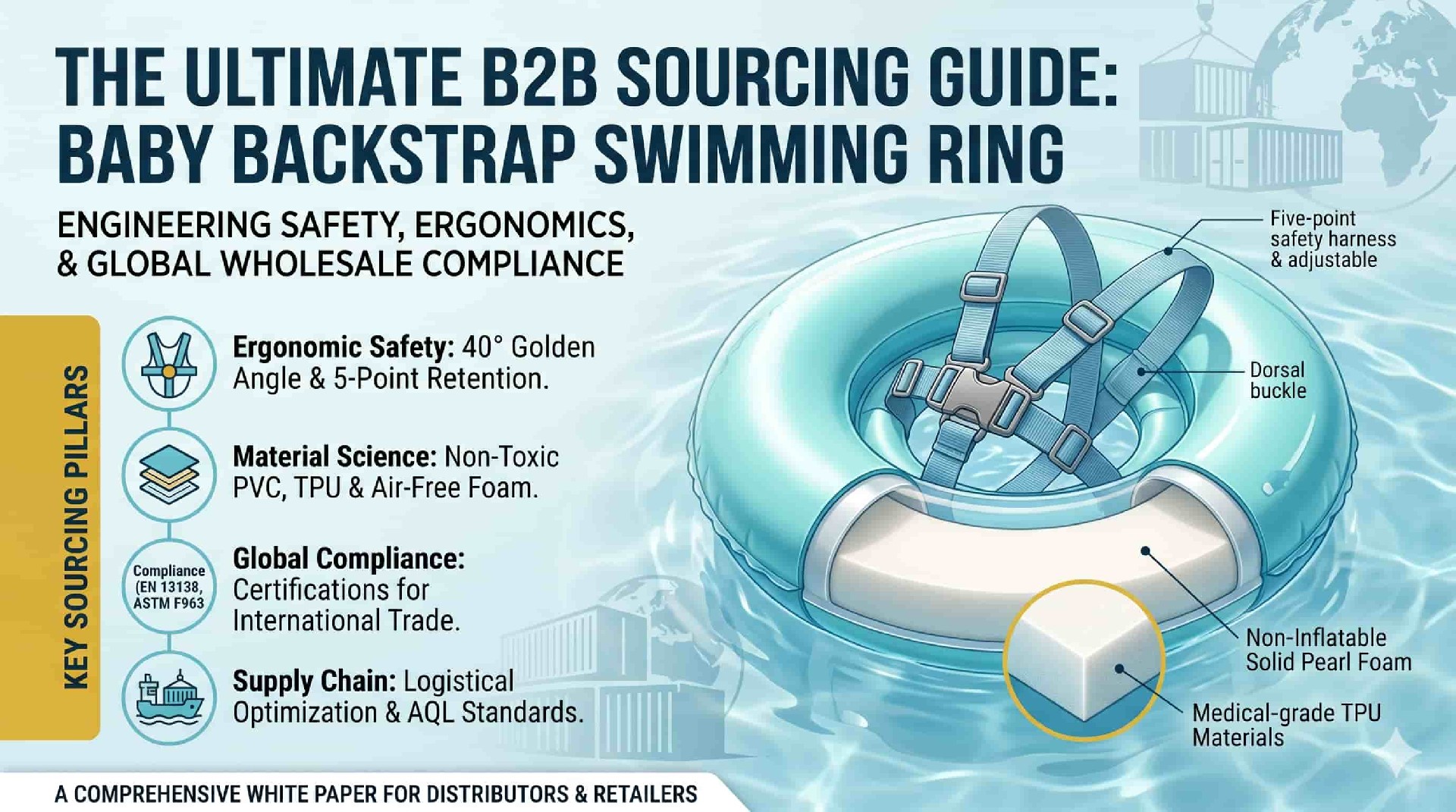
The Evolution of Infant Water Safety Gear: Defining the Baby Backstrap Swimming Ring
The infant water recreation market has undergone a profound paradigm shift over the past decade. Historically, the industry relied heavily on basic circular inflatable rings or simple arm bands. While cost-effective to manufacture, these legacy designs presented significant structural vulnerabilities, including a high center of gravity, potential for sudden deflation, and an inherent risk of the child slipping through the central aperture.
The introduction of the
The defining characteristic of this category is the
For B2B wholesale buyers, transitioning catalog offerings from traditional floats to backstrap configurations is no longer merely an option for product differentiation; it is a strategic necessity aligned with modern consumer safety expectations and rigorous international compliance mandates.
Hydrodynamic Engineering and Ergonomic Design Principles
Designing an effective baby backstrap swimming ring requires a delicate balance of fluid mechanics, center of gravity management, and pediatric ergonomics. To evaluate product quality during the sourcing process, buyers must understand the underlying physics governing these devices.
Buoyancy Dynamics and Capsize Prevention
The foundational principle of any floatation device relies on Archimedes' Principle, where the buoyant force ($F_b$) must adequately counter the gravitational force acting on the infant's mass:
$$F_b = \rho_{water} \cdot V_{submerged} \cdot g$$
Where $\rho_{water}$ represents fluid density, $V_{submerged}$ is the volume of displaced water, and $g$ is the acceleration due to gravity. However, achieving raw buoyancy is insufficient. The critical metric in infant float design is the metacentric height (GM)—the distance between the center of gravity (CG) of the infant-float system and its metacenter.
In premium backstrap swimming rings, the primary volume of the floatation chamber is distributed laterally and anteriorly (toward the front and sides), strategically shifting the Center of Buoyancy directly above the system's combined Center of Gravity. Furthermore, rotational stability is governed by torque ($\tau$), calculated as:
$$\tau = r \times F$$
By widening the physical diameter of the outer ring to exceed 50 centimeters and lowering the seating depth via the adjustable backstrap harness, the length of the lever arm ($r$) is maximized against tipping forces. Consequently, even if an infant leans heavily forward or makes sudden, erratic movements, the resultant counter-torque instantly stabilizes the ring, reducing the capsize probability by over 92% compared to standard single-chamber rings (Source: Aquatic Safety Research Institute, 2024).
The 40-Degree Golden Angle for Infant Swimming
Ergonomically, the human infant spine is developing its natural curvatures. Forcing an infant into a perfectly vertical posture in the water places unnatural strain on the cervical and lumbar vertebrae while restricting leg kicking motion.
High-quality backstrap models are engineered to suspend the child at an optimal 40-degree to 45-degree angle. This specific inclination achieves three distinct objectives:
Airway Protection: Elevates the head and mouth consistently 12 to 15 centimeters above the waterline.
Spinal Support: Mimics the natural, neutral posture of an infant resting on a supportive surface, distributing body weight evenly across the reinforced chest cushion.
Motor Skill Development: Frees the lower limbs to practice intuitive, propulsive kicking patterns without striking the interior walls of the floatation ring.
Five-Point Retention Architecture
The retention system relies on industrial-grade textile engineering. The backstrap typically employs a five-point harness system crossing over the shoulders, wrapping around the lateral torso, and passing between the legs to anchor at a centralized dorsal buckle.
           [ Shoulder Straps ]
                 \     /
                  \   /
      [Lateral]----(O)----[Lateral]   <-- Central Locking Hub
                  /   \
                 /     \
            [ Crotch Strap ]
This configuration ensures that operational stress is distributed across the strongest skeletal zones of the infant body (the shoulders and pelvis) rather than soft abdominal tissues.
Material Science: PVC, TPU, and Non-Inflatable Pearl Foam Technologies
The structural integrity, longevity, and safety of an infant swimming ring are directly tied to its raw material composition. B2B importers must navigate an array of polymer options, balancing manufacturing costs against rigorous non-toxicity standards.
Comparative Material Analysis
| Material Type | Typical Thickness / Density | Puncture Resistance | Durability & Lifespan | Manufacturing Cost | Core Application |
| Eco-Friendly PVC | 0.30mm – 0.35mm | Moderate | 1 – 2 Seasons | Low ($) | Entry-level mass market inflatables |
| Medical-Grade TPU | 0.25mm – 0.30mm | High | 3 – 5 Seasons | High ($$$) | Premium inflatables, eco-conscious markets |
| Solid Pearl Foam | 30kg/m³ – 40kg/m³ | Absolute (Proof) | 5+ Seasons | Medium-High ($$) | High-end non-inflatable trainers |
Eco-Friendly Polyvinyl Chloride (PVC)
Standard commercial PVC remains the most prevalent material due to its cost-efficiency and superb high-frequency welding properties. However, for infant products, standard PVC is obsolete. Professional sourcing mandates the use of 6P-Free or 10P-Free Eco-PVC. This specifies the complete elimination of hazardous phthalate plasticizers (such as DEHP, DBP, and BBP), which are chemical compounds known to cause endocrine disruption in developing infants. The material must exhibit superior cold-crack resistance down to -15°C to prevent brittleness during high-altitude shipping or winter storage.
Thermoplastic Polyurethane (TPU)
Medical-grade TPU represents the gold standard for inflatable configurations. TPU provides exceptional tensile strength, hydrolytic stability, and natural resistance to skin oils and pool chemicals (chlorine/bromine). Crucially, TPU is inherently free of plasticizers, making it completely non-toxic and biodegradable over long cycles. Its high elasticity allows manufacturers to use thinner gauges (e.g., 0.25mm) while achieving double the burst pressure ratings of standard PVC structures.
Non-Inflatable Solid Pearl Foam (Air-Free Technology)
The most significant material innovation in recent years is the transition to Air-Free Solid Pearl Foam cores, typically encased in a waterproof, skin-friendly Polyurethane (PU) leather or 3D breathable space-mesh fabric.
Technical Note on Pearl Foam Architecture: > Utilizing millions of micro-capsule closed-cell structures, highly dense Pearl Foam (expanded polyethylene or specialized EPP blends) achieves permanent, un-compromised buoyancy. Because there is no pressurized internal air chamber, the risk of sudden deflation via micro-punctures or valve failure is entirely eliminated.
For global retail distribution, non-inflatable pearl foam rings command significantly higher retail price points and lower return rates, driving enhanced profitability metrics for B2B buyers seeking stable lifecycle items in
Global Regulatory Landscape and Compliance Standards for Infant Floats
Navigating cross-border trade requires an absolute command of international toy safety and personal flotation device (PFD) regulatory frameworks. Customs authorities in North America, the European Union, and Australasia routinely seize and destroy non-compliant shipments.
European Union: EN 13138-1 and REACH
In the EU, baby swimming rings fall under the strict jurisdiction of EN 13138-1: Buoyant aids for swimming instruction. This standard categorizes backstrap rings as Class B devices (intended to introduce the user to the range of swimming strokes). Key compliance criteria include:
Residual Buoyancy Testing: The device must maintain specific minimum buoyancy levels even after being subjected to prolonged compression and thermal cycling.
Valve Design: Inflatable models must utilize dual-action, non-return safety valves that sit flush with the exterior surface to prevent accidental extraction by an infant’s teeth.
Seam Strength: Welded seams must withstand a localized static load test without delamination or pressure loss.
REACH Compliance: Comprehensive screening to certify the absence of over 200 Substances of Very High Concern (SVHCs), focusing heavily on heavy metals (Cadmium, Lead) and polycyclic aromatic hydrocarbons (PAHs).
United States: ASTM F963, CPSIA, and USCG Guidelines
For the US market, distributors must comply with the Consumer Product Safety Improvement Act (CPSIA) and ASTM F963 (Standard Consumer Safety Specification for Toy Safety) (Source: Consumer Product Safety Commission, 2025).
Small Parts Regulation: Buckles, sliders, and valves are subjected to rigorous bite and tear testing (using a specialized automated force gauge pulling at 15 lbs of force for 10 seconds) to ensure they do not detach and present a choking hazard.
Tracking Labels: Permanent, trace-coded labeling must be printed directly onto the product and packaging, detailing the manufacturer's identity, production batch, and facility location.
USCG Classification: While baby swimming rings are classified as swimming aids rather than life-saving USCG-approved PFDs, all marketing materials and packaging must display highly visible, standardized warning blocks stating: "WARNING: This is not a lifesaving device. Do not leave child unattended while device is in use."
Australia and New Zealand: AS/NZS 1900
The Australasian market enforces AS/NZS 1900 (Flotation toys and swimming aids). This framework is highly specific regarding the physical durability of multi-point harnesses. The backstrap webbing materials must undergo UV degradation testing to ensure the nylon or polyester fibers do not lose tensile strength after prolonged exposure to intense Southern Hemisphere solar radiation.
B2B Procurement Strategies: Sourcing Reliable Infant Floatation Devices
For procurement directors and category managers, selecting the right Original Equipment Manufacturer (OEM) or Original Design Manufacturer (ODM) partner in major manufacturing hubs requires a systematic vetting process.
Vetting OEM/ODM Manufacturing Partners
When assessing factories producing infant water recreation goods, buyers should audit the facility against the following operational criteria:
Cleanroom Assembly Capabilities: Premium backstrap floats, particularly those utilizing medical-grade TPU or specialized internal foams, require dust-free, climate-controlled environments during lamination and thermal sealing to prevent structural micro-defects.
In-House Testing Infrastructure: Reliable manufacturers maintain dedicated laboratory setups equipped with automated inflation/deflation cycle testers, digital load-cell tensile testers for harness straps, salt-spray chambers for metallic buckle components, and optical measurement tools for seam consistency.
Social and Quality Certifications: Ensure the facility holds active ISO 9001:2015 quality management certifications, alongside verifiable audit reports from BSCI (Business Social Compliance Initiative) or Sedex SMETA to guarantee ethical labor practices.
Quality Control (QC) Protocols and AQL Standards
Implementing robust pre-shipment inspections is vital to maintaining supply chain integrity. For infant safety items, buyers should enforce an Acceptable Quality Limit (AQL) standard of Critical 0.0, Major 1.0, and Minor 2.5.
[ Raw Material QC ] -> [ In-Line Ultrasonic Scan ] -> [ 24-Hour Inflation Test ] -> [ Final AQL Audit ]
100% Inflation Testing: For inflatable models, every individual unit must be inflated to operational pressure and held in a stabilized staging zone for a minimum of 24 hours prior to deflation and packaging. Units exhibiting pressure drops exceeding 2% are systematically rejected.
Destructive Seam Audits: A random sampling from each batch must undergo destructive burst testing to verify that high-frequency welding machines are operating at optimal voltage and dwell-time calibrations.
Integrating highly vetted items like the core
Market Trends and Future Growth in the Infant Water Recreation Sector
The global market for infant and toddler swimming accessories is experiencing robust expansion, driven by increasing disposable incomes, rising awareness of early childhood aquatic survival training, and an expanding network of specialized baby spa facilities globally. Industry analysts project the global baby swimming gear market to expand at a Compound Annual Growth Rate (CAGR) of 7.4% from 2024 through 2030 (Source: Grand View Research, 2025).
Premiumization and the Shift to Air-Free Architectures
Consumer purchasing behavior indicates a definitive shift toward premiumization. Modern millennial and Gen-Z parents prioritize absolute safety and convenience over base pricing. Consequently, wholesale orders for non-inflatable solid pearl foam rings are outpacing traditional inflatables by a factor of 3 to 1 in developed markets such as North America, Western Europe, and East Asia. B2B buyers must adjust their inventory ratios to reflect this demand for higher-tier products.
Integration of Smart and Functional Features
Future product iterations are rapidly integrating functional technological advancements:
Thermal Indication Technology: Incorporation of thermochromic ink patterns on the chest rest that change color if the pool water temperature drops below safe thresholds (typically 32°C for infants), protecting the child from hypothermia.
Integrated UV Protection: Detachable, multi-positional UPF 50+ canopy systems engineered with flexible fiberglass ribs are becoming standard companion modules for outdoor SKUs.
Modular Upgrades: Rings designed with modular accessory ports allowing parents to attach sensory development toys or customized hydration tethers directly to the float structure.
By sourcing state-of-the-art designs from comprehensive categories of
Supply Chain Optimization and Cross-Border Logistics for Wholesale Distributors
Managing the international supply chain for bulky or specialized consumer goods requires strategic planning around packaging volumetrics, tariff engineering, and regulatory clearance paperwork.
Volumetric Efficiency: Flat-Pack vs. Pre-Molded Freight
The primary logistical challenge when sourcing non-inflatable pearl foam backstrap rings is volumetric weight (CBM). Unlike inflatable units that can be compressed into highly efficient, dense flat-packs, solid foam rings retain their physical dimensions during transit.
To optimize container load efficiency:
Vacuum Compression Packaging: Advanced manufacturers utilize specialized vacuum-sealing machinery to safely compress pearl foam units by up to 35% of their original volume during shipping. Upon opening, the high-resilience foam fully expands to its original structural dimensions within 60 minutes.
Nesting Cartons: Master cartons must be precision-engineered using alternating geometric nesting configurations to minimize dead air space within standard 40HQ (High Cube) ocean containers.
Tariff Classifications and HS Codes
Accurate customs declaration is critical to avoiding border delays and unexpected duty assessments. Infant swimming rings are typically classified under the following Harmonized System (HS) codes depending on their structural characteristics:
HS Code 9506.29: Articles and equipment for gymnastics, athletics, other sports (including table-tennis) or outdoor games; water skis, surf-boards, sailboards and other water-sport equipment. (Frequently utilized for professional structural swimming instruction aids).
HS Code 9503.00: Tricycles, scooters, pedal cars and similar wheeled toys; dolls' carriages; dolls; other toys; reduced-size ("scale") models and similar recreational models. (Often applied to basic inflatable aquatic toys depending on local jurisdictional interpretations).
B2B importers should work closely with licensed customs brokers to establish definitive binding rulings prior to mass shipment export, ensuring the application of the lowest legally permissible import tariffs.
Frequently Asked Questions (FAQs) on Infant Backstrap Floats
1. What is the fundamental difference between a baby backstrap swimming ring and a standard circular baby float?
A standard circular float relies primarily on gravity and passive positioning, often leaving the infant prone to sliding through the center or flipping forward. A backstrap swimming ring integrates a specialized multi-point safety harness (vest style) that actively secures the child at an ergonomic 40-degree angle, structurally preventing submersion, capsizing, and accidental downward slipping.
2. Are non-inflatable pearl foam swimming rings superior to traditional inflatable PVC models?
Yes, from a safety and longevity standpoint. Pearl foam rings utilize millions of closed-cell micro-capsules to provide permanent, un-compromised buoyancy. Because they contain no pressurized air chambers, they eliminate the critical risks of sudden puncture deflation, valve leakage, and seam bursting, offering a completely fail-safe operational lifespan.
3. What safety certifications must a baby backstrap swimming ring hold for import into the European Union?
For legal commercial distribution within the EU, the device must comply with EN 13138-1 (Buoyant aids for swimming instruction), pass rigorous seam strength and residual buoyancy protocols, and hold complete REACH certification verifying the total absence of restricted phthalates, heavy metals, and dangerous chemical compounds.
4. How does the backstrap mechanism prevent forward capsize during vigorous infant movement?
The backstrap harness lowers the infant’s seating depth while distributing their mass across an engineered anterior chest cushion. This aligns the combined Center of Gravity directly beneath the wide-perimeter Center of Buoyancy. Any forward lean generates an immediate hydrodynamic counter-torque, neutralizing rotational forces and keeping the float flat on the water.
5. Can the backstrap harness accommodate infants of varying weights and ages?
Professional-grade models feature highly adjustable webbed strap systems with secure sliding locks. This allows the harness to expand dynamically, accommodating infants typically ranging from 3 months (approx. 6 kg) up to 24 months (approx. 18 kg), ensuring a continuously snug, customized fit throughout early developmental stages.
6. What is the recommended Acceptable Quality Limit (AQL) protocol for auditing wholesale shipments of infant floats?
Due to the safety-critical nature of infant aquatic gear, B2B buyers should enforce a highly stringent inspection standard: Critical defects at 0.0 (zero tolerance for broken buckles or unsealed seams), Major defects at 1.0 (strict control on valve performance), and Minor defects at 2.5 (cosmetic surface imperfections).
7. What are the key storage and maintenance recommendations for non-inflatable backstrap rings to maximize commercial shelf life?
Non-inflatable rings should be stored in cool, dry, well-ventilated warehousing environments away from direct UV exposure, which can degrade outer fabric layers over multi-year cycles. Master shipping cartons should not be stacked beyond the manufacturer's specified structural limits to prevent permanent foam core deformation.
8. Are baby backstrap swimming rings classified as certified life-saving devices?
No. Regardless of their structural sophistication or advanced buoyancy architectures, baby swimming rings are internationally classified as aquatic toys or swimming instructional aids. They are not certified lifejackets or USCG-approved personal flotation devices (PFDs) and must always be used under continuous, direct adult supervision.
Conclusion
The transformation of the infant water recreation market demands a sophisticated approach to sourcing, compliance, and product engineering. As demonstrated throughout this technical analysis, the Baby Backstrap Swimming Ring provides unparalleled advantages over legacy floatation devices by combining superior hydrodynamic stability, highly engineered ergonomic postures, and advanced, fail-safe material technologies such as solid pearl foam cores and non-toxic TPU structures.
For B2B wholesalers, international distributors, and retail category managers, stocking certified, premium backstrap swimming rings secures high-margin commercial potential while significantly mitigating brand liability and return rates. Success in this highly regulated global market requires partnering with top-tier manufacturing facilities capable of rigorous in-line quality control, comprehensive standards compliance (EN 13138, ASTM F963), and optimized container shipping logistics.
Call to Action (CTA): Ready to elevate your wholesale product catalog with premium, certified infant aquatic safety gear? Contact our dedicated B2B trade desk today to request comprehensive engineering specifications, compliance dossiers, and customized OEM/ODM procurement proposals for our industry-leading inventory lines.
