

The Strategic Guide to Christmas Snowman Manufacturing and Wholesale
Abstract:This comprehensive white paper explores the evolution of the Christmas Snowman from a traditional yard ornament into a high-tech, multi-billion dollar segment of the global seasonal decoration market. As we approach the 2026 holiday season, the industry is witnessing a significant shift toward sustainable materials, integrated smart-lighting technologies, and optimized B2B supply chain logistics. Retailers and distributors must navigate a landscape defined by fluctuating raw material costs (such as PVC and specialized textiles) and the increasing demand for "Smart Holiday" ecosystems. This article provides a deep dive into the manufacturing innovations driving product durability, the economic impact of seasonal consumer shifts, and actionable procurement strategies for global wholesalers. By analyzing data from the National Retail Federation and recent industrial manufacturing reports, we provide the technical and commercial insights necessary for businesses to secure a competitive edge in the high-stakes Q4 market. Readers will gain an understanding of how to leverage RPA-driven inventory management and material science to maximize ROI in the outdoor holiday leisure sector.
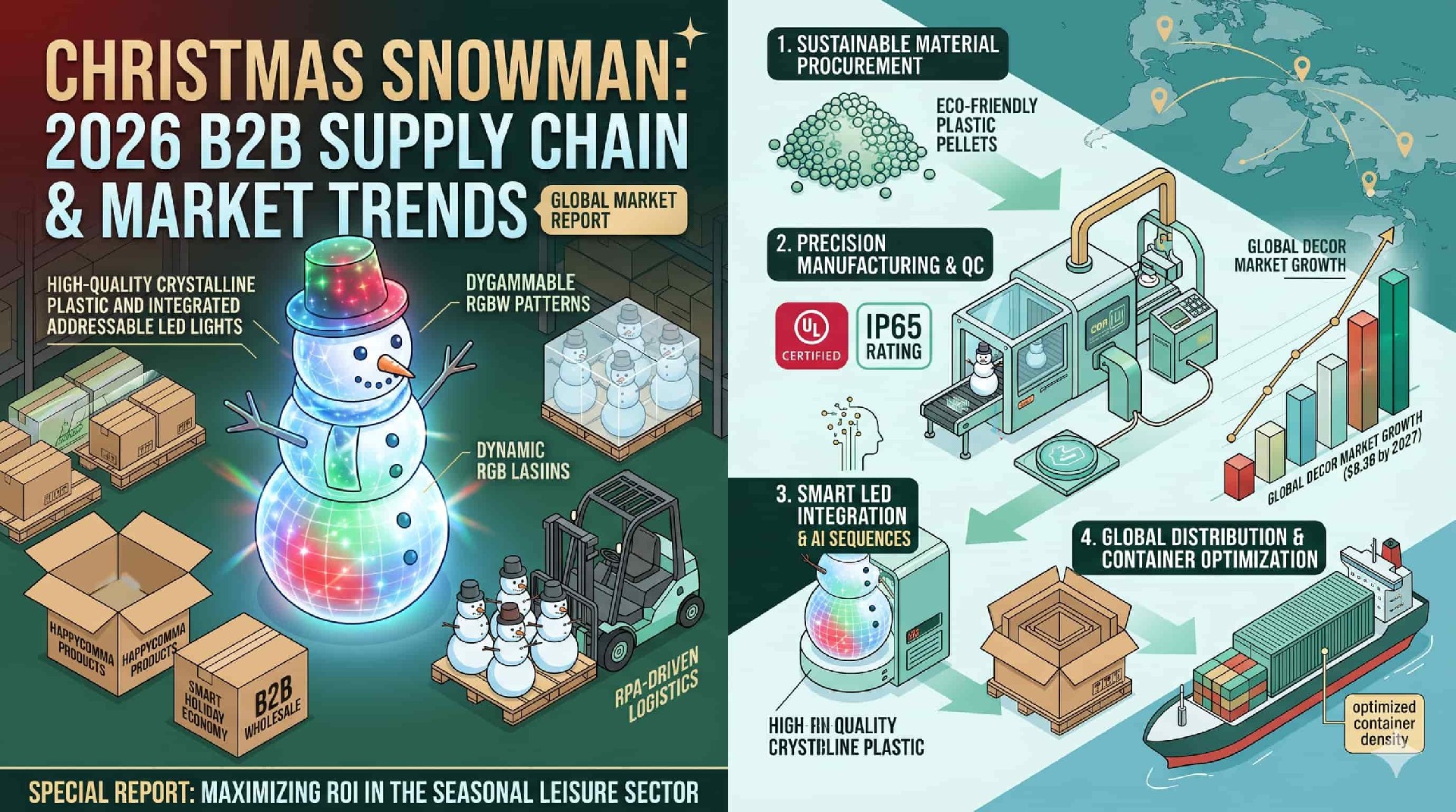
1. Global Market Analysis: The Economic Resilience of Seasonal Decor
The global Christmas decoration market is no longer a peripheral industry; it is a central pillar of the annual retail cycle. According to recent market projections, the seasonal decor sector is expected to reach a valuation of approximately $8.3 billion by 2027, growing at a CAGR of 3.8% (Source: Statista, 2025). Within this broader category, the Christmas Snowman—available in formats ranging from heavy-duty inflatables to crystalline rigid structures—represents one of the most stable sub-categories in terms of consumer demand.
For B2B stakeholders, the resilience of the
2. Material Science in Modern Snowman Manufacturing
The transition from "disposable decor" to "durable assets" is driven primarily by advancements in material science. For a B2B buyer, understanding the technical specifications of these materials is crucial for quality assurance and brand reputation.
2.1 Technical Textiles for Inflatable Structures
Inflatable
Tensile Strength: High-denier fabrics prevent tearing under high wind loads, a common point of failure for outdoor installations.
Hydrophobic Coatings: Advanced PU (Polyurethane) coatings ensure that the fabric does not absorb water, which can lead to mold during storage and added weight that stresses the internal blower motor.
2.2 Rigid and Crystalline Frameworks
For high-end architectural displays, manufacturers are utilizing acrylic (PMMA) and polycarbonate shells reinforced with internal aluminum frames. These materials offer superior clarity for LED light refraction. According to a report by Materials Today (2025), the use of recycled polycarbonate in seasonal goods has increased by 15% year-over-year, reflecting the industry's pivot toward circular economy principles.
3. Engineering the "Smart" Snowman: Lighting and Automation
The integration of IoT (Internet of Things) has transformed the
3.1 Advanced LED Integration
Traditional incandescent bulbs have been entirely phased out in favor of RGBW (Red, Green, Blue, White) LED systems.
Luminous Efficacy: Modern LEDs used in seasonal decor now exceed 100 lumens per watt, significantly reducing the energy footprint for large-scale municipal displays.
IP Ratings: For outdoor reliability, a minimum of IP44 (splash-proof) is required, though premium commercial models are increasingly moving toward IP65 (water-jet proof) to withstand extreme winter storms.
3.2 AI-Driven Lighting Sequences
The latest generation of premium snowman figures features addressable LEDs that can be synchronized via mobile apps or DMX512 controllers used in professional stage lighting. This allows commercial venues to program light shows that match their corporate branding or local festivities, adding a layer of "experiential retail" that traditional decor cannot match.
4. Manufacturing Processes and Quality Control (QC)
To ensure high-volume reliability, the manufacturing of a Christmas Snowman involves several critical phases where precision is non-negotiable.
4.1 Precision Cutting and Ultrasonic Welding
For inflatables, the move from manual stitching to ultrasonic welding has been a game-changer. This process uses high-frequency vibrations to create a molecular bond between fabric layers, resulting in seams that are 30% stronger than traditional thread-and-needle methods (Source: Journal of Industrial Textiles, 2024).
4.2 Blower Motor Calibration
The "heart" of any inflatable snowman is its blower. Modern blowers are now engineered with brushless DC motors, which offer:
Extended Lifespan: Up to 20,000 hours of continuous operation.
Noise Reduction: Operating at under 50 decibels (dB), making them suitable for indoor residential use and quiet neighborhood environments.
Thermal Protection: Integrated sensors that shut down the motor if it exceeds a specific temperature, preventing fire hazards.
5. B2B Supply Chain & Logistics: Navigating the Q4 Peak
The seasonal nature of the Christmas decor industry creates a "bullwhip effect" in the supply chain. For wholesalers, the window for success is narrow, requiring meticulous planning.
5.1 Lead Times and Production Cycles
Typically, the production cycle for a Christmas Snowman intended for the North American or European market begins in January and February.
Q1-Q2: Prototyping and bulk material procurement.
Q3: Mass production and quality inspections.
Late Q3/Early Q4: Trans-oceanic shipping and regional distribution.
5.2 Optimizing Container Utilization
Logistics costs can account for up to 25% of the landed cost of a snowman product. Manufacturers are now utilizing RPA (Robotic Process Automation) to optimize "nesting" in packaging—ensuring that the maximum number of units fits into a 40ft High Cube container. For inflatables, vacuum-sealing technology has allowed for a 40% increase in container density, significantly lowering the carbon footprint per unit and the overall freight cost.
6. The Sustainability Mandate: Eco-Friendly Decorations
Sustainability is no longer a niche preference; it is a B2B requirement. Corporate Social Responsibility (CSR) policies of major retailers like Walmart and Target now mandate strict adherence to environmental standards.
6.1 Biodegradable and Recycled Plastics
The industry is exploring the use of PLA (Polylactic Acid) for rigid snowman components. While the cost is currently 12-18% higher than traditional plastics, the market demand for "Green Christmas" options is allowing for premium pricing that offsets the production cost.
6.2 Energy Conservation
The integration of solar-powered charging for small-to-medium outdoor
7. Procurement Strategies for Wholesalers and Distributors
To maximize profitability in the 2026 season, B2B buyers should adopt a multi-pronged approach to sourcing.
Diversify Supplier Base: Do not rely on a single manufacturing hub. While China remains the leader in seasonal decor production, emerging hubs in Southeast Asia are offering competitive pricing on labor-intensive hand-painted snowman figures.
Tiered Quality Strategy: Offer a "Good-Better-Best" product ladder.
Entry-level: 190T Polyester inflatables for mass retail.
Mid-range: LED-integrated acrylic structures for garden centers.
Premium: DMX-controlled, commercial-grade fiberglass figures for the B2B hospitality sector.
Early-Bird Contracts: Secure manufacturing capacity by March to avoid the "peak season surcharge" that factories often apply during the July-August rush.
FAQs: Frequently Asked Questions about Christmas Snowman Procurement
Q1: What is the average MOQ (Minimum Order Quantity) for custom-designed snowmen?
For standard inflatable models, MOQs typically start at 500 units. For high-end rigid fiberglass or acrylic models, MOQs can be as low as 20-50 units due to the higher unit price and specialized manufacturing process.
Q2: How do I ensure the snowman meets safety standards for North American markets?
Ensure the manufacturer provides UL (Underwriters Laboratories) or ETL certification for all electrical components, including blowers and LED adapters. Compliance with ASTM F963 is also essential for products that might be accessible to children.
Q3: What is the expected lifespan of a commercial-grade inflatable snowman?
A well-maintained commercial-grade inflatable, made from 210D Oxford fabric with a brushless motor, should last for 3 to 5 holiday seasons (approx. 90-150 days of continuous outdoor use).
Q4: Are there specific storage requirements to prevent damage during the off-season?
Yes. Products must be completely dry before packing to prevent mildew. Store in a cool, dry environment away from direct sunlight, ideally in rodent-proof containers, as certain insulation materials in blowers can attract pests.
Q5: How have shipping costs affected the price of large Christmas decorations recently?
While container rates have stabilized compared to the 2021-2022 peak, "Dimensional Weight" (DIM weight) pricing remains a factor. This is why collapsible or inflatable designs are significantly more profitable for B2B distributors than pre-assembled rigid figures.
Q6: Can I request "Smart Home" integration (Alexa/Google Home) for these products?
Absolutely. Many tier-1 manufacturers now offer Wi-Fi or Bluetooth-enabled controllers as an OEM option. This allows end-users to schedule lighting and inflation via voice commands or mobile apps.
Q7: What are the most popular sizes for retail versus commercial use?
For residential retail, 4ft to 6ft (1.2m to 1.8m) is the "sweet spot." For commercial installations or municipal parks, demand usually starts at 10ft (3m) and can go as high as 30ft (9m) for landmark displays.
Q8: Is it better to source fiberglass or inflatable snowmen for heavy-snow regions?
In regions with heavy snowfall, rigid fiberglass is superior as it can support the weight of accumulated snow. Inflatables may "collapse" under heavy snow loads if the internal pressure is insufficient, though premium models with high-output blowers can mitigate this.
8. Conclusion: The Future of the Christmas Snowman Industry
The Christmas Snowman remains an indispensable asset in the global holiday decor portfolio. However, the path to profitability in 2026 and beyond requires a sophisticated understanding of technical specifications, environmental compliance, and logistical efficiency. As consumer expectations shift toward "smart" and "sustainable," the B2B winners will be those who move beyond basic price-point competition and focus on delivering high-durability, technologically advanced products.
Whether you are a big-box retailer or a specialized distributor, the key is to prioritize certified safety, material longevity, and innovative lighting. By aligning your procurement strategy with these industrial trends, you ensure that your seasonal inventory not only sells out but also builds long-term brand equity.
Ready to upgrade your seasonal inventory?Explore our full range of commercial-grade holiday solutions and
