

Repairing Heavy-Duty PVC: A Technical Overview
For commercial operators of heavy-duty inflatable equipment, a puncture is not a matter of 'if' but 'when'. The downtime caused by a leaking chamber translates directly into lost revenue, delayed operations, or compromised safety. While a patch kit is an essential part of any field kit, the selection of the correct adhesive for a repair is a critical engineering decision that determines the long-term reliability of the asset. Using the wrong glue can lead to a failed bond, an enlarged hole, or a compromised material structure. This guide provides a commercial and technical framework for selecting the best adhesive for repairing heavy-duty PVC in your specific application.
The Prime Directive: Matching Adhesive to PVC Type
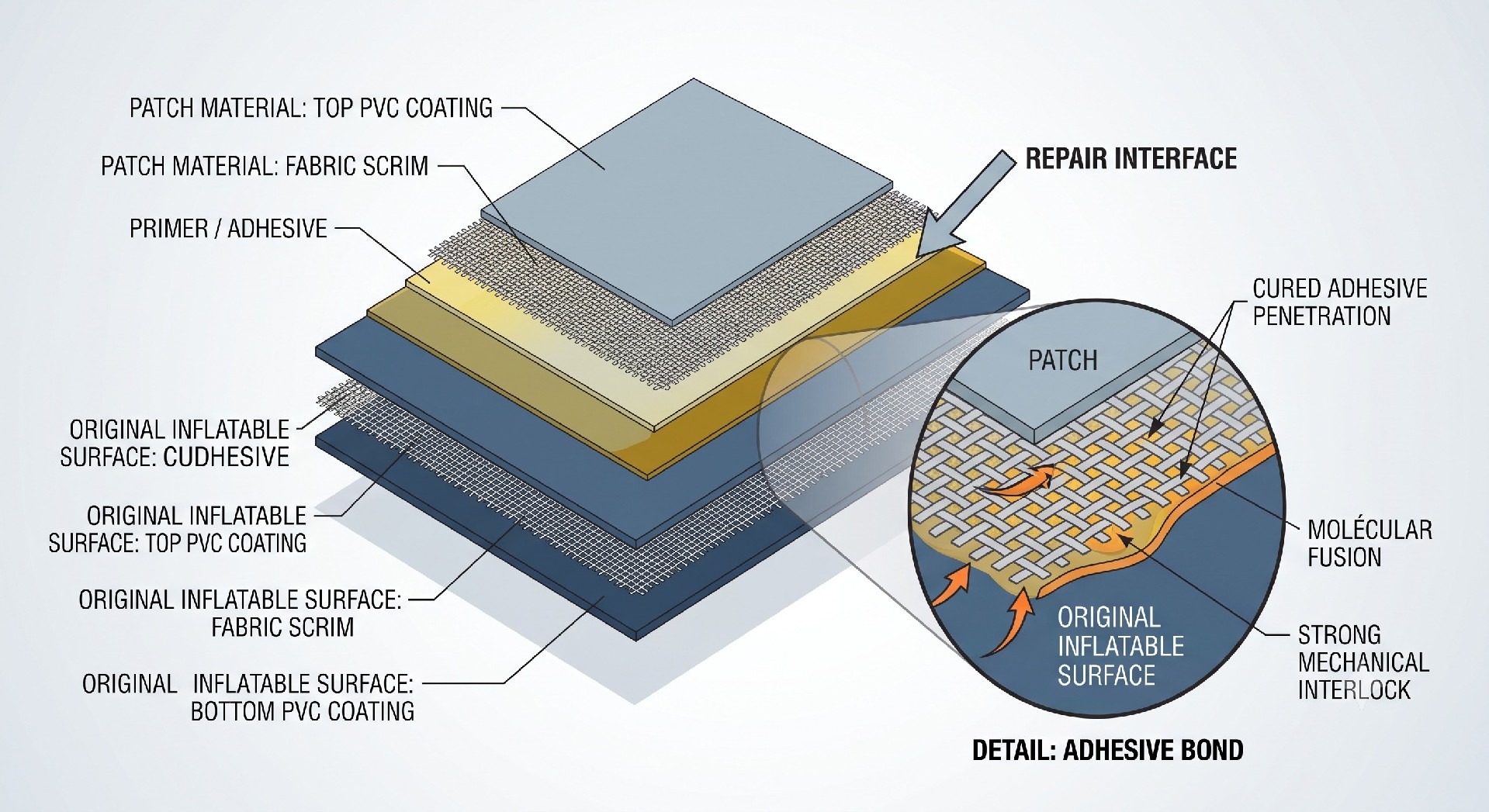
The term 'PVC' covers a broad spectrum of materials. In the context of heavy-duty inflatables, the PVC is usually a coated fabric—a high-tenacity polyester or nylon scrim coated with a plastisol or polymer-based PVC layer. The adhesive you choose must be chemically compatible with the specific coating formulation.
Common Adhesive Types and Their Applications
Two-Part PVC Adhesives (e.g., SC-2000, HH-66): This is the industry standard for professional repairs on all types of heavy-duty PVC inflatables. It is a solvent-based contact cement that uses a chemical reaction to cure. It offers a strong, flexible bond that can withstand the working pressures and flexing typical of commercial equipment.
Single-Part PVC Solvent Cements: These are easier to use for small, emergency repairs. They work by dissolving the surface layer of the PVC, welding the patch to the material. While quick, the bond is often more brittle and may not have the same long-term durability as a two-part adhesive, particularly under high pressure or UV exposure.
Cyanoacrylate (Super Glue) and Epoxies: These are generally unsuitable for flexible PVC. They cure to a hard, brittle state that will crack and fail under the flexural stress of an inflatable. They are only appropriate for bonding rigid components like valves to the fabric, and even then, a flexible epoxy is preferred.
For most commercial applications, a two-part adhesive is the preferred choice for its superior strength, flexibility, and resistance to environmental factors.
Critical Adhesive Performance Metrics
When evaluating adhesives for your fleet, consider the following performance characteristics. These are not universal absolutes but are typical of high-quality commercial-grade two-part products. Verify these values against the product's technical data sheet (TDS).
Peel Strength: Measured in pounds per lineal inch (PLI) or Newtons per millimeter (N/mm), this indicates how much force is required to pull the patch away from the base material. A higher value is better. A typical target for heavy-duty applications is often above 30 PLI.
Shear Strength: This is the adhesive's resistance to forces acting parallel to the bond line, such as the pressure pushing outwards on a patch. This is a critical metric for internal patches or repairs on high-pressure drop-stitch materials.
Temperature Range: The adhesive must maintain its bond across the operational temperature range of the equipment. For a tropical resort, you need an adhesive that won't soften in high heat. For winter deployment, it must remain flexible in freezing temperatures.
Cure Time: In a commercial rental operation, time is money. Faster cure times reduce downtime, but a faster cure can sometimes compromise ultimate bond strength. Understanding the 'tack time' and full cure time is essential for workflow planning.
| Adhesive Type | Best For | Key Commercial Advantage | Potential Drawback |
|---|---|---|---|
| Two-Part (e.g., SC-2000, Stabond) | All heavy-duty commercial repairs | Strongest, most durable bond, excellent water/UV resistance | Requires mixing, longer full cure time, more expensive |
| Single-Part Solvent Cement | Small, non-critical repairs; quick fixes | Easy to apply, no mixing, fast initial bond | Brittle bond, shorter shelf life, lower ultimate strength |
| Cyanoacrylate / Epoxy | Rigid component bonding (valves, D-rings) | Very strong on rigid substrates, gap-filling properties | Unsuitable for flexible fabric, will crack under stress |
| Self-Vulcanizing Tape | Emergency/temporary field repairs | No drying time, works on wet surfaces, very easy to apply | Temporary solution only, not a permanent structural bond |
Best Adhesive for Specific Product Classes
While a two-part PVC cement is a great starting point, the specific product class and its operating environment can make one brand or formulation more suitable than another. Here is a breakdown for common heavy-duty PVC inflatables.
Inflatable Watercraft
For SUPs, kayaks, and rafts, the adhesive must withstand constant water immersion, UV radiation, and flexing. Two-part adhesives like Stabond are extremely popular in the whitewater industry. Their high initial tack makes them excellent for field repairs when you need to get back on the water quickly after a full cure is not strictly possible.
Inflatable Docks and Marine Platforms
These are often subjected to high static loads, constant UV exposure, and abrasion from foot traffic and mooring lines. An adhesive that cures to a firm but flexible finish is ideal. Products like SC-2000 are well-regarded for their excellent water and UV resistance, making them suitable for heavy-duty applications where the patch must maintain its strength over long periods.
Inflatable Amusement and Bounce Houses
Safety and inspections are the primary concerns for these products. The adhesive must meet the requirements of standards like EN 14960. A strong, permanent bond is required to prevent seam failure. The choice of adhesive is often dictated by the specific PVC or vinyl used by the original equipment manufacturer (OEM) to ensure the repair doesn't void any safety certifications. Adhesives that cure to a clear finish are preferred for a more professional appearance.
Repair Procedure: A Step-by-Step Commercial Protocol
The best adhesive will fail if the surface preparation is not meticulous. A robust repair process is as much about the procedure as the product.
Isolate and Depressurize: Completely deflate the equipment. This is non-negotiable for a successful bond.
Clean the Area: Wash the area around the puncture with a mild solvent like isopropyl alcohol or a dedicated PVC cleaner. This removes oils, dirt, and surface contaminants that can inhibit adhesion.
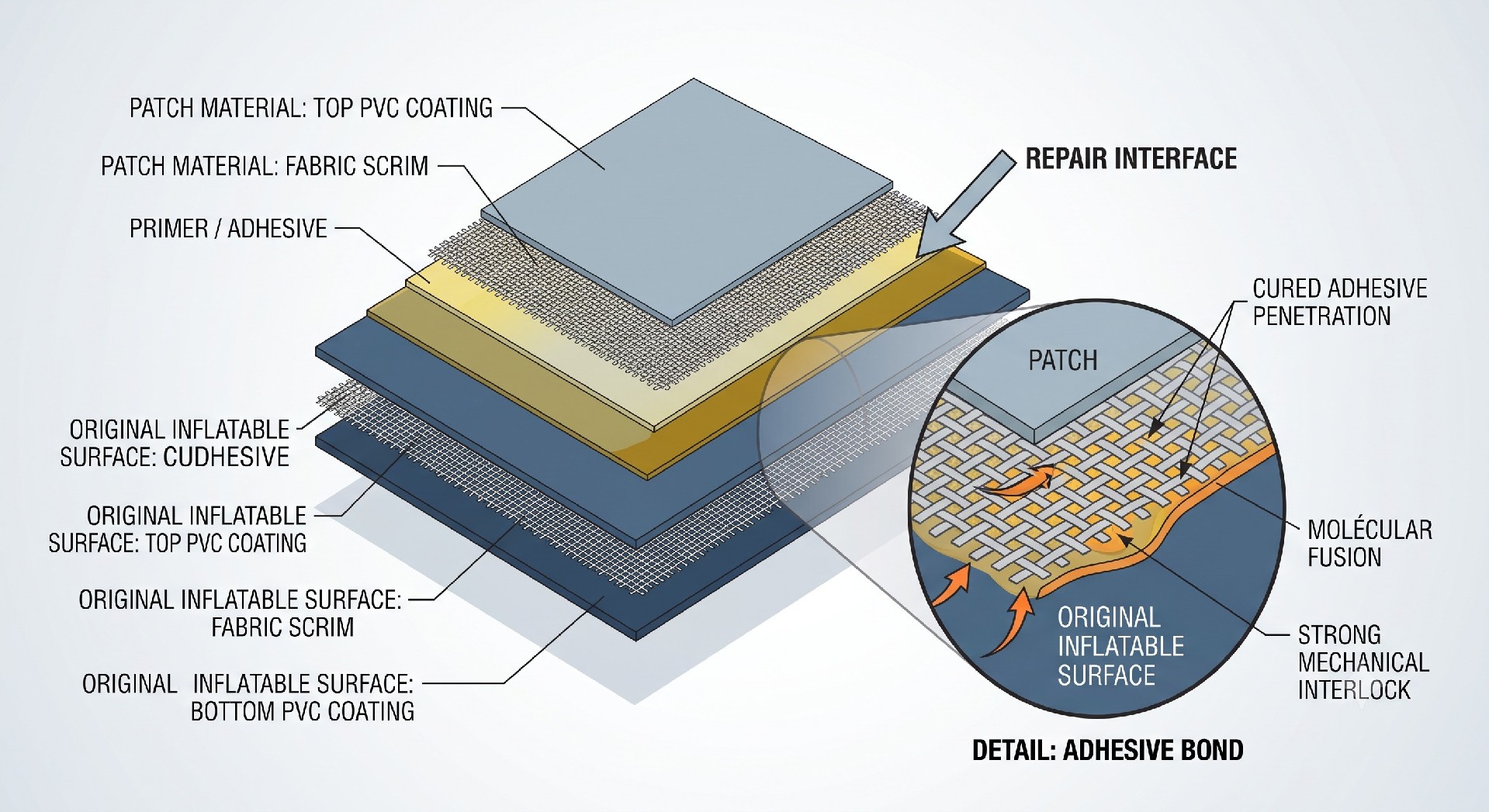
Abrasion (Scuffing): Lightly scuff the surface with fine-grit sandpaper (e.g., 120-220 grit). This creates a 'tooth' for the adhesive to mechanically grip and removes the outer oxidized layer of the PVC. Be careful not to sand into the fabric scrim.
Second Cleaning: Clean the abraded area again with solvent to remove any dust and debris.
Apply Adhesive and Patch: For two-part adhesives, apply a thin, even coat to both the patch and the area around the puncture. Allow it to become 'tacky' to the touch (usually 5-15 minutes depending on humidity and temperature). For solvent cements, apply and press immediately.
Bonding: Carefully position the patch and apply firm, even pressure. For field repairs, a hand roller is sufficient to remove air bubbles. For the strongest possible bond, use a specialized roller or a clamp with a flat, padded plate to maintain consistent pressure while the adhesive cures.
Cure: Allow the adhesive to cure for its full specified time before re-inflating. A full cure is essential to achieve maximum peel and shear strength. Rushing this step is the most common cause of repair failure.
Supplier Considerations and Product Sourcing
When procuring adhesives for a commercial fleet, consider the following:
Shelf Life: Solvent-based adhesives have a finite shelf life, often 1-2 years. Ensure your supplier provides fresh stock and check the manufacturing date.
Bulk Packaging: For high-volume operations, purchasing adhesive in larger, industrial quantities (gallon or five-gallon containers) is more cost-effective than buying dozens of small tubes.
Regional Availability: Ensure the product is available from a local distributor to avoid costly international shipping on hazardous chemicals.
Manufacturer's Instructions: Always, always follow the specific application and cure instructions from the adhesive manufacturer. Do not rely on a generic procedure.
Final Decision: A Buyer's Checklist
Choosing the 'best' glue is ultimately about the use case. Here is a final checklist for your procurement decision.
For immediate, high-strength field repairs on watercraft or docks: Choose a two-part adhesive like Stabond, known for its fast initial tack and water resistance.
For cost-effective, general-purpose repairs on inflatable shelters or commercial toys: A high-quality two-part cement like HH-66 or SC-2000 is an excellent, versatile choice that balances performance with cost.
For repairs on critical safety equipment (e.g., rescue rafts, life jackets): The only acceptable answer is to follow the manufacturer's specific repair manual. Use only the adhesive and material they specify to maintain the product's certification.
For a temporary, emergency seal in the field: A self-vulcanizing, silicone-based repair tape can be a lifesaver. It is not a permanent solution but can get equipment back to base for a proper adhesive repair.
