

The Commercial Choice: Shaded Play vs. Basic Function
For B2B buyers—resort procurement teams, rental operators, and e-commerce sellers—the decision between a canopy pool and a standard baby inflatable pool is rarely about price alone. The canopy pool adds a sun-shading structure, which expands its utility to outdoor venues and sunny climates, but also increases setup complexity, packed volume, and material stress. The standard baby inflatable pool offers simplicity and faster turnover, but provides no UV protection and may require more frequent monitoring in direct sun. This guide compares these two product classes across commercial decision factors: thermal performance, structural stability, cleaning workflow, storage, and end-user satisfaction.
Use-Case Requirements: Where Shade Matters
Before selecting, define the operational environment:
Resort or hotel pool deck: Canopy pool is often preferred for daytime use, as it reduces UV exposure for children and extends play duration. However, wind loading becomes a critical design consideration.
Rental fleet for private events: Standard baby inflatable pool is lighter and quicker to set up, making it more cost-effective for short-term rentals. Canopy pool may be reserved for premium packages.
E-commerce private-label sales: Retail customers typically seek convenience. Standard pools outsell canopy versions in most volume tiers, but canopy models attract a niche willing to pay a premium for UV protection.
Daycare or indoor play center: Canopy is unnecessary unless used outdoors. Standard pool offers lower cost and easier sanitization when used indoors.
Product Architecture and Material Choices
Canopy Pool Design
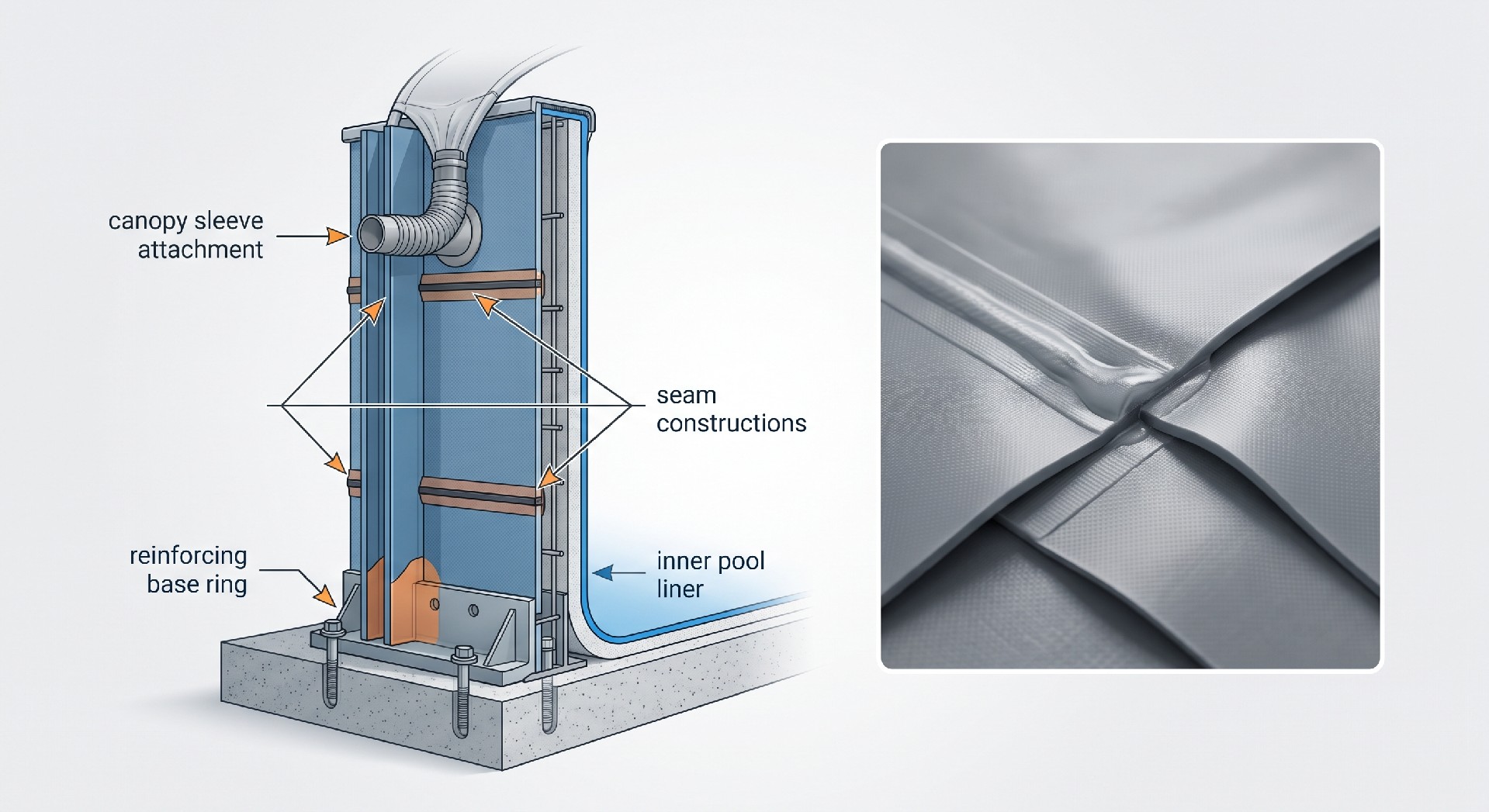
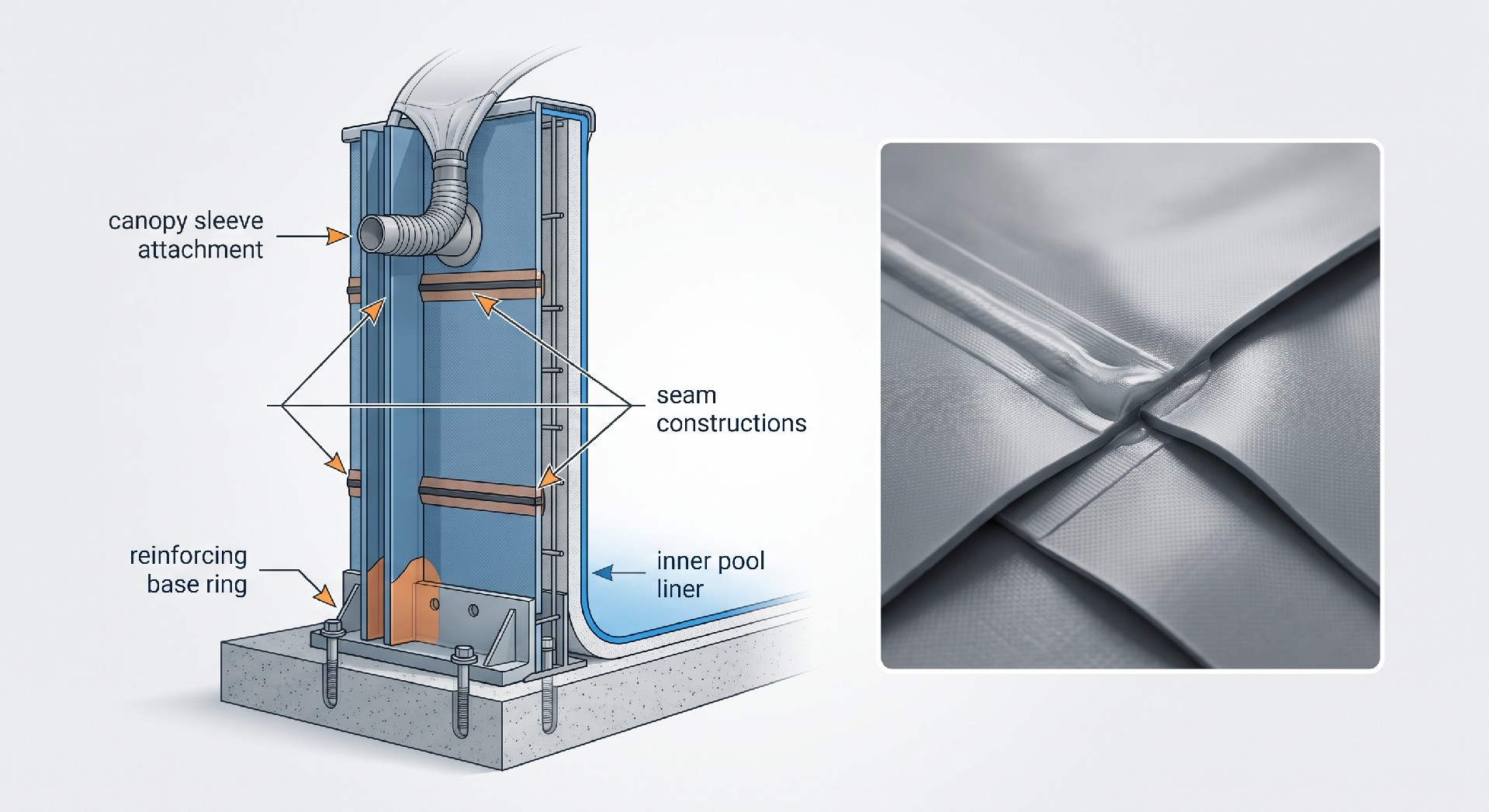
Canopy pools typically integrate a separate canopy frame (often fiberglass or aluminum poles) that attaches to the pool wall via sleeves or straps. The canopy material is usually lightweight, UV-resistant polyester or nylon. The pool itself is constructed from 0.25mm to 0.35mm vinyl (PVC), with multiple air chambers for stability. The canopy increases the overall height to approximately 1.5–2.0 meters, which raises the center of gravity. This design creates additional stress on the wall seams and anchor points, requiring reinforced seams and a wider base to prevent tipping.
Material selection must balance UV stability and tear strength. Pool vinyl often includes a UV inhibitor to prevent degradation, but the canopy fabric may degrade faster if not specified with a UV-blocking coating. Typical commercial-grade pools use 0.30mm vinyl with a 1000-denier base layer, while canopy frames use 16mm diameter poles with a 0.6mm wall thickness.
Standard Baby Inflatable Pool Design
Standard baby inflatable pools are simpler: one or two inflatable rings at the top, a soft floor (often 0.20mm vinyl), and vertical walls. Height rarely exceeds 0.5 meters. There is no canopy, so the product is lighter—typically 1.5–2.5 kg vs. 3.5–5.5 kg for a canopy pool. The absence of a canopy reduces wind load, simplifies storage, and lowers material costs. However, it offers no sun protection, which limits outdoor use in high-UV regions.
Seam construction differs: canopy pools often use high-frequency welded seams on the pool body and additional stitching on canopy attachments. Standard pools use welded seams exclusively. For commercial buyers, inspect weld consistency and seam thickness tolerance—typically ±0.02mm.
Buyer Acceptance Criteria
Commercial buyers should verify these criteria before committing to either product:
UV resistance: Canopy pools require UV-blocking fabric (UPF 50+ typical). Standard pools should include UV inhibitors in the vinyl to prevent material degradation—UV test (e.g., ASTM G154) should show < 10% tensile strength loss after 500 hours.
Stability against wind: Canopy pools must withstand a 15 mph wind without toppling. This often requires a wider base (e.g., 1.5m diameter for a 1.2m tall pool) or water ballast anchors. Standard pools are less affected, but still benefit from a flat, level surface.
Inflation time: Canopy pools with an electric pump typically inflate in 3–5 minutes; standard pools in 1–3 minutes. Acceptable for rental operations, but longer inflation times reduce daily turnover.
Drain and cleanability: Both products should feature a bottom drain plug (approx. 25mm diameter) for quick draining. Canopy pools may have more crevices at attachment points, increasing cleaning time.
Packed volume: Canopy pools pack into a larger box—typical dimensions 60cm x 45cm x 20cm vs. 45cm x 35cm x 10cm for a standard pool. This impacts shipping container utilization and storage costs.
| Decision Factor | Canopy Pool | Standard Baby Inflatable Pool | Commercial Impact |
|---|---|---|---|
| UV Protection | Integrated canopy, UPF 50+ typical | None; relies on PVC UV inhibitors | Canopy pools allow longer outdoor use; reduces heat stress on vinyl. |
| Stability | Wider base required; more susceptible to wind (15 mph max) | Lower profile; stable in moderate wind | Canopy pools need careful anchoring; may require ballast. |
| Setup Time | 3–5 minutes (electric pump); canopy assembly adds 2–3 minutes | 1–3 minutes; no assembly beyond inflation | Canopy pools reduce turnover speed for rental fleets. |
| Packed Volume | 60cm x 45cm x 20cm (approx.) | 45cm x 35cm x 10cm (approx.) | Canopy pools increase shipping and storage costs by 30–50%. |
| Material Cost | Higher; canopy fabric and poles add cost | Lower; less material and simpler design | Canopy pool retail price is typically 50–100% higher. |
| Maintenance | More crevices; canopy attachments require cleaning | Simple cleaning; fewer areas for debris | Canopy pools increase cleaning labor time by ~2 minutes per unit. |
| Lifecycle Expectancy (Typical) | 2–3 seasons (commercial use) | 3–4 seasons (commercial use) | Canopy pools often have shorter lifespan due to canopy fabric degradation. |
Supplier Questions and Sample Checks
When sourcing either product, request the following from potential suppliers:
Material certifications: Provide REACH compliance declaration for PVC and phthalate-free status. For canopy fabric, require a certificate of UV resistance and flame retardancy (e.g., CPAI-84 where applicable).
Seam strength test report: Should include peel strength data. A typical target for welded seams is at least 30 N/cm, but verify with the supplier’s test method.
Sample inspection: Order a pre-production sample. Check the canopy pool’s assembly—canopy sleeves must be evenly sewn, and pole ends must not protrude. For the standard pool, inspect the bottom weld for leaks.
Pressure decay test: Inflate both products to their rated working pressure (typically 0.5–1.0 psi for pools). Record pressure drop over 24 hours. An acceptable rate is < 10% drop.
Packaging durability: Request a drop test on the packed carton to ensure products arrive intact. This is critical for both product types, as damaged canopies are a common complaint.
Purchase Recommendation by Buyer Type
Choose a canopy pool when:
You operate in a sunny, low-wind environment (e.g., resorts, summer camps).
Your customers prioritize UV protection for children.
You can justify a higher price point (typically 50–100% above standard pools).
You have storage space for larger packed units.
Choose a standard baby inflatable pool when:
Your use case is indoors or in shaded areas.
You need high-volume, low-cost units for rental or retail.
Setup speed and low packed volume are critical.
Your primary concern is cost per unit and ease of replacement.
For a balanced commercial fleet: Many operators stock both, using standard pools for quick-turn rentals and canopy pools for premium bookings. Evaluate your utilization and customer demographics to determine the optimal ratio.
Remember: the canopy pool’s added complexity does not inherently guarantee higher ROI unless it unlocks a premium-priced service. Validate your market demand and expected rental premium before committing to a large order. For OEM buyers, ensure your supplier’s quality control includes canopy attachment testing—a common point of failure.
