

The Anchor Choice Problem for Lightweight Inflatable Kayaks
Selecting an anchor for a lightweight inflatable kayak is a different decision than equipping a rigid hull or a large RIB. The primary challenge is not holding power alone; it is the relationship between anchor weight, the kayak's low mass and windage, and the practicalities of stowing and deploying ground tackle from a compact, flexible watercraft. A misjudged anchor can result in a dragged position, a torn handle, or a kayak that is dangerously tender. This guide addresses the commercial buyer, fleet operator, and serious paddler by breaking down the engineering and commercial decisions behind choosing a durable anchor that works with an inflatable kayak, not against it.
Understanding the Operating Environment
An inflatable kayak presents a unique set of constraints. Typically constructed from drop-stitch or high-frequency welded PVC, the hull is lightweight, often weighing between 20 and 40 pounds. This low mass means the kayak is easily influenced by wind and current. A hard-shell kayak offers significant inertia and a defined keel line; an inflatable, by contrast, presents a broad, flat bottom with moderate rocker. This shape provides stability but also generates higher windage when empty or lightly loaded. For a commercial fleet or a guided tour operation, an anchor must reliably hold a kayak that could be carrying one or two paddlers, along with camping or fishing gear, against currents of up to 2 knots and moderate wind. The anchor's performance is directly coupled to the kayak's surface area and the seabed type.
Critical Environmental Factors
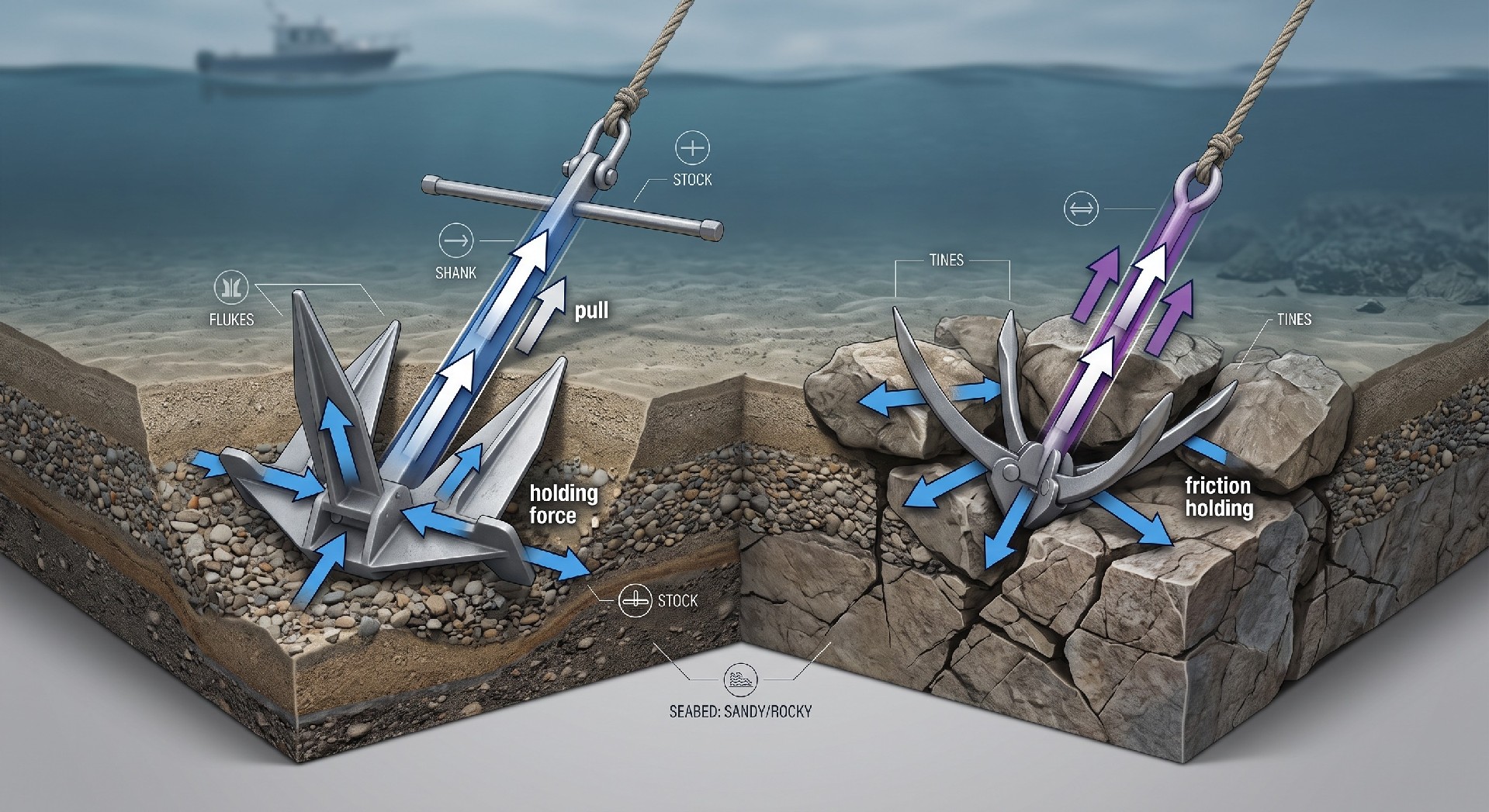
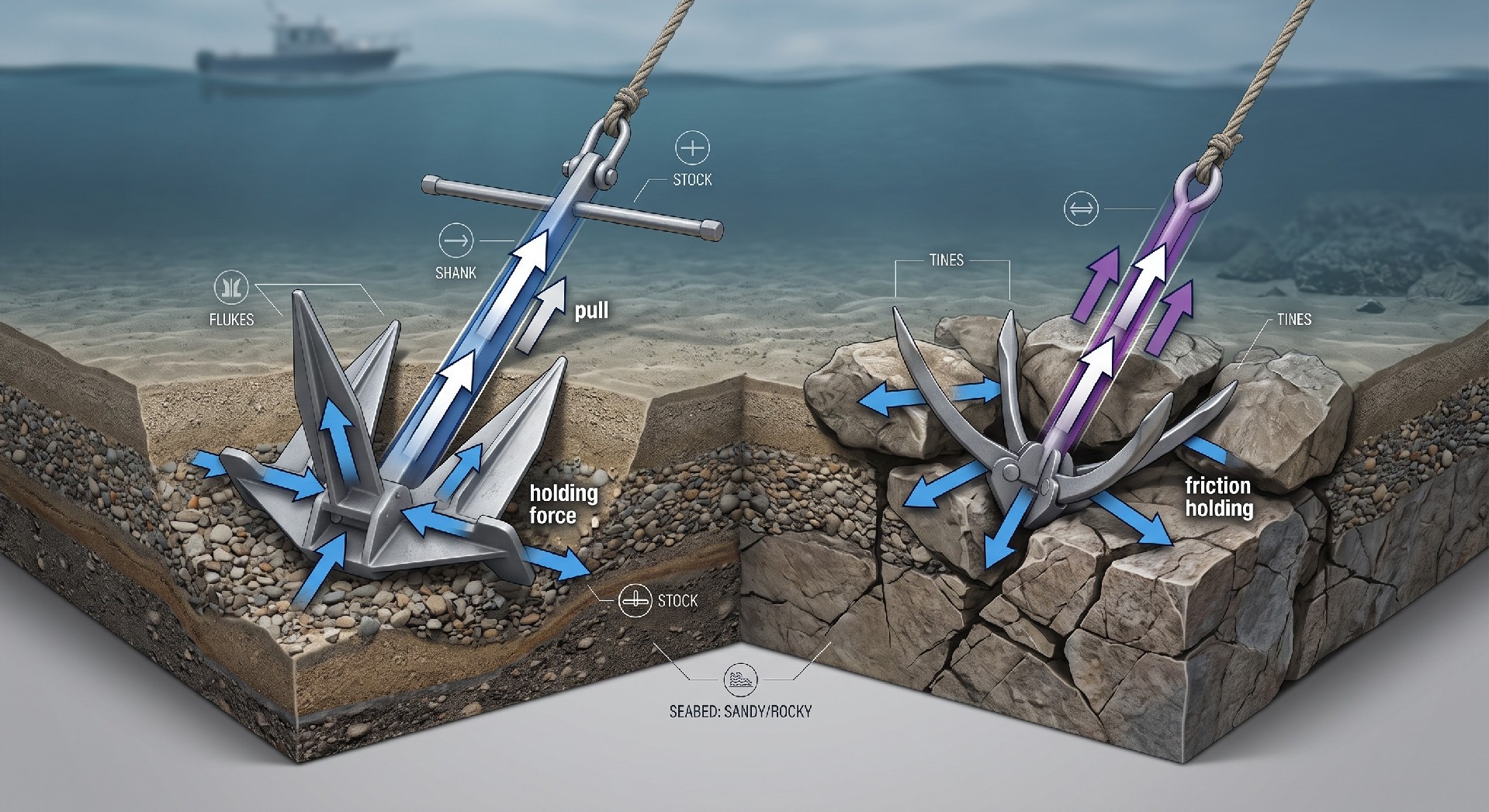
Bottom Composition: Sand, mud, rock, and weed require different anchor designs. A fluke anchor excels in sand and mud, while a grapnel is necessary for rocky bottoms.
Current and Wind: The combination of windage and current determines the required holding force. A typical commercial range for a lightweight inflatable kayak in moderate conditions is an anchor weight of 1.5 kg (3.3 lbs) to 3.0 kg (6.6 lbs).
Deployment Depth: The rode length is critical. A commonly specified scope ratio for this class is 5:1 (rode:depth) to ensure the anchor's pull angle is horizontal enough to set properly.
Anchor Types and Their Suitability
The choice of anchor type is the first major decision. Each design has trade-offs regarding holding power, weight, and stowability.
Grapnel (Folding) Anchors
These are the most common for small inflatables. Their collapsible arms allow for compact storage, which is vital when packing a kayak. However, the holding power is entirely dependent on the tines digging into a crevice or soft bottom. They are less effective in shifting sand or mud. Fleet operators often choose a grapnel for its versatility, but it requires a careful inspection of the tines and pivot point for corrosion. A common commercial failure point is the folding mechanism seizing due to saltwater ingress, reducing the anchor's ability to deploy correctly.
Fluke (Danforth-style) Anchors
Danforth-style anchors offer superior holding power relative to weight in sand and mud, making them ideal for high-windage areas. The fluke design buries itself into the bottom, creating significant resistance. For a lightweight kayak, a 1.5 kg fluke anchor can hold effectively where a 3 kg grapnel might drag. The downside is that a fluke anchor does not collapse as compactly as a grapnel, and it performs poorly on rocky bottoms. For a B2B buyer, this is a specification choice driven by the primary operating environment. For example, a fleet operating on the sandy bottom of a large lake will find a fluke anchor to be a more reliable and lighter solution.
Mushroom Anchors
Mushroom anchors are generally not recommended for lightweight inflatable kayaks. They rely on suction and sheer weight, typically requiring significantly more mass (e.g., 5 kg or more) to hold effectively. Their size and weight make them impractical for stowage and increase the risk of damaging the kayak's flexible hull if not handled carefully. Their only advantage is on soft, muddy bottoms where their suction can be effective, but the weight penalty is often too high.
Durability: Material and Construction
An anchor for a lightweight inflatable kayak must survive repeated impacts with the seabed, saltwater exposure, and UV degradation. The material choice dictates the anchor's working life.
| Anchor Material | Corrosion Resistance | Impact Resistance | Commercial Buy Recommendation |
|---|---|---|---|
| Galvanized Steel (Hot-dipped) | Moderate; coating degrades over time | Good; can withstand regular impacts | Suitable for seasonal fleets with regular inspections. |
| 316 Stainless Steel | Excellent; superior corrosion resistance | Excellent; holds shape under impact | Recommended for coastal and saltwater operations. |
| Zinc-Plated Steel | Poor; prone to rust quickly | Moderate; plating is easily scratched | Avoid for commercial use; limited lifespan. |
Galvanized steel is the industry standard offering a good balance between cost and corrosion resistance, but the galvanized layer can be damaged by repeated impacts on rocky bottoms, leading to rust. Stainless steel (316-grade) is the premium choice, offering excellent corrosion resistance and a longer lifespan, which is crucial for a fleet where anchors are a recurring replacement cost. A buyer should verify that the pivot points and folding mechanisms are free of small crevices that trap moisture, as these are the primary origins of mechanical failure.
The Rode: Line and Connection Points
Choosing a durable anchor is not just about the metal; the rode is a critical component. For a lightweight inflatable kayak, a nylon rope is standard due to its elasticity, which helps absorb shock loads. The diameter is a specification decision. A 6mm to 8mm line is typical. The rode length should be adequate for the maximum intended depth with a 5:1 scope. More importantly, the connection to the kayak must be considered. A quick-release system is highly recommended for safety, allowing the paddler to release the anchor instantly in an emergency. Commercial buyers should specify anchor trolleys or tie-off points that reinforce the kayak's D-rings, as pulling on a single D-ring at an angle can eventually cause the weld to fail. The manufacturer's stated pull strength for the D-ring should exceed the expected anchor load by a significant margin.
Commercial Buyer Decisions and Inspection
For a fleet operator or guide service, the anchor system is a recurring expense. A poor choice leads to downtime, lost anchors, and damaged kayaks. The inspection protocol should focus on several key areas:
Pre-Trip Inspection
Inspect the folding mechanism for ease of operation and any signs of seizing.
Check the galvanized coating for chips or rust, which indicates a reduced lifespan.
Examine the swivel and shackle for wear, ensuring they are not becoming thin.
Feel the rope for abrasion; replace any line with significant fraying.
Assess the condition of the line-to-anchor knot or splice, ensuring it is secure.
Post-Trip Maintenance
Rinse the anchor and rode thoroughly with fresh water.
Allow the anchor to dry completely before stowing to prevent rust and mildew.
Periodically disassemble the anchor, grease the pivot point, and reassemble to ensure longevity.
Implementation and Setup Guidelines
The setup of the anchor system is as important as the hardware. A commercial operator should standardize the deployment procedure. The anchor should be deployed from the bow or stern, depending on the wind and current. Using an anchor trolley system allows the paddler to adjust the attachment point, which affects the kayak's orientation. In strong wind, a bow anchor points the kayak into the wind, while a stern anchor can be used for fishing to keep the kayak stationary. The most common failure in operation is insufficient scope. In a shallow, swift river, a heavy anchor with 3:1 scope may drag, whereas a lighter anchor with a 7:1 scope may hold perfectly. Providing clear crew training on this principle reduces loss and improves safety.
Supplier Questions for an Anchor Specification
When engaging with an OEM supplier or distributor, consider these technical verification questions:
What is the exact material grade and thickness used in the anchor arms and shank?
Can you provide a salt-spray test report (e.g., ASTM B117) to demonstrate corrosion resistance?
What is the target pull strength of the pivot and welded joints?
Is a sample package available for destructive or long-term wear testing?
What is the typical lead time for a bulk order, and what is the MOQ for custom branding?
A supplier that cannot provide basic material certification or test data should be a red flag. A durable anchor for a professional application is a test of material science and manufacturing consistency, not just price.
Decision Guidelines for Your Fleet
Choosing a durable anchor comes down to evaluating your use case:
Choose a Folding Grapnel when you need a single, versatile anchor for variable bottom types and must prioritize compact stowage. Pay particular attention to the pivot point's build quality.
Choose a Fluke Anchor when operating primarily on sand or mud bottoms, as its superior holding power-to-weight ratio reduces the burden on the paddler. For rocky bottoms, this is not the ideal choice.
Avoid Mushroom Anchors for lightweight inflatable kayaks due to their excessive weight and poor holding power on common substrates.
Ultimately, the most durable anchor is the one that is correctly specified for the environment, inspected regularly, and maintained diligently. The commercial decision should weigh the upfront cost of a premium stainless-steel anchor against the long-term costs of replacements and lost gear.
