

Choosing Between Open and Enclosed Inflatable Kayak Designs
For commercial buyers, the decision between a sit-on-top (SOT) and a sit-inside (SI) inflatable kayak is rarely about personal preference. It directly influences daily throughput, safety margins, maintenance costs, and guest experience. The fundamental difference is cockpit exposure: SOT kayaks have a sealed, open deck where the paddler sits on top, while SI designs feature an enclosed cockpit where the paddler sits inside the hull. This seemingly simple distinction drives divergent specifications in primary stability, secondary stability, self-bailing capacity, and thermal protection. Understanding these tradeoffs is essential for rental fleet operators, resort buyers, and OEM brand owners who need to match the right kayak to their specific operational environment.
Use-Case Requirements and Commercial Environments
The suitability of each design hinges on where and how the kayak will be deployed.
Sit-On-Top Inflatable Kayaks
SOT designs are typically preferred for warm-weather, splash-and-play environments. The open deck allows for easy re-entry after a capsize, making them a popular choice for guided tours in sheltered coastal waters, lakes, and slow-moving rivers. For rental operations, the intuitive entry and exit reduce staff supervision time. However, the paddler is more exposed to wind, spray, and sun, which limits comfort in colder conditions. Commercial operators often favor SOT kayaks when guest turnover is high and the primary concern is ease of use rather than paddling efficiency.
Sit-Inside Inflatable Kayaks
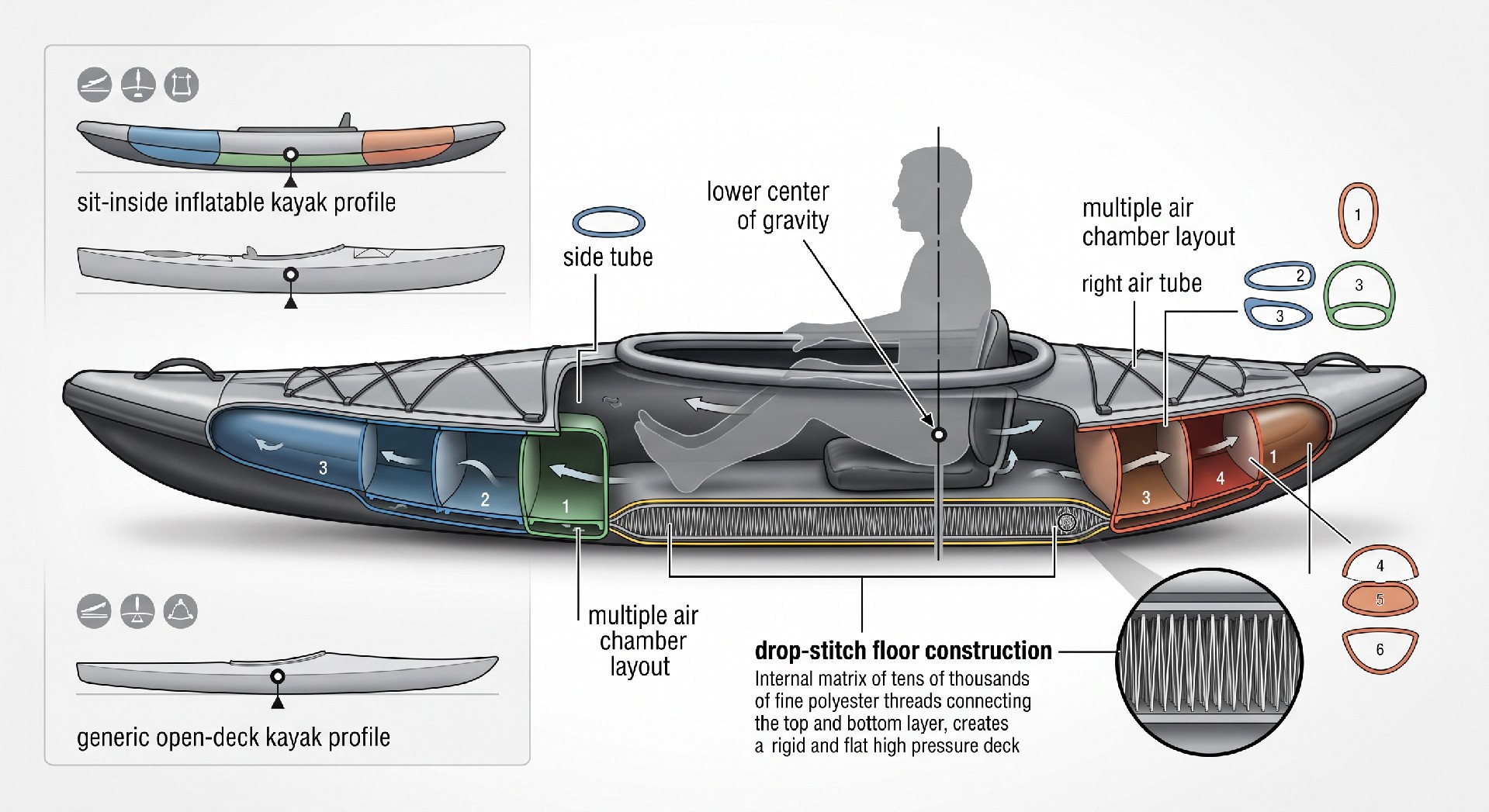
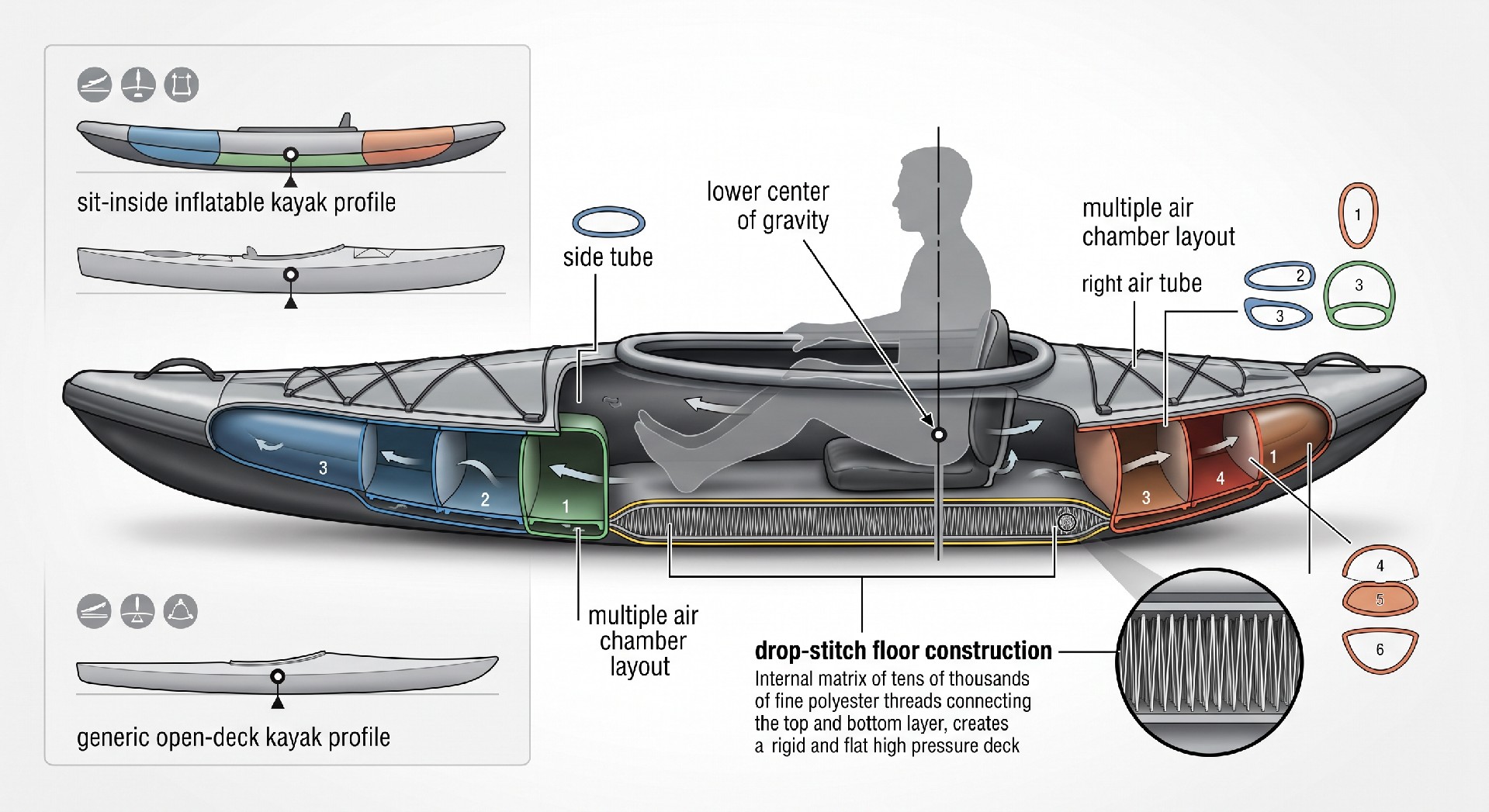
SI designs, on the other hand, offer superior protection from the elements. The enclosed cockpit, often fitted with a spray skirt, keeps the paddler drier and warmer, which extends the season in cooler climates. The lower center of gravity also enhances secondary stability, meaning the kayak can be leaned further without capsizing—a crucial feature for more technical paddling or rougher water. For expedition outfitters or resorts offering multi-day tours, the SI design provides better cargo storage options inside the hull and a more efficient paddling posture for longer distances.
Product Architecture and Material Choices
Beyond the cockpit layout, the construction details differ significantly and impact commercial durability.
Floor Construction and Stiffness
The floor is a critical load-bearing component. Most commercial-grade inflatable kayaks use drop-stitch technology, where thousands of threads connect the top and bottom fabric panels, creating a rigid, flat surface when inflated. In SI kayaks, the enclosed cockpit often allows for a narrower, more streamlined hull shape, which can be advantageous for tracking but may reduce primary stability. SOT kayaks typically have a wider beam to compensate for the higher center of gravity, providing a more stable platform for novice users. For rental fleets, the floor's resistance to abrasion from sand, gravel, and rocky launches is a key commercial decision. Thicker floor materials (e.g., 0.9 mm or 1.2 mm PVC or TPU) are often specified for SOT kayaks expected to endure frequent beaching.
Self-Bailing Systems
One of the most distinctive technical features is the self-bailing mechanism. Many SOT inflatable kayaks are equipped with scupper holes—openings in the deck that allow water to drain through the hull. This is essential for a kayak that takes on water from splashes or paddler entry, as it prevents the cockpit from filling up. The drainage rate depends on the size and number of scuppers and the kayak's load. For SI kayaks, self-bailing is not a standard feature; instead, they rely on a sealed cockpit and the paddler's spray skirt to keep water out. If water does enter, it must be removed with a pump or sponge. This makes SI kayaks less suitable for surf zones or heavy whitewater where water ingress is inevitable, but they are preferred for flat water touring where dryness is a priority.
Chamber Configuration
The number and arrangement of air chambers impact both safety and setup. SI kayaks often have multiple chambers (e.g., bow, stern, side tubes, and floor) to maintain buoyancy even if one is punctured. Some SOT designs also feature multiple chambers, but the open deck sometimes allows for simpler, single-chamber side tubes. For fleet operations, a chamber count of three or more is a typical commercial target to mitigate downtime from minor leaks. The valve type and placement also matter; commercial buyers often prefer universal valves (e.g., Halkey-Roberts or leafield) for easier maintenance and replacement.
| Feature | Sit-On-Top Inflatable Kayak | Sit-Inside Inflatable Kayak | Commercial Implications |
|---|---|---|---|
| Cockpit Design | Open deck with scupper holes for drainage | Enclosed cockpit, often requiring a spray skirt | SOT is best for warm weather and high turnover; SI is best for cold weather and touring. |
| Primary Stability | High (wide beam, typically 85-90 cm) | Moderate to high (narrower beam, but lower COG) | SOT is more forgiving for beginners; SI requires more skill but offers better secondary stability. |
| Self-Bailing | Yes, standard feature via scupper holes | No, relies on sealed cockpit and bilge pump | SOT is suitable for surf and splash zones; SI requires active water management. |
| Typical Working Pressure | Side tubes: 2-3 PSI; Floor: 8-12 PSI (drop-stitch) | Side tubes: 2-3 PSI; Floor: 10-14 PSI (drop-stitch) | Higher floor pressure in SI enhances rigidity for paddling efficiency. |
| Payload Capacity (Typical Range) | 180-220 kg (two-person) | 200-250 kg (two-person touring) | Verify dynamic load limits with the supplier based on intended water conditions. |
| Packed Volume (Typical) | 80 x 45 x 30 cm | 95 x 50 x 35 cm | SI kayaks are often longer, affecting storage and transport logistics. |
| Setup Time (Manual Pump) | 5-8 minutes | 6-9 minutes | Electric pumps reduce setup time significantly for both designs. |
Buyer Acceptance Criteria and Commercial Decisions
For commercial procurement, the evaluation goes beyond personal paddling preference. Here are key acceptance criteria that should be verified before ordering.
Payload and Capacity
Commercial kayaks must be specified with a clear payload limit. For a SOT kayak, the listed weight capacity often includes the paddler, any gear, and the water weight that may accumulate in the deck wells. For an SI kayak, the capacity is based on the volume of the enclosed hull and the paddler's weight. Buyers should verify whether the listed capacity is for flat-water or rough-water conditions, as dynamic loading reduces the safe margin. A typical commercial target for a two-person SOT kayak is a payload of 180 kg to 220 kg, while a touring SI kayak might be specified for 200 kg to 250 kg.
Primary and Secondary Stability
Stability is not a single metric. Primary stability is the feeling of being on a flat, steady platform; SOT kayaks with a wider beam (e.g., 85 cm to 90 cm) have high primary stability, making them ideal for beginners. Secondary stability is the kayak's ability to resist capsizing when leaned; SI kayaks with a narrower, V-shaped hull offer better secondary stability for more advanced paddlers. Commercial operators should test both attributes for their target user base. A rental fleet for a lake resort may prioritize primary stability, whereas an outfitter for coastal touring may prioritize secondary stability.
Inflation Time and Setup Labor
Setup efficiency is a significant cost driver for daily rental operations. SOT kayaks, often with larger air volumes, may take 5 to 8 minutes to inflate to working pressure using a standard double-action pump. SI kayaks can take a similar time, but the use of a drop-stitch floor may require higher pressures (e.g., 10 PSI compared to 2-3 PSI for side chambers), which can increase the time if using a manual pump. Many commercial buyers specify a high-pressure, high-volume electric pump to reduce setup time to under 3 minutes and minimize staff fatigue. The number of chambers and valves directly influences the inflation sequence.
Storage and Transport
Packed volume is another critical commercial dimension. Both designs are highly portable when deflated, but the packed dimensions can vary. A typical two-person SOT kayak may pack down to 80 cm x 45 cm x 30 cm, while a longer touring SI kayak might pack to 95 cm x 50 cm x 35 cm. For fleet operators, the packed volume affects storage space and transport logistics. Buyers should also consider the packed weight; commercial-grade materials add weight, with a typical hull weight of 15 kg to 22 kg for SOT and 17 kg to 25 kg for SI designs.
Supplier Questions and Sample Checks
When evaluating OEM suppliers, commercial buyers should ask specific questions tailored to the chosen design:
What is the specified working pressure for the floor versus the side chambers? Are there separate pressure relief valves?
What is the scupper hole diameter and count on the SOT model, and how does that correlate with the self-bailing rate?
For the SI model, what is the volume of the enclosed cockpit and the recommended spray skirt attachment system?
What abrasion tests (e.g., Taber Abrasion) have been conducted on the hull material, and what were the results?
Can you provide a sample acceptance test protocol covering seam tensile strength, valve leak rate, and payload deflection?
What is the typical production lead time for a container order (e.g., 200 units), and what is the MOQ for a custom color or branding?
Purchase Recommendation by Buyer Type
The final decision depends on your commercial context:
For a high-volume rental fleet in a warm climate: Choose a sit-on-top inflatable kayak. The ease of entry, self-bailing capability, and high primary stability will reduce supervision needs and guest complaints. Accept the tradeoff of lower paddling efficiency and increased sun exposure.
For a guided tour operator in a cooler region or offshore environment: Opt for a sit-inside inflatable kayak. The enclosed cockpit provides thermal protection, the lower center of gravity improves handling in wind and chop, and the cargo capacity supports multi-day excursions. Be prepared to invest in staff training for safe entry and exit.
For a resort offering mixed-use activities: Consider a fleet of both types. SOT kayaks for casual, short-duration rentals and SI kayaks for structured tours. This allows you to cater to different guest skill levels and weather conditions. Ensure your supplier can provide a consistent material specification (e.g., same PVC or TPU grade) across both designs to simplify spare parts and repair procedures.
For an OEM brand owner developing a new product line: Conduct a market analysis to identify the dominant use case in your target region. If you are competing in the US recreational market, SOT designs are more popular. For the European touring market, SI designs have a strong following. A versatile platform that allows for interchangeable decks or cockpit configurations could be a competitive differentiator.
Ultimately, the right choice is not about which design is universally better, but which one aligns with your operational reality. Use a sample evaluation to verify the manufacturer's specification against your actual use scenario, including the loaded performance, inflation workflow, and durability over a three-month trial period.
