

The Real Reason You Keep Losing Pegs (And It Is Not Carelessness)
Losing tent pegs is rarely a memory problem. It is a storage system failure. Pegs get separated from the tent, scattered across a garage floor, left in the ground at a campsite, or buried at the bottom of a duffel bag. The solution is not to try harder to remember where you put them. The solution is to make it physically impossible for the pegs to migrate away from their designated container.
The best way to store tent pegs and stakes without losing them is to use a dedicated, closed, labeled peg bag or peg tube that lives permanently inside the tent's carry bag. Every time you strike camp, the pegs go straight into that container before the tent comes down. This single habit eliminates the three most common loss scenarios: leaving pegs in the ground, dropping them during packing, and storing them loose where they roll away.
Why Most Peg Storage Methods Fail
Campers try many approaches. Some work briefly. Most fail for predictable reasons.
Loose pegs in the tent bag
This is the default for many tent manufacturers. Pegs rattle around with the tent fabric, poles, and guy lines. During transport, they work their way into folds of fabric, puncture the tent body, or fall out the moment the bag is opened. A peg that falls onto grass or gravel at a windy campsite is gone within seconds.
Pegs stored separately from the tent
A separate peg bag kept in a different part of the car or garage creates a separation risk. You grab the tent, forget the peg bag, and arrive at camp with a shelter and nothing to anchor it. This is especially common when multiple tents share one storage area.
Open trays or open-top containers
An open tray in a garage collects dust, spiders, and stray screws. More importantly, it offers no containment during transport. If the tray tips, pegs scatter. If you grab a handful, you leave some behind.
Pegs left in the ground
This is the single largest cause of peg loss. When breaking camp in rain, cold, or fading light, pulling every peg feels like a low priority. The result is a slow attrition of your peg supply over a season.
The Core Principle: One Container, One Home, One Habit
A peg storage system only works if it satisfies four conditions:
Closed containment: Pegs cannot escape even if the container is dropped, shaken, or inverted.
Permanent attachment: The peg container stays with the tent at all times, including during transport and storage at home.
One-step packing: Putting pegs away is faster than leaving them out. If it takes longer, you will skip it.
Visual verification: You can confirm at a glance that all pegs are accounted for before you leave a campsite.
| Storage Method | Best For | Loss Risk | Packing Speed |
|---|---|---|---|
| Closed drawstring peg bag attached to tent bag | Most campers, 4-12 pegs, backpacking and car camping | Low, if attached and closed after each use | Fast, under 30 seconds |
| Rigid peg tube with screw cap | Car camping, 20+ pegs, heavy-duty stakes, garage storage | Very low, pegs cannot escape even if dropped | Moderate, requires unscrewing and resealing |
| Fabric peg roll with individual slots | Glamping, mixed peg types, campers who want visual counting | Low, but slower to close in rain | Slow to moderate, 1-2 minutes |
| Integrated sewn-in pocket in tent bag | Any camper whose tent includes one and whose pegs fit | Very low, cannot be separated from tent | Fast, under 20 seconds |
| Loose pegs in tent bag (no container) | No one, this is the default failure mode | Very high, pegs fall out, puncture fabric, or get left behind | Fast but costly in lost pegs and damaged tents |
| Open tray or open-top bin | Garage storage only, never transport | High during transport, dust and moisture exposure | Fast at home, useless at campsite |
| Separate peg bag stored away from tent | No one, separation risk is too high | High, tent and pegs become separated | Fast if you remember both, frustrating if you forget one |
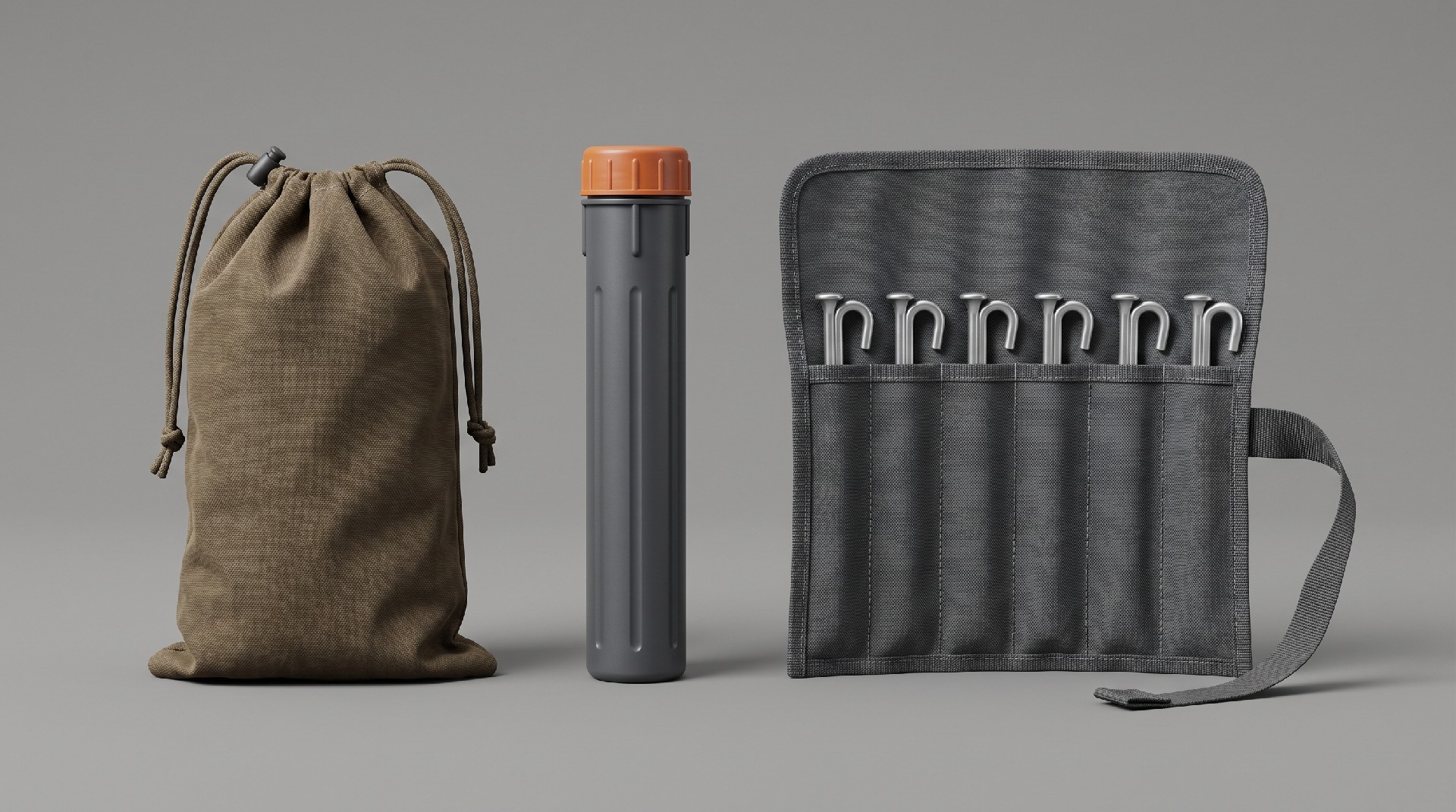
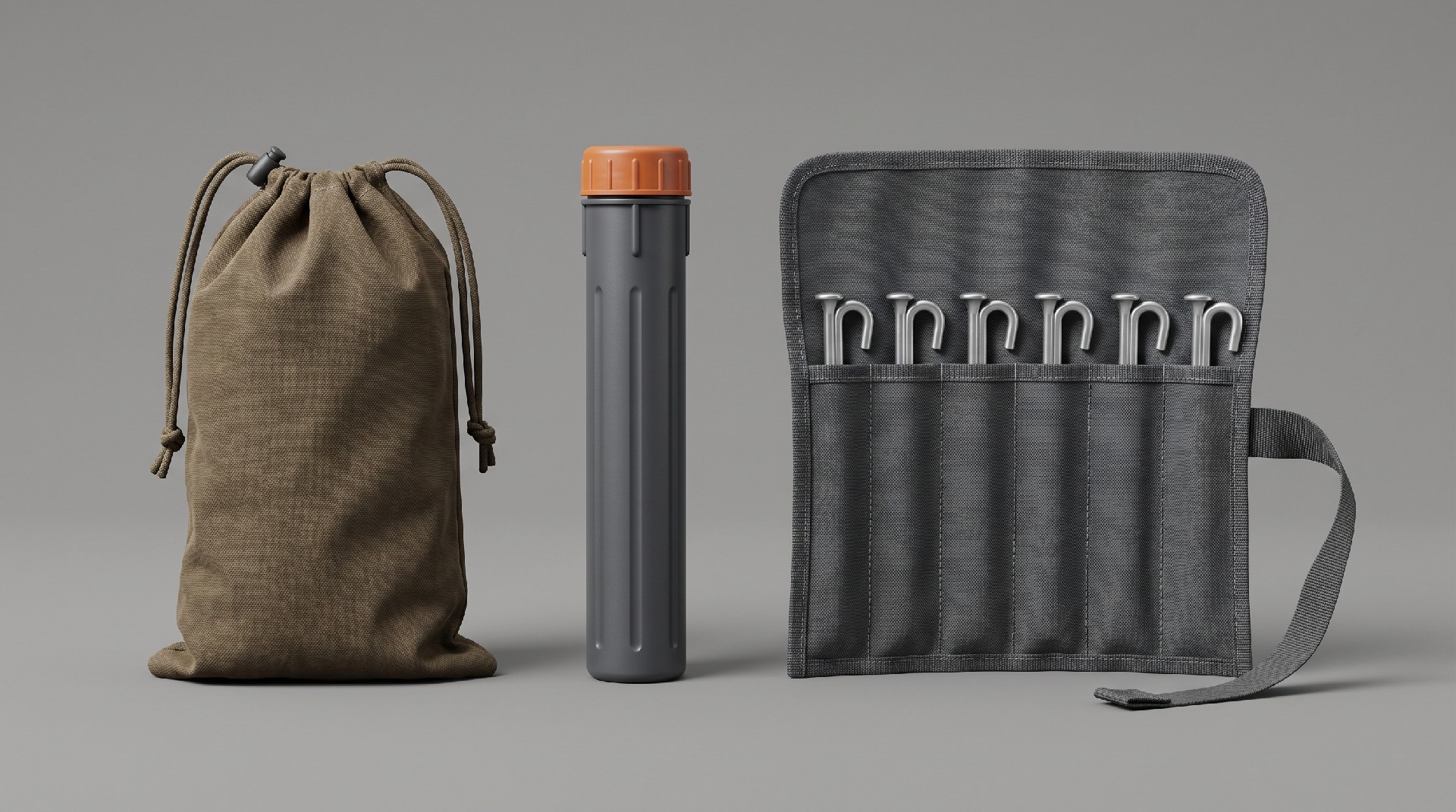
Peg Bag vs. Peg Tube vs. Peg Roll: Which Container Fits Your Kit?
There is no universal best container. The right choice depends on peg type, count, and how you camp.
Drawstring peg bag (fabric)
Best for: Standard steel or aluminum pegs, 4-12 pegs, casual camping, backpacking.
Not ideal for: Heavy-duty stakes, rocky ground where pegs get bent, or long-term storage where moisture is a concern.
A simple drawstring bag made from the same fabric as the tent (often 210D or 300D polyester) is lightweight and packable. The risk is that a thin bag can be punctured by sharp peg tips. Reinforce the bottom or use a double layer.
Rigid peg tube (plastic or aluminum)
Best for: Car camping, family tents with 20+ pegs, heavy-duty stakes, garage storage.
Not ideal for: Backpacking, where every gram matters, or tents with very long pegs that exceed tube length.
A tube protects pegs from bending, keeps them dry, and can be labeled with the tent name. The tradeoff is bulk. A 40 cm tube with a screw cap holds 20-30 standard pegs and weighs 150-300 g depending on material.
Peg roll (fabric with individual slots)
Best for: Campers who want to see every peg at a glance, glamping setups, tents with mixed peg types.
Not ideal for: Quick packing in rain, very muddy conditions, or users who dislike folding.
A peg roll lays flat, holds each peg in a separate slot, and rolls up into a compact cylinder. It is the easiest system for visual counting. The downside is that rolling and unrolling takes slightly longer than dropping pegs into a bag.
Integrated peg pocket inside the tent bag
Best for: Any camper who wants zero extra containers and cannot lose the peg bag because it is sewn in.
Not ideal for: Tents where the integrated pocket is too small for upgraded pegs, or where wet pegs would soak the tent fabric.
Many modern tents include a sewn-in peg pocket. If yours does, use it. If it is too small, upgrade to a separate container that clips to the tent bag's handle or daisy chain.
Step-by-Step: The No-Loss Peg Storage Routine
This routine takes under two minutes and works for any tent, any peg type, and any campsite.
At home, before the trip
Count your pegs. Write the number on a piece of tape on the container. If you have 24 pegs, the container says 24.
Inspect each peg. Discard bent, cracked, or heavily rusted pegs. A bent peg is harder to drive and harder to pull, increasing the chance you leave it behind.
Pair the peg container permanently with the tent. Clip it, sew it, or store it inside the tent bag. Never store them in separate locations.
At the campsite, when pitching
Open the peg container and keep it at the tent door or on a groundsheet. Do not scatter pegs on the grass.
Drive pegs one at a time, returning the container to the same spot after each peg. This prevents pegs from being kicked or lost in leaf litter.
When finished, close the container immediately. Do not leave it open while you adjust guy lines.
At the campsite, when striking
Pull pegs one at a time and place each directly into the open container. Do not pile pegs on the ground.
Wipe mud or moisture off each peg with a rag before storage. Wet pegs rust and seize in the container.
Count pegs as you pack. If the number does not match the tape label, search the ground before you leave.
Close the container, place it inside the tent bag, and close the tent bag.
At home, after the trip
Remove pegs from the container and let them dry completely if they were wet.
Return pegs to the container and store the container inside the tent bag.
Store the tent bag in a dry, temperature-stable location. Avoid garages with extreme humidity swings, which accelerate rust.
Special Cases: Sand, Snow, and Rocky Ground
Different ground conditions demand different pegs, and different pegs demand different storage considerations.
Sand pegs
Sand pegs are long, wide, and often made from aluminum or plastic. They are too large for standard peg bags. Use a dedicated sand peg sleeve or a rigid tube. Label it clearly so you do not accidentally grab the sand peg tube for a forest trip.
Snow stakes
Snow stakes are broad and flat, designed to hold in soft snow. They are best stored in a flat sleeve or roll, not a tube. Keep them separate from standard pegs to avoid confusion in winter conditions.
Rocky ground
Rocky ground bends pegs. Carry a small file or a peg straightener if you camp in rocky areas. Bent pegs should be straightened before storage or retired. A bent peg that jams in a tube can cost you five minutes of wrestling at the end of a long hike.
Buyer Checklist: Choosing a Peg Storage Container
Capacity: Holds your full peg count plus 2-3 spares. Typical commercial tents use 8-30 pegs depending on size and guy-line configuration.
Closure: Drawstring, zipper, screw cap, or Velcro. Must stay closed when shaken.
Attachment: Clip, loop, or sewn-in pocket that connects to the tent bag.
Material: Abrasion-resistant fabric (210D+ polyester or nylon) or rigid plastic/aluminum.
Drainage or ventilation: If pegs go in wet, the container should allow moisture to escape or be easy to dry.
Labeling: A clear external label or window to write the tent name and peg count.
Weight and packed size: For backpacking, aim under 50 g. For car camping, weight is less critical than durability.
The Decision: What Should You Actually Do?
If you want the simplest system that works for most campers: buy or sew a closed drawstring peg bag, attach it permanently to your tent bag with a clip, and adopt the count-and-close routine at every campsite.
If you car camp with a large tent and many pegs: use a rigid labeled peg tube that lives in your tent bin.
If you backpack and count grams: use a lightweight drawstring bag stored inside the tent stuff sack, and carry only the pegs you need for the expected ground.
If you manage a rental fleet or scout group: assign one numbered peg container to each tent, keep a master count log, and inspect containers at check-in and check-out. Peg loss in group gear is almost always a system problem, not a user problem.
The best storage method is the one you will actually use every single time. A cheap bag used consistently beats an expensive organizer left at home. Pick a container, attach it to the tent, count your pegs, and close the container before the tent comes down. That is how you stop losing tent pegs.
