

Why Back Pain on Inflatable Mats Is a Specification Problem, Not a User Problem
Sleeping on an outdoor inflatable mat should not leave a healthy adult waking with lumbar stiffness or mid-back pressure points. When it does, the cause is almost always a mismatch between the mat's construction and the sleeper's body weight, sleeping position, and ground conditions — not a lack of toughness on the camper's part. For commercial buyers, rental fleets, and OEM brand owners, that distinction matters: back pain complaints are a product-development signal about support structure, inflation pressure, and surface stability, not a customer-education problem.
This guide answers the specification question behind "how to avoid back pain while sleeping on an outdoor inflatable mat" — how to select, configure, and verify an inflatable sleeping mat that maintains spinal alignment and pressure distribution across a realistic range of users and terrain.
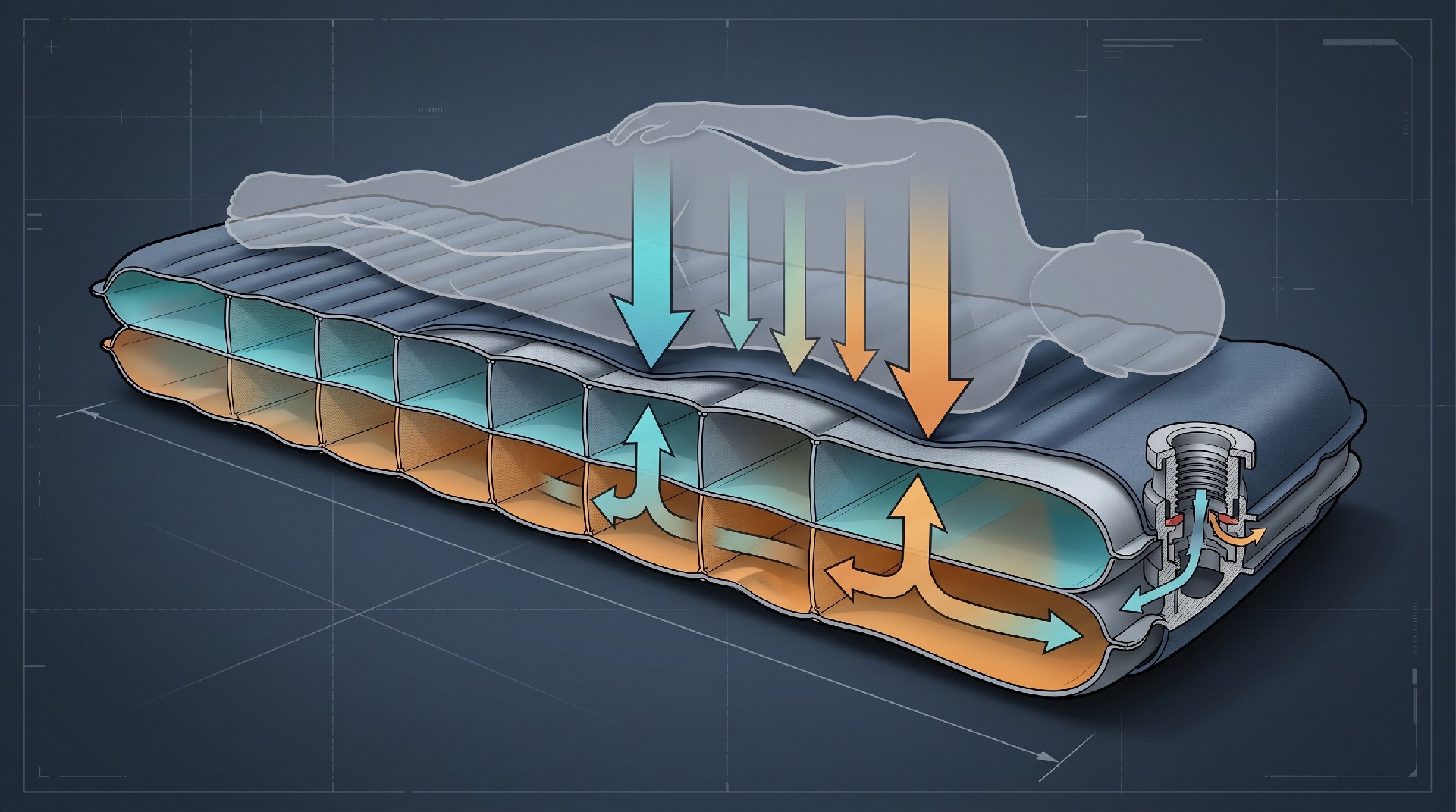
How an Inflatable Mat Actually Supports the Spine
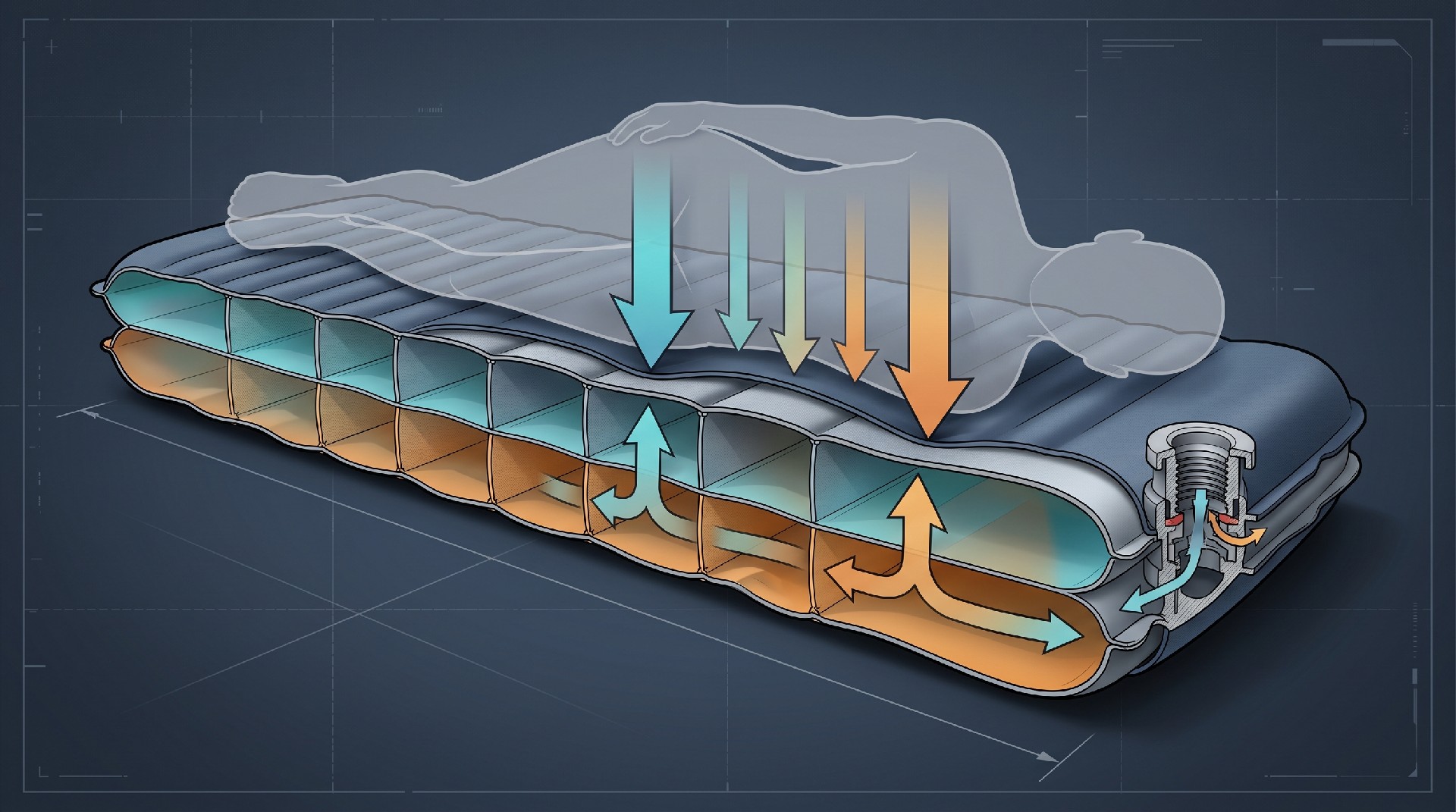
A sleeping mat prevents back pain through two mechanisms: bottoming-out prevention and even pressure distribution. Bottoming out occurs when the sleeper's hip or shoulder compresses the mat until it contacts the ground, creating a localized high-pressure point and forcing the spine out of neutral alignment. Pressure distribution depends on how the mat's internal structure — vertical walls, baffles, or foam-and-air hybrids — spreads load across the contact area.
Three structural variables control both mechanisms:
Thickness and internal architecture. A thicker mat with vertically oriented baffles resists compression at the hip and shoulder better than a thinner mat with horizontal channels. Typical commercial ranges for three-season mats sit between 5 cm and 10 cm inflated thickness, but the effective support depends on baffle density and chamber geometry, not thickness alone.
Working pressure and pressure retention. Higher inflation pressure increases rigidity and reduces bottoming out, but it also raises stress on seams, valves, and the mat's internal walls. A mat that feels firm at bedtime but soft by 3 a.m. usually has a slow leak or a valve seal that is not holding — both cause the spine to lose support progressively through the night.
Surface stability. A mat that rocks, slides, or rolls on uneven ground forces the sleeper to stabilize with back muscles, which prevents deep sleep and produces morning soreness even when the mat itself is adequately thick.
Side Sleepers, Back Sleepers, and Stomach Sleepers Need Different Mat Behavior
Side sleepers place the highest point load on the hip and shoulder and need the greatest compression resistance at those zones. Back sleepers need uniform support under the lumbar curve. Stomach sleepers need a firmer surface to prevent the lower back from sagging into hyperextension. A single mat design rarely optimizes all three; this is why commercial buyers should verify the intended sleeping-position mix before committing to a specification.
Buyer Acceptance Criteria for a Back-Pain-Resistant Inflatable Mat
The following table translates the support mechanics above into verifiable purchasing criteria. Ranges are typical commercial targets and must be confirmed against the final product datasheet and sample test.
| Decision Factor | Commercial Target | Why It Matters | Buyer Check |
|---|---|---|---|
| Inflated thickness | Typical 5–10 cm for three-season mats; greater thickness may improve bottoming-out resistance but increases packed volume | Thinner mats compress to the ground under hip and shoulder load, causing pressure points and spinal misalignment | Measure inflated thickness under a loaded hip condition on the actual sample |
| Internal architecture | Vertical baffles or hybrid foam-and-air construction; exact geometry is supplier- and model-dependent | Baffle orientation controls how load spreads across the contact area and whether the mat rocks or rolls | Request a cross-section drawing or cut sample and inspect baffle orientation |
| Overnight pressure retention | No measurable pressure loss over an 8-hour loaded hold; verify against final datasheet | Progressive pressure loss is the most common hidden cause of morning back pain | Inflate, close valve, load with representative weight, and check firmness after 8 hours |
| Valve seal design | Seals reliably across the full inflation range, including low pressure; compatible with standard pump interface | A valve that leaks at low pressure will fail overnight even if it holds at high pressure | Perform a loaded pressure-hold test with the valve in the closed position |
| Ground stability | Mat stays flat and does not slide or roll on uneven ground; verify on worst-case surface | A moving mat forces the sleeper to stabilize with back muscles, preventing deep sleep | Test on rock, packed gravel, or sloping ground, not on a showroom floor |
| Pump compatibility | Pump interface seals correctly and achieves target firmness within a practical time | Under-inflation from poor pump fit or excessive effort reproduces all the problems of a thin mat | Inflate the sample with the intended pump and assess firmness and effort |
| Batch consistency | Construction, thickness, and valve performance consistent across production lots | A good first sample does not guarantee that later shipments will retain the same support characteristics | Request golden-sample retention and pre-shipment inspection records |
Inflation Pressure, Valve Quality, and Overnight Pressure Retention
Overnight pressure loss is the most common hidden cause of morning back pain. A mat that loses even a small amount of air over eight hours will progressively bottom out under the hip, and the sleeper wakes with the same discomfort as if the mat had been under-inflated from the start.
Buyers should distinguish three separate issues:
Initial inflation pressure. Most inflatable sleeping mats are designed to be inflated by mouth, foot pump, or hand pump to a target firmness, not to a gauge-measured pressure. For mats without a pressure gauge, the practical target is the point at which the surface no longer compresses to the ground under the sleeper's hip when lying on the side.
Valve seal integrity. A valve that seals reliably at high pressure but leaks at low pressure will fail overnight. Buyers evaluating samples should inflate, close the valve, and check for pressure loss over a minimum of eight hours, ideally under a loaded condition.
Seam and internal wall creep. Under sustained load, seams and internal baffles can creep or separate. This is a manufacturing-quality issue, not a user issue, and should be verified through a loaded pressure-hold test.
Ground Conditions Change the Pressure Requirement
On soft ground — sand, duff, or snow — the mat sinks and the effective support surface becomes the compressed ground beneath it. On hard, uneven ground — rock, packed gravel, or tent platforms — the mat must bridge small irregularities without collapsing. Buyers specifying mats for rental or resort use should test on the worst ground condition the end user is likely to encounter, not on a showroom floor.
Pumping, Setup, and the Ergonomics of Getting a Firm Mat
Back pain often begins before sleep: inflating a mat by mouth to a genuinely firm pressure is exhausting and frequently produces an under-inflated mat. Commercial and rental buyers should consider pump compatibility as a specification item, not an accessory afterthought.
Pump interface. Valve designs vary; a pump that does not seal correctly will never achieve target firmness. Verify the pump-to-valve interface on the actual sample, not on a catalog drawing.
Inflation time and effort. A mat that requires more than a few minutes of vigorous pumping will be under-inflated by most users. This is a commercial risk for rental fleets, where setup labor and user compliance directly affect return rates and complaint volume.
Deflation and packing. A mat that is difficult to deflate fully will be stored with residual air, which increases seam stress during transport and storage. Buyers should verify that the valve opens sufficiently for rapid deflation and that the packed volume is consistent with the intended transport method.
Matching Mat Specification to User, Terrain, and Commercial Context
There is no single inflatable mat specification that eliminates back pain for every user. The correct specification depends on who sleeps on it, where, and for how many nights.
Best for: rental fleets and resort buyers
Choose mats with higher compression resistance, verified overnight pressure retention, and a valve design that accepts a standard pump. Prioritize durability and consistent firmness over minimum packed volume. A mat that is slightly heavier but reliably firm will generate fewer complaints than an ultralight mat that requires perfect inflation technique.
Best for: OEM brand owners and private-label sellers
Specify the internal architecture explicitly — baffle orientation, chamber count, and target thickness — and require a loaded pressure-hold test as part of sample approval. Back-pain complaints are a warranty and return-rate issue; they are cheaper to prevent at the specification stage than to resolve through customer service.
Not ideal for: buyers seeking a universal mat for all sleeping positions
A single mat design will not optimize side, back, and stomach sleepers simultaneously. If the user mix is broad, specify a mat with moderate thickness and high compression resistance, and accept that side sleepers may need additional hip support.
Verify when: the mat will be used on hard or uneven ground
Test the sample on the actual ground condition. A mat that performs well on a carpeted floor may bottom out on rock or packed gravel.
Avoid when: the mat has no verifiable pressure-hold test data
Without evidence of overnight pressure retention, the buyer is accepting the primary cause of morning back pain as an uncontrolled variable.
The Buyer's Decision Sequence
Define the dominant sleeping position and body-weight range of the intended users.
Specify minimum inflated thickness and internal architecture based on that range.
Require a loaded pressure-hold test over at least eight hours as a sample acceptance criterion.
Verify pump-to-valve compatibility and realistic inflation effort.
Test on the worst-case ground condition the user will encounter.
Confirm that the supplier can provide consistent batch-to-batch construction, not just a good first sample.
Back pain on an inflatable mat is not inevitable. It is the predictable result of a mat that loses pressure, compresses too far at the hip or shoulder, or destabilizes on uneven ground. Each of those is a specification decision the buyer controls before the order is placed.
