

Why a Two-Person Tent Becomes a Three-Body Problem
Two adults plus a dog in a two-person tent is not a capacity failure — it is a layout and floor-planning problem. A standard two-person backpacking tent typically offers 2.2–2.8 m² of floor area, and a medium dog (20–30 kg) lying stretched out occupies roughly 0.5–0.7 m². That leaves each adult with around 0.7–0.9 m² of sleeping space, which is workable only if you plan sleeping orientation, gear storage, and entry/exit flow before you pitch. The tips below focus on the decisions that actually change comfort: tent architecture, floor protection, temperature control, and a repeatable camp routine.
Choose the Right Two-Person Tent Architecture for a Dog
Not every two-person tent is dog-compatible. The single most important feature is a large, low-threshold door — a dog cannot comfortably step over a 25–30 cm bathtub floor lip, and repeated scrambling damages both the floor and the door zip. Look for a tent with a door sill height under 15 cm, or plan to add a small folding ramp or a foam step.
Floor dimensions and vestibule trade-offs
Floor width: 130 cm minimum for two adults plus a medium dog; 150 cm is significantly more comfortable.
Floor length: 210–220 cm lets you sleep head-to-toe with the dog in the middle or at the foot.
Vestibule: a 60–80 cm deep vestibule keeps muddy paws, bowls, and leashes out of the sleeping area. This is often more valuable than extra interior floor space.
Peak height: 100–115 cm allows you to sit up without pressing the dog against the wall.
If you camp in warm, dry conditions, a mesh-heavy double-wall tent improves ventilation but offers less claw resistance. If you camp in cold or wet conditions, a solid inner with a full-coverage rainfly is warmer but requires more active moisture management with a wet dog inside.
Materials that survive claws and wet fur
Typical commercial tent floors use 20D–70D nylon or polyester with a 1,500–5,000 mm hydrostatic head coating. For dogs, a 70D or heavier floor with a bathtub construction is the practical minimum. Silnylon and silpoly are lightweight and pack small but are more vulnerable to abrasion; a cheap closed-cell foam mat or a custom groundsheet under the tent adds a sacrificial layer that is far cheaper to replace than a floor.
Floor Protection, Bedding, and the Sleep Zone
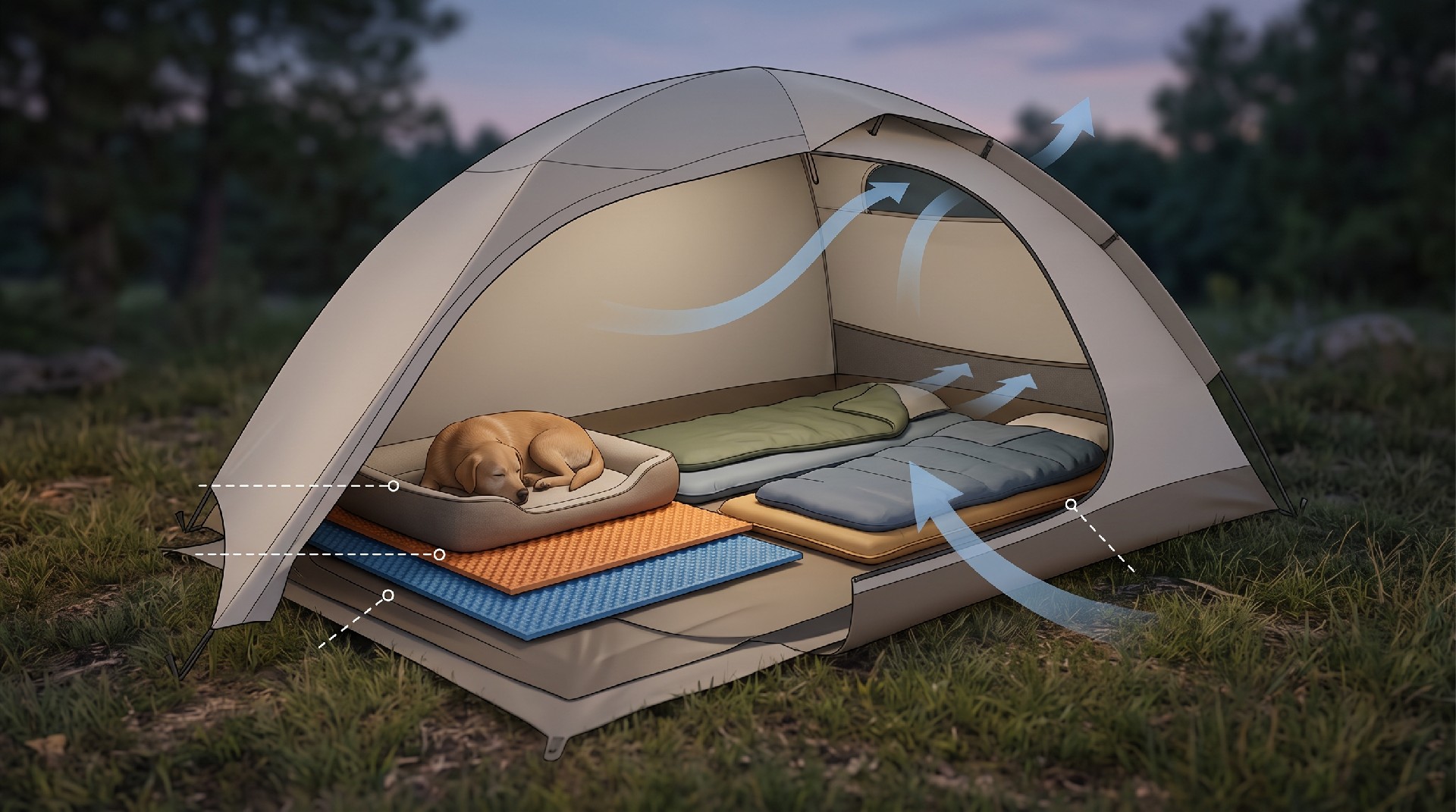
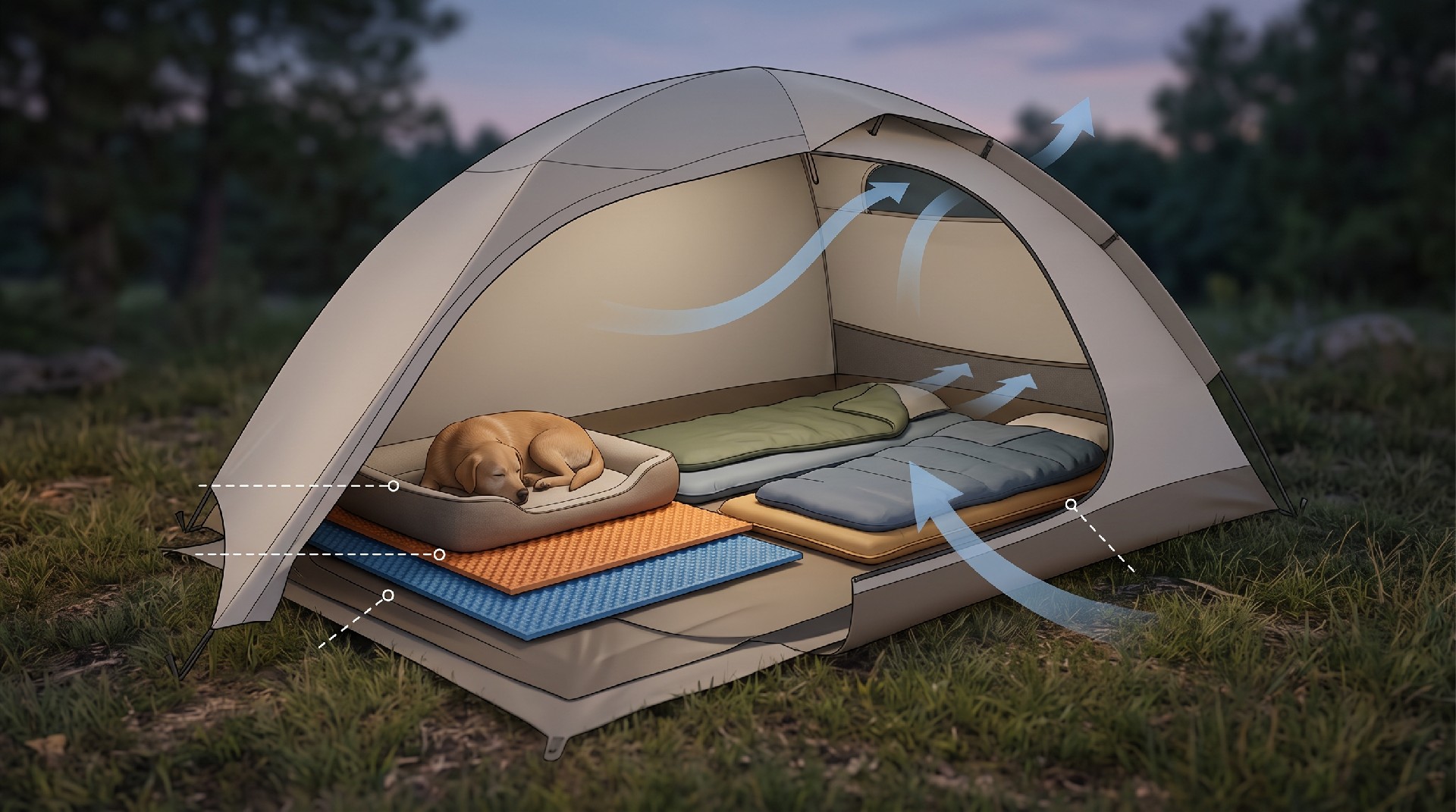
The fastest way to ruin a tent floor is to let a dog lie directly on it after a wet walk. A three-layer system works well:
Layer 1 — Groundsheet: a footprint or 100–200 g/m² PE tarp cut slightly smaller than the tent floor.
Layer 2 — Closed-cell foam mat: 6–10 mm thick, cut to the dog's sleeping area. This absorbs claws, warmth, and minor moisture.
Layer 3 — Dog bed or blanket: a washable, low-profile bed or fleece blanket that can be shaken out and dried.
Place the dog's sleep zone at the foot of the tent or beside the door, not between two sleeping adults. This keeps the center of the tent clear for movement and reduces the chance of a midnight trampling. A short 30–50 cm tether attached to a structural point near the door keeps the dog from rotating onto sleeping bags.
| Decision Factor | Comfort Target | Why It Matters | Buyer Check |
|---|---|---|---|
| Floor area for two adults + medium dog | 2.5–3.0 m² total; dog zone 0.6–0.7 m² | Prevents sleeping-bag compression and middle-of-night repositioning | Measure dog length and width lying down; subtract from tent floor area |
| Door sill height | Under 15 cm, or add a ramp | Dogs cannot comfortably step over a deep bathtub floor lip | Check spec sheet or pitch the tent and measure |
| Floor fabric denier | 70D or heavier, or add groundsheet + foam | Claws and wet fur abrade lightweight 20D–30D floors quickly | Confirm denier and hydrostatic head; plan sacrificial layer |
| Ventilation openings | Two or more, low and high | Wet dog adds 100–200 ml overnight moisture; condensation soaks bedding | Identify vent positions and test airflow with a small fan |
| Sleep zone placement | Foot of tent or beside door, not between adults | Reduces trampling and keeps center clear for movement | Lay out pads and dog mat before first trip |
| Tether anchor point | Structural loop near door, never guyline or pole | Limits pacing without choking or damaging tent structure | Identify a reinforced loop or add one |
| Temperature management | Cross-ventilation in heat; insulated mat in cold | Sealed tent can exceed outdoor temp by 8–12 °C in 30 minutes | Plan shade, fan, or fly-off configuration by season |
| Pre-trip test | One full night at home with the dog | Reveals fit, settling behavior, and floor damage risk before commitment | Pitch in yard, run full routine, inspect floor after |
Temperature, Ventilation, and Condensation with a Wet Dog
A wet dog adds significant moisture to a sealed tent. A 25 kg dog with wet fur can release 100–200 ml of water vapor overnight, which condenses on cold fly walls and drips onto sleeping bags. Manage this with cross-ventilation: open the low door vent and the high rear vent, and leave the rainfly door partially unzipped if rain allows. In humid conditions, a small battery-powered fan moving 20–40 m³/h reduces condensation noticeably.
Heating and cooling rules
Never use a catalytic heater or open flame inside a tent with a dog — carbon monoxide risk and burn risk are both serious.
In hot weather, choose a shaded pitch and a tent with two large mesh panels. Dogs pant to cool, and a sealed tent can exceed outdoor temperature by 8–12 °C within 30 minutes.
In cold weather, an insulated dog mat and a fleece layer do more than heating the whole tent.
If your dog is elderly, brachycephalic, or heavily coated, treat the tent as a temperature-sensitive environment and plan to leave the door open or sleep with the fly off when conditions allow.
Camp Routine: Entry, Mud, and Night Behavior
Comfort depends less on the tent than on the routine around it. A predictable sequence reduces stress for the dog and damage to the tent.
Pre-entry routine
Wipe paws with a microfiber towel kept in the vestibule.
Remove burrs and check for ticks before the dog enters the sleeping area.
Offer water 20–30 minutes before bedtime to reduce midnight restlessness.
Give a final toilet break immediately before zipping up.
Night behavior management
Most dogs settle faster if they can see or touch their owner. A thin sleeping pad placed so the dog can rest a paw against your bag often eliminates whining. If your dog is prone to pacing, a short tether to a structural loop near the door — never to a guyline or pole — limits movement without creating a choking hazard.
Morning exit
Open the door fully, let the dog exit first, then pack bedding. This prevents a wet, excited dog from trampling sleeping bags and gear. Check the floor for claw punctures and moisture before rolling the tent.
Decision Checklist Before You Buy or Pitch
Use this sequence to decide whether a specific two-person tent will work for you and your dog:
Measure your dog: length nose-to-tail and width at the shoulders when lying down.
Confirm floor area: total floor m² minus 0.6–0.7 m² for a medium dog.
Check door sill height: under 15 cm, or plan a ramp.
Verify floor denier: 70D or heavier, or add a groundsheet and foam layer.
Plan ventilation: two openings minimum, plus a fan in humid conditions.
Test the routine at home: pitch the tent in the yard and run one full night with the dog before committing to a trip.
If your dog is large (over 35 kg), anxious, or prone to chewing, a two-person tent is likely too small — consider a three-person tent with a large vestibule. If your dog is small (under 10 kg) and calm, most well-ventilated two-person tents with a protected floor will work. The deciding factors are almost always door design, floor durability, and ventilation, not the tent's headline capacity.
