

Executive Summary: The Commercial Imperative of Grass-Safe Pool Solutions
For B2B buyers, sourcing inflatable baby pools involves balancing consumer safety, material durability, and operational logistics. While residential guides focus on moving the pool daily or placing it on hard surfaces , commercial applications demand a technical solution. Grass damage is not merely an aesthetic issue for hotels, daycares, or rental fleets; it represents a significant Total Cost of Ownership (TCO) factor. Prolonged placement kills grass by blocking sunlight, restricting airflow, and causing soil compaction . This guide deconstructs the engineering specifications required to mitigate these risks, focusing on advanced material science, inflation protocols, and compliance with international safety standards such as EN71 and REACH.
Material Science Deep Dive: Beyond Conventional PVC
The primary failure point for commercial inflatable pools is the combination of material fatigue and environmental stress. Entry-level, single-layer PVC degrades under UV exposure and is susceptible to punctures, leading to slow leaks that saturate the soil and accelerate grass death . To protect your investment and the client's turf, the material thickness must be commercially viable.
Denier Count and PVC Thickness
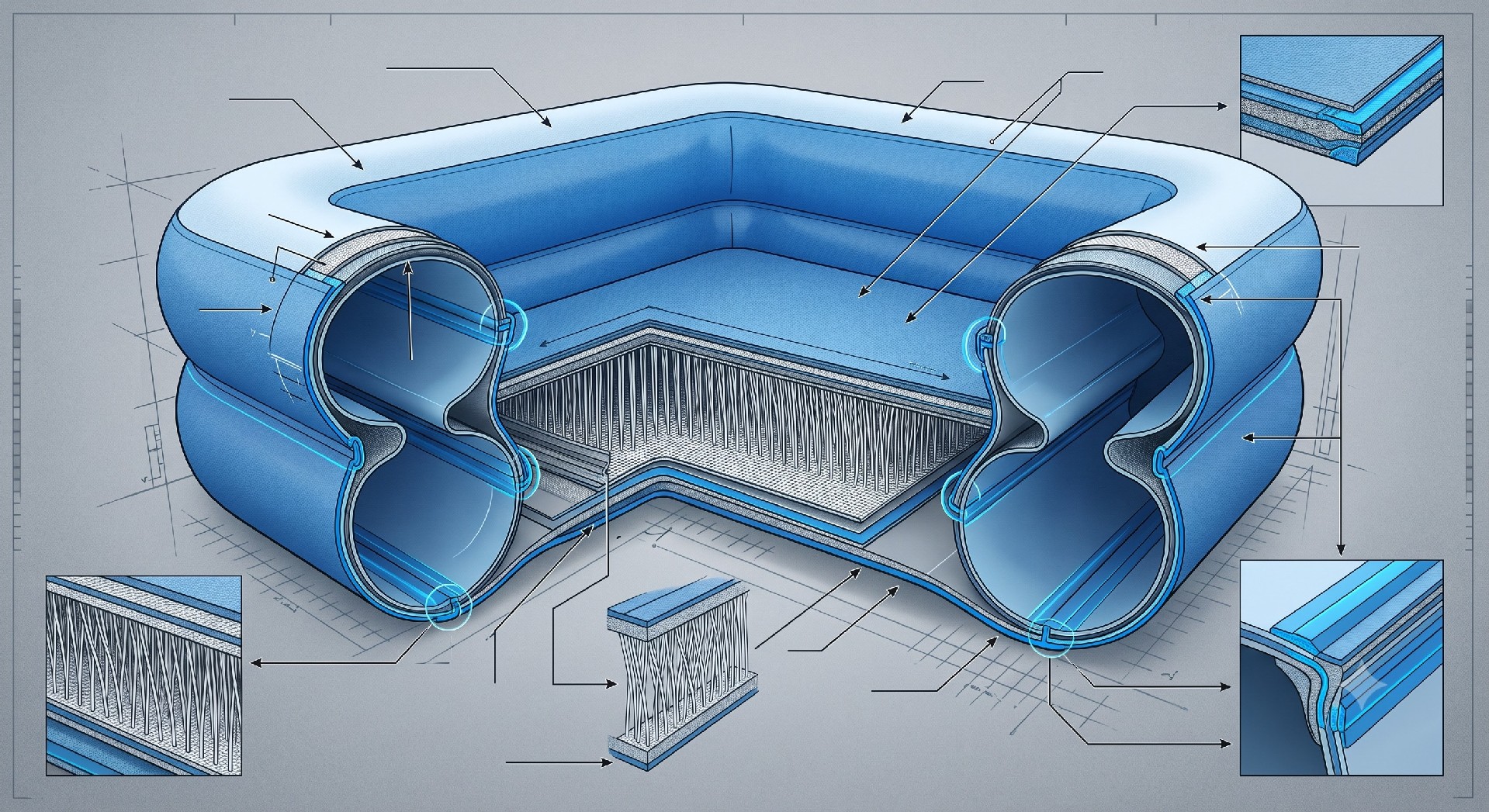
For high-usage environments, look for Reinforced PVC with a minimum thickness of 0.9mm. The fabric denier (e.g., 1100D) directly correlates with abrasion resistance. While many retail products use 0.3mm PVC, commercial-grade pools utilize heavier gauges to withstand the weight of water and children without deforming. This rigidity prevents the bottom of the pool from creating a vacuum-sealed mud pit against the grass .
Drop-Stitch Core Engineering
If the pool utilizes a drop-stitch floor or walls, the PSI (Pounds per Square Inch) rating is critical. Standard ring pools are low-pressure (approx. 1-2 PSI), but drop-stitch technology allows for high-pressure rigidity (10-15 PSI). This stiffness ensures that the base remains suspended slightly above the grass surface, allowing for airflow and reducing the "suffocation" effect that kills the lawn within 48 hours .
Technical Specifications and Performance Metrics
To ensure a successful deployment without damaging the underlying landscape, B2B buyers must verify specific performance parameters. The following table outlines the baseline requirements for a commercial-grade inflatable baby pool.
| Key Parameter | Technical Specification |
|---|---|
| Material Thickness | ≥ 0.9mm / 1100D Reinforced PVC |
| Maximum Payload | ≥ 400 kg / 880 lbs |
| Drop-Stitch Pressure | 10-15 PSI (High Rigidity) |
| Seam Construction | Heat-Welded (High-Frequency) |
| Compliance | CE, EN71, REACH, Phthalate-Free |
| Inflation Time | < 2 mins (Electric Pump) |
| Deflation/Storage | Compact fold, dry storage |
Heat-Welded Seams vs. Glued Seams
One of the most overlooked aspects of grass protection is seam integrity. Glued seams are susceptible to hydrolysis, where moisture breaks down the adhesive, leading to small leaks along the bottom perimeter. These small leaks are insidious; they do not cause catastrophic deflation but instead create a constantly damp ring around the pool, killing the grass .
Heat-welded seams offer superior structural integrity. The fusion of the PVC material creates a permanent bond that resists water seepage and puncture damage from roots and small pebbles. This ensures that the turf beneath remains dry and healthy.
Protective Ground Layers and Air Circulation
Contrary to consumer myth, using a solid plastic tarp can actually exacerbate grass damage by trapping heat and moisture . Commercial buyers should source or recommend breathable ground cloths or interlocking foam mats . These materials spread the payload capacity (e.g., 300 kg of water + children) over a wider area to prevent soil compaction while allowing the grass to breathe and photosynthesize.
[IMAGE_2]
Regulatory Compliance and Safety Standards
All commercial procurement must prioritize child safety and material non-toxicity. Ensure products strictly adhere to EN71 (Safety of Toys) and REACH (Registration, Evaluation, Authorization, and Restriction of Chemicals) regulations. Phthalate-free PVC is non-negotiable for any product intended for infants. Additionally, look for compliance with CE standards regarding water depth specifications to ensure that the infant's feet cannot touch the bottom only when the water level is too high, ensuring safe submersion levels .
Commercial ROI: Deflation Efficiency and Storage
For rental companies, the deflation time is part of the operational workflow. A product that takes 5 minutes to deflate versus 15 minutes adds up to significant labor costs over a season. Furthermore, optimized folding reduces storage volume, lowering off-season warehousing expenses. Regular maintenance includes checking high-pressure valve lifespans and ensuring the pool is dried completely before storage to prevent mold growth, which can damage both the material and the lawn next season .
Conclusion: Engineering for Sustainability
In conclusion, an inflatable baby pool does not have to conflict with turf management. By selecting products with reinforced 0.9mm PVC, heat-welded seams, and a high drop-stitch PSI, you mitigate the risks of compaction and waterlogging. Coupling this engineering with a breathable ground barrier and regular rotation protocols ensures the longevity of your equipment and the vibrant health of the environment where it is deployed.
